
Wage growth vocabulary
Educational only. Average hourly earnings, unit labor costs, and wage-price language as labels—not a Fed call. Not financial advice, not a forecast, and not a recommendation to buy, sell, or hold any asset.
Site vs Telegram
Durable primers live here. Live headline decoding belongs on Telegram: Macro Simplified on Telegram.
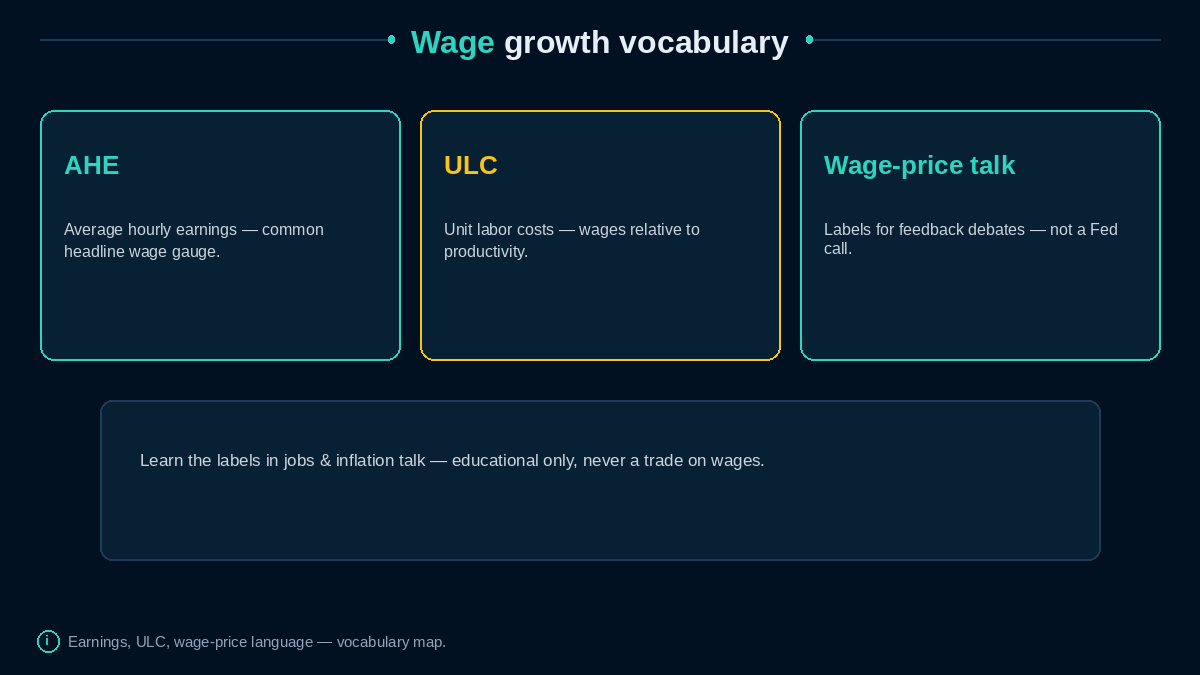
Diagram: AHE, unit labor costs, and wage-price talk — labels for jobs and inflation debates.
Why wages show up next to inflation
Labor costs are a large share of services production. When wages rise quickly, commentators ask whether firms will pass costs into prices—and whether inflation expectations stay anchored. That debate sits inside the dual mandate and Phillips curve maps without becoming a trading rule.
This primer is a label sheet, not a wage forecast.
Average hourly earnings (AHE)
Average hourly earnings from the employment report is a common headline wage gauge for private nonfarm workers. Strengths: timely and familiar. Limits: composition effects (who is working) can move the average even when “true” underlying pay growth differs; revisions happen (Data revisions and nowcasting).
Always pair AHE with jobs and participation context (Jobs and growth, Labor force participation).
Unit labor costs (ULC)
Unit labor costs relate compensation to productivity—roughly how much labor cost attaches to a unit of output. If productivity rises with wages, ULC pressure can stay mild (Growth and productivity, AI, productivity, and potential growth). Hot wages with flat productivity raise more inflation-pass-through talk—still a hypothesis, not a print-day order ticket.
“Wage-price spiral” language
Media shorthand for wages and prices chasing each other. Historical teaching cases exist; modern officials watch for spiral risk without this site declaring one is underway. Sticky services often carry wage-sensitive stories (Sticky services and shelter inflation).
Common confusions
- “One hot AHE print equals spiral.” Composition and base effects matter.
- “Real wages never matter.” Purchasing-power lens still counts (Real vs nominal).
- “ULC is the only true wage measure.” Multiple gauges; none is gospel.
- “This page is a Fed call.” Explicitly not.
In practice
On NFP day, note AHE, unemployment, and revisions together. Ask whether the wage story is about scarcity, composition, or catch-up—then stop before inventing a trade (Event playbook).
Other gauges you will meet: employment cost indexes, wage trackers that try to strip composition, and negotiated-wage series in some countries. You do not need all of them on day one. You need the habit of asking whether a wage print is noisy, composition-driven, or broad-based.
Real wage growth (after inflation) matters for living standards and consumption (Consumption and saving, Real vs nominal). Hot nominal wages with hotter prices can leave real wages flat—another reason headline “wage boom” language needs a purchasing-power footnote.
Labor-supply shifts—including participation and migration channels—enter the same conversation without this page turning into political campaigning (Labor force participation, Immigration and labor supply).
Sector detail matters: goods-producing vs services wages can diverge for long stretches, feeding the sticky-services inflation debate without proving a spiral on their own.
How this connects
- Jobs and growth · Inflation 101
- Inflation expectations and anchoring · Sticky services and shelter inflation
- Phillips curve for beginners
Related reads
Telegram
Wage lines inside employment reports: Join Macro Simplified.