
Fiscal dominance vocabulary
Educational only. This primer defines fiscal dominance as debate vocabulary. It is not a prediction that dominance “is happening,” not a budget campaign, and not advice to buy or sell bonds or currencies.
Site vs Telegram
Vocabulary primers live here. When “fiscal dominance” trends in market essays, Telegram can gloss the live usage: Macro Simplified on Telegram.
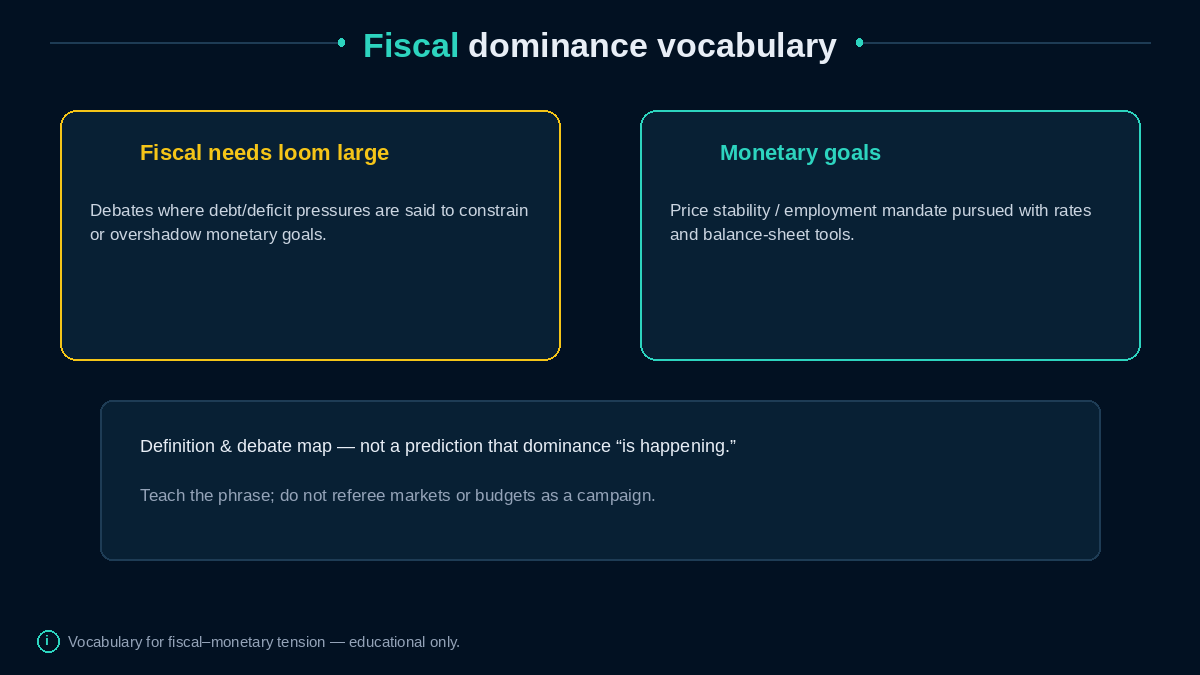
Diagram: Fiscal pressures vs monetary goals — definition map, not a forecast.
What people usually mean
In macro slang, fiscal dominance gestures at situations where government financing needs are said to constrain, overshadow, or effectively outrank the central bank’s inflation (and employment) goals. Instead of monetary policy freely pursuing the dual mandate, the story is that debt, deficits, or rollover needs shape what policy “can” do—including pressure toward easier policy or inflation that erodes debt burdens in extreme textbook cases.
Related measurement: Deficits, debt, and debt-to-GDP, Fiscal policy basics, Treasury issuance basics.
The opposite teaching ideal is often labeled monetary dominance: the central bank prioritizes price stability and the fiscal authority adjusts. Real institutions sit in messy middles.
Why the phrase surged in commentary
High debt stocks, large deficits, rising interest costs, and debates about central-bank independence bring the phrase back. Commentators disagree on thresholds and on whether today’s advanced economies fit the label. Your job as a learner is to recognize the claim being made, not to rubber-stamp it.
Term premium and issuance supply stories sometimes get bundled into the same essays (Term premium)—related, not identical.
What this page will not do
- Declare that fiscal dominance has arrived (or never can)
- Endorse a political budget
- Tell you to short bonds because of a buzzword
- Conflate ordinary deficits with dominance by definition
Ordinary deficits exist in most modern economies. Dominance is a stronger claim about who effectively sets the constraints.
Common confusions
- “Any deficit equals fiscal dominance.” No—dominance is about constraint hierarchy, not the mere existence of a gap.
- “Fiscal dominance is just QE.” QE is a tool (QE and QT explained); dominance is a regime claim.
- “Using the phrase means you are in a political camp.” Not required—define, then evaluate evidence separately.
- “This primer is a market call.” Explicitly not.
In practice — hearing the claim
When an essay says “fiscal dominance,” ask: Are they claiming the central bank has lost inflation priority? Citing debt dynamics? Mixing in politics? Separate definition from evidence from recommendation. Keep Central-bank independence themes in the toolkit page’s spirit even before a dedicated independence primer ships.
A milder cousin phrase is “fiscal–monetary coordination”: intentional teamwork in a crisis versus contested hierarchy in peacetime. Coordination is not automatically dominance; dominance claims imply the central bank’s inflation priority is subordinated. Keeping those words distinct prevents every joint press conference from being mislabeled. For issuance mechanics that feed the debate, stay with Treasury issuance basics.
Inflation as unintended debt eraser shows up in extreme historical teaching cases; it is not a policy recommendation and not a casual label for every year with a deficit. Keep catastrophe history distinct from routine fiscal arithmetic.
How this connects
- Deficits, debt, and debt-to-GDP · Fiscal policy basics
- Treasury issuance basics · Term premium
- The Fed toolkit · Dual mandate
Related reads
- Deficits, debt, and debt-to-GDP
- Fiscal policy basics
- Treasury issuance basics
- The Fed toolkit
- Glossary
Telegram
Fiscal–monetary debate headlines: Join Macro Simplified.