
Treasury issuance basics
Educational only. This primer explains how U.S. Treasury issuance appears in markets. It is not a recommendation to buy or sell bills, notes, or bonds, and not a call on the next auction.
Site vs Telegram
Issuance plumbing lives here. When refunding or auction headlines move yields, use Telegram: Macro Simplified on Telegram.
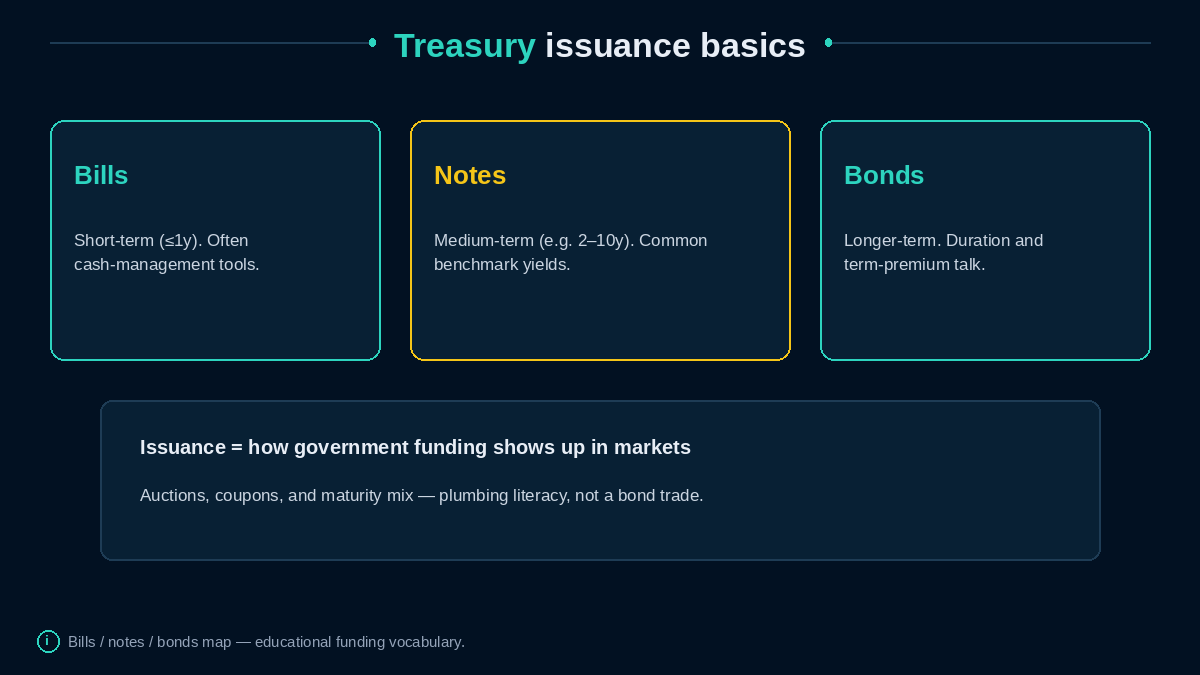
Diagram: Bills / notes / bonds — funding vocabulary, not a trade setup.
Why the government issues securities
When spending exceeds receipts, the government borrows (Deficits, debt, and debt-to-GDP, Fiscal policy basics). It borrows by selling Treasuries—among the world’s most referenced fixed-income instruments. Issuance is how that funding shows up in markets: auction calendars, coupon rolls, and maturity mix.
This is plumbing literacy for reading yield stories—not a portfolio recipe (Bonds for beginners).
Bills, notes, and bonds (beginner map)
| Type | Teaching sketch | Why beginners hear it |
|---|---|---|
| Bills | Short-term, discount instruments (≤1 year) | Cash-management and money-market cousins |
| Notes | Medium-term coupons (commonly 2–10y talk) | Benchmark yields and curve points |
| Bonds | Longer-term coupons | Duration and term premium debates |
Exact maturity menus evolve; learn the family, not a memorized PDF of every CUSIP.
Auctions and the curve
Treasury announces auction sizes and maturities; dealers and investors bid; yields clear. Heavy issuance at a maturity can matter for local supply—sometimes discussed alongside term premium and foreign demand. The Fed’s balance sheet may hold Treasuries too (Fed balance sheet and reserves, QE and QT explained), which interacts with net supply stories without turning this page into a basis-trade manual.
Refunding announcements (how coupons are rolled and sized) are recurring calendar events for rates desks—and for learners practicing calm reading (Event playbook habits).
Common confusions
- “Issuance means the Fed is printing.” Treasury issues debt; the Fed is a different institution (though they interact).
- “More issuance always crashes bonds tomorrow.” Demand, growth, inflation, and policy path all matter.
- “Bills are risk-free in every sense.” Credit risk of the sovereign is distinct from interest-rate and inflation risk on longer paper.
- “This page picks maturities for you.” It does not.
In practice — reading an issuance headline
Ask: bills vs coupons? Which maturities grew? Is the story about deficit funding, cash management (TGA-related talk belongs in a later plumbing primer), or Fed runoff interacting with supply? Then open Interest rates and yields rather than jumping to a trade.
Who buys Treasuries—domestic banks, money funds, foreign official accounts, households via funds—shapes market narratives about “bid” strength. Ownership shifts are interesting plumbing; they still are not a green light to position from this educational page. When QT runoff meets heavy coupon supply, commentators debate net duration the private sector must absorb (QE and QT explained). Listen for net vs gross issuance language.
Coupon vs principal rollovers matter for cash-flow calendars inside the Treasury’s own management. Learners mainly need to know that maturity mix is a choice with market consequences—not that they should trade the refunding statement.
How this connects
- Deficits, debt, and debt-to-GDP · Fiscal dominance vocabulary
- Term premium · Yield curve
- Bonds for beginners · SOFR vs federal funds
Related reads
- Fiscal policy basics
- Deficits, debt, and debt-to-GDP
- Interest rates and yields
- Bonds for beginners
- Glossary
Telegram
Auction and refunding headline days: Join Macro Simplified.