
Credit spreads as a macro signal
Educational only. Credit spreads are a macro context gauge on this site. They are not a signal desk, not bond picks, and not advice to buy or sell credit.
Site vs Telegram
Spread vocabulary stays here. Live risk-mood decoding belongs on Telegram: Macro Simplified on Telegram.
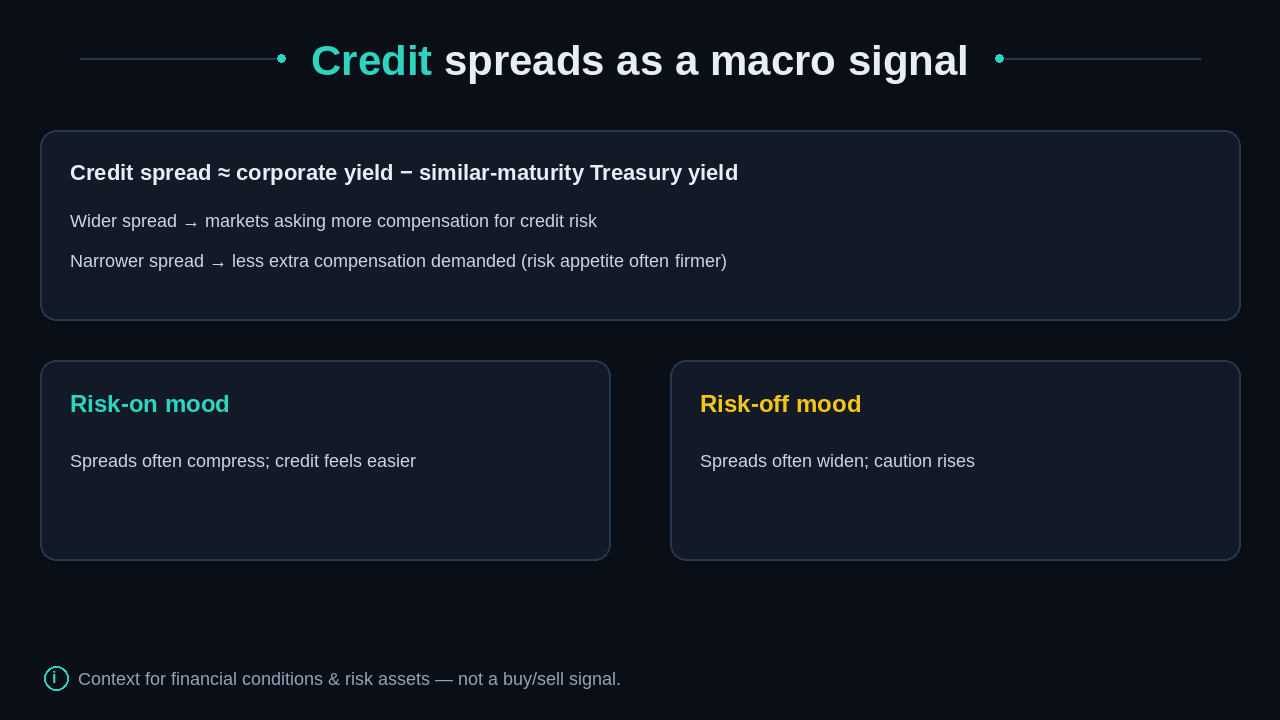
Diagram: spread as extra yield over Treasuries — educational context only.
What a credit spread is
A credit spread is roughly:
corporate (or other credit) yield − a similar-maturity Treasury yield
It is the extra yield markets demand for taking credit risk versus a comparable government bond. When spreads widen, that extra compensation is larger (caution often rises). When spreads narrow/compress, markets are asking for less extra compensation (risk appetite often firmer).
Exact indexes and ratings buckets vary—beginners only need the direction-of-travel idea.
Risk-on / risk-off (labels, not orders)
Credit spreads often travel with broader risk mood:
- Risk-on stories: spreads frequently compress; credit feels easier
- Risk-off stories: spreads frequently widen; funding caution rises
Same mood language appears in Risk assets 101. None of it is an instruction to buy or sell stocks, crypto, or bonds.
Link to financial conditions
Financial conditions fold together rates, credit, the dollar, and risk appetite. Spreads are one reason commentators say conditions are tight or easy even when the Fed has not moved that day.
Also nearby: Debt, leverage, and cycles (why borrowed money amplifies swings) and Money and banking basics (credit channel intuition).
How to read a spread headline calmly
- Which spread? High-yield vs investment-grade stories differ.
- Widen or tighten—versus what? Day, month, or cycle.
- Companion dials: policy rates, equity volatility talk, dollar, liquidity.
- Stop at context. Turning a spread move into a position is outside this site.
Next reads
- Financial conditions — tight vs easy map
- Risk assets 101 — risk mood framing
- Interest rates and yields — the Treasury baseline
- Debt, leverage, and cycles — amplification vocabulary
- Glossary — credit spread, financial conditions
Related reads
Telegram
Risk-mood and credit headlines: Join Macro Simplified.