
Central bank independence
Educational only. Why many countries separate the central bank from day-to-day politics—history and tradeoffs, not slogans. Not financial advice, not a forecast, and not a recommendation to buy, sell, or hold any asset.
Site vs Telegram
Durable primers live here. Live headline decoding belongs on Telegram: Macro Simplified on Telegram.
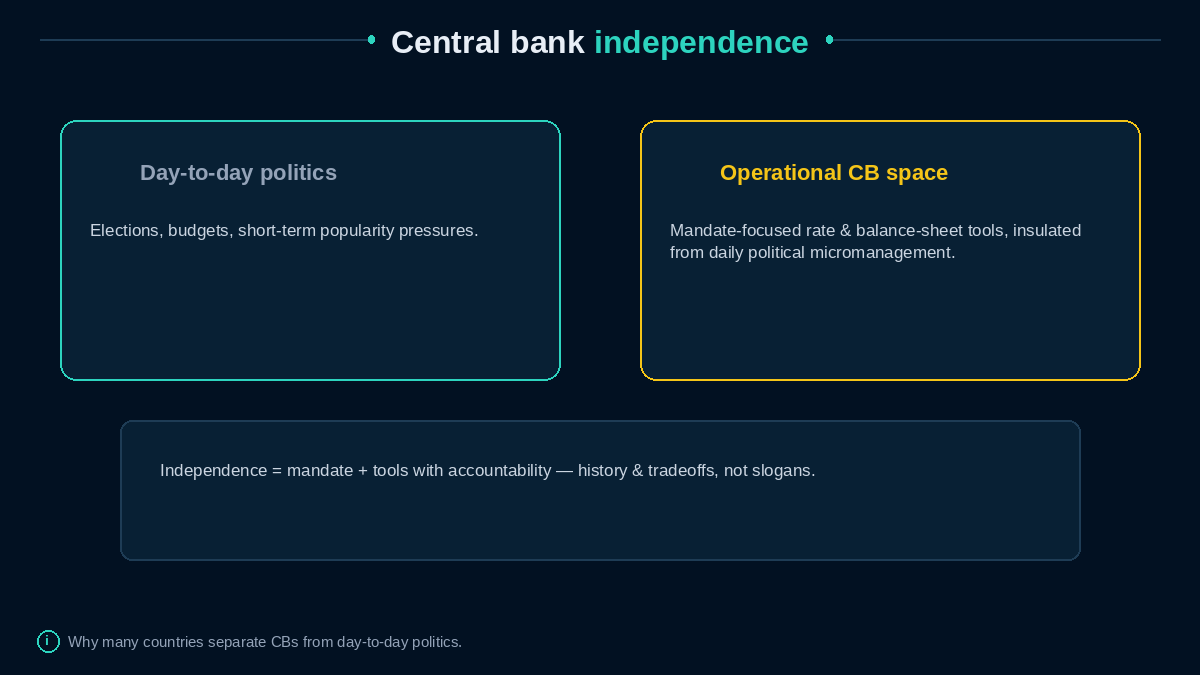
Diagram: Day-to-day politics vs operational central-bank space — mandate, tools, accountability.
What “independence” usually means
Central bank independence is teaching shorthand for giving the central bank operational room to pursue a legally assigned mandate—often price stability, sometimes with employment goals (Dual mandate)—without day-to-day political micromanagement of the policy rate.
Independence is rarely absolute. Legislatures write mandates, appoint leaders, and can change laws. The idea is insulation from short-term electoral pressure, not a state within a state. Accountability (reports, testimony, transparency) is the usual companion (Reading the Fed, The Fed toolkit).
Why the idea spread historically
Twentieth-century inflation episodes taught many countries that politicians facing elections may prefer easier money than price stability requires. Independent (or operationally autonomous) central banks were one institutional answer. History is full of partial successes and failures—this page is not a victory lap for any single charter.
Tradeoffs exist: too little independence risks fiscal–monetary blur (Fiscal dominance vocabulary); poorly designed independence can weaken democratic accountability. Serious debate lives in that tension, not in slogans.
What independence is not
- Not a promise markets always like every decision
- Not immunity from criticism or law change
- Not the same as “never coordinate in a crisis”
- Not a personal endorsement of any sitting official
Global variety is large—see Global central banks at a glance.
Common confusions
- “Independent means unelected and unchecked.” Mandates and oversight still bind.
- “Independence guarantees low inflation forever.” Tools and credibility help; shocks still happen.
- “Any fiscal–monetary meeting proves dominance.” Coordination ≠ automatic dominance.
- “This primer picks a political side.” It maps an institutional idea.
In practice
When commentary says independence is “under threat,” translate to specifics: legal changes, appointment fights, deficit monetization claims, or mere disagreement with a hike. Specifics first—then Policy uncertainty as a shock if rules feel unstable.
Operational independence usually means the central bank chooses instruments day to day; goal independence (who sets the inflation target) is a related but distinct debate. Many modern frameworks give elected bodies the goal and the CB the instruments—an accountability compromise.
Crisis episodes test the boundary: emergency lending, QE, and fiscal–monetary coordination blur lines that look clean in peacetime (QE and QT explained, Financial crises vocabulary). Historians study whether temporary teamwork becomes permanent subordination. Learners should keep that question open rather than sloganized.
Personnel matters: appointment rules, terms, and removal standards shape de facto independence even when statutes look strong. Reading appointment fights as institutional stories—not personality gossip—is part of literacy (Reading the Fed).
Transparency tools—published forecasts, press conferences, and meeting minutes—are part of modern accountability bundles that make independence politically sustainable. Opacity without accountability is a different, weaker institutional story.
Watch for in headlines: laws changing CB charters, appointment fights framed as independence tests, and claims that deficits force the CB’s hand. Translate each into mandate, tools, or fiscal–monetary hierarchy language before accepting a slogan.
How this connects
- The Fed toolkit · Dual mandate
- Fiscal dominance vocabulary · Reading the Fed
- Global central banks at a glance
Related reads
Telegram
Independence and mandate debate days: Join Macro Simplified.