
Cash, stocks, and bonds
Educational only. This page explains common roles people assign to cash, stocks, and bonds in macro conversation. It is not a portfolio recipe, not asset-allocation advice, and not a recommendation to buy, sell, or hold any product.
Site vs Telegram
Evergreen asset-role vocabulary lives here. Live print decoding lives on Telegram: Macro Simplified on Telegram.
When headlines say “investors fled to cash” or “bonds sold off as yields rose,” they are using shorthand about how different assets often behave when growth, inflation, and rates shift. Learning that shorthand helps you read the news. It does not tell you what mix is right for you—that decision needs your own goals, constraints, and (if you want it) a qualified adviser. This site stays in teaching mode only.
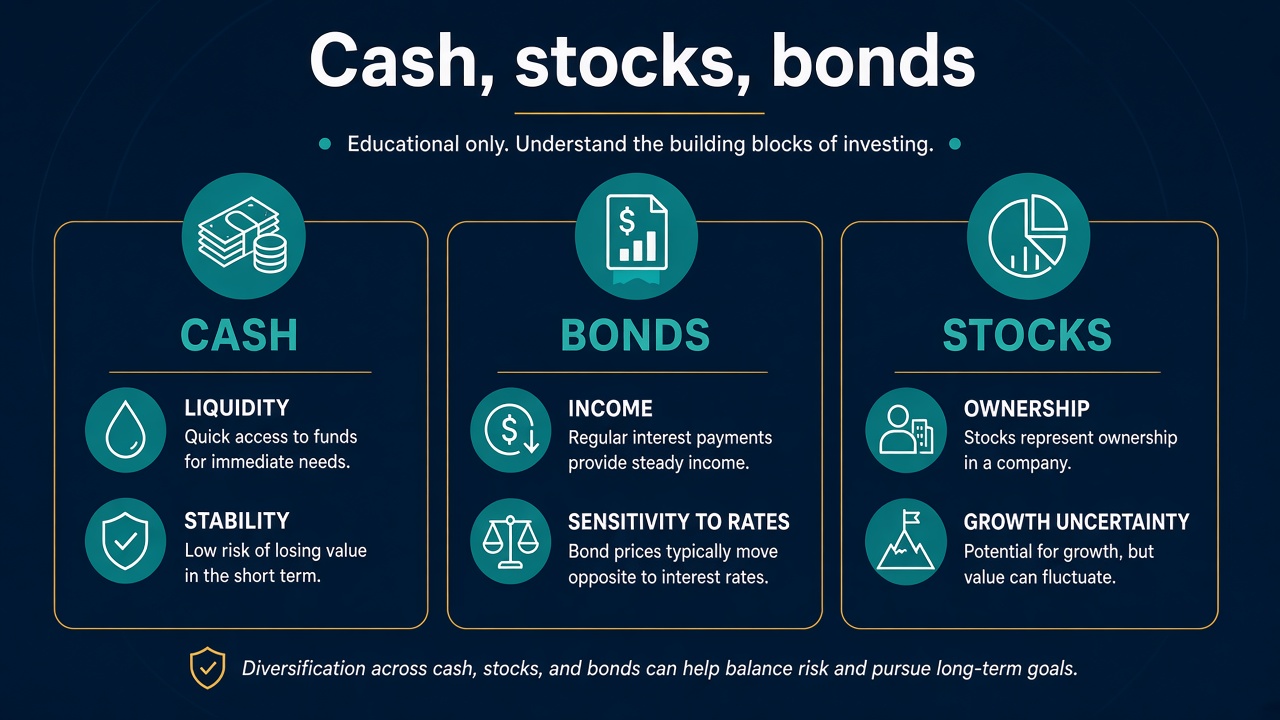
Diagram placeholder: cash / stocks / bonds roles against macro dials — educational map only, not an allocation pie.
Cash (and cash-like)
Cash here means money ready to spend or park short-term—bank balances, and instruments that behave like short-term money. In macro talk, cash is the “optionality and ballast” role: it does not usually chase long-run growth the way equities can, and it does not lock you into a long bond’s price swings.
How the backdrop matters:
- Higher policy rates often mean short-term cash-like yields become more interesting in the conversation—people notice the opportunity cost of holding zero-interest balances. That is a vocabulary point, not a pitch for a product.
- High inflation erodes cash’s buying power over time. Inflation does not “force” a trade; it changes how people talk about sitting in cash.
- Stress periods often increase demand for cash-like safety because people want dry powder and fewer surprises.
Cash is not “bad” or “good.” It is a role: liquidity and flexibility. Crypto-curious readers hear “stablecoins” and money-market talk in the same breath as cash—still treat that as language, not a shopping list.
Stocks (equities)
Stocks represent ownership claims on companies. In macro headlines, equities often stand in for “risk appetite”: when growth looks resilient and financial conditions ease, risk assets (including many equity markets and, often, crypto in the same mood conversation) tend to get more attention. When growth scares or tighter conditions dominate, the opposite mood label—risk-off—shows up. See Risk assets 101.
Backdrop links (context, not signals):
- Growth: Stronger activity can support earnings stories; weaker growth feeds caution stories.
- Inflation & rates: Hot inflation and rising discount-rate talk can weigh on how investors value distant cash flows. Easier rate paths often feed more optimistic valuation talk. Again: talk and context—not a buy/sell rule.
- Liquidity: Easier money and credit conditions often travel with risk-on mood; tighter conditions with caution.
No stock tips live here. No sector rotation recipes. No “buy the dip” language.
Bonds (fixed income)
Bonds are loans you (or a fund) make to a borrower—governments, companies, and others—in exchange for coupons and repayment of principal under the bond’s terms. For beginners, two headlines matter most:
- Bond prices and yields move inversely in everyday language—see Interest rates and yields and Bonds for beginners.
- Bonds often appear in “ballast vs growth” conversations: some government bonds are treated as relatively safer claims than equities in certain stress stories, while other bonds (credit) behave more like risk assets.
Backdrop:
- Rising yields often mean falling bond prices for existing bonds—painful for mark-to-market holders, interesting to new buyers as vocabulary.
- Falling yields often mean rising bond prices.
- Inflation worries can push longer yields higher if markets demand more compensation for eroded buying power.
This site does not pick Treasuries vs corporates vs anything else. Duration and credit risk are teaching ideas, not product menus.
How rates, inflation, and growth set the backdrop
Keep the four dials nearby:
| Dial shift people debate | Cash talk often becomes… | Stocks talk often becomes… | Bonds talk often becomes… |
|---|---|---|---|
| Policy rates higher / conditions tighter | Opportunity cost & safety | More cautious risk mood | Yields up / prices down stories |
| Inflation hotter | Buying-power worry | Discount-rate & margin debates | Inflation-premium / real-yield talk |
| Growth stronger | Less panic demand for cash | Earnings & risk-on stories | Growth vs inflation tug-of-war in yields |
| Growth weaker | Safety & dry-powder stories | Risk-off & earnings-scare stories | Flight-to-quality & cut-path debates |
Tables like this are maps of common narratives, not predictions and not instructions.
Explicit anti-allocation advice
We will not tell you:
- What percent cash / stocks / bonds to hold.
- Whether to “rotate” into any bucket this month.
- Which ETF, coin, or bond to buy.
Your mix depends on horizon, risk tolerance, liabilities, taxes, and personal constraints—none of which this page knows. Use primers to understand headlines; use your own decision process (or a licensed professional) for personal choices.
Related reads
| If you want… | Read |
|---|---|
| Price vs yield intuition | Bonds for beginners |
| Policy rate vs market yields | Interest rates and yields |
| Risk mood language | Risk assets 101 |
| Tight vs easy conditions | Financial conditions |
| Study order for beginners | First 30 days |
Live decoding lives on Telegram
Site = durable primers. Telegram = live event decoding.