
Geopolitics and risk premiums
Educational only. This primer labels how geopolitical events can affect risk premiums. It is not war forecasting, not a sanctions trade desk, and not advice to buy or sell defense names, oil, or gold.
Site vs Telegram
Vocabulary for tense headlines lives here. Live decoding: Macro Simplified on Telegram.
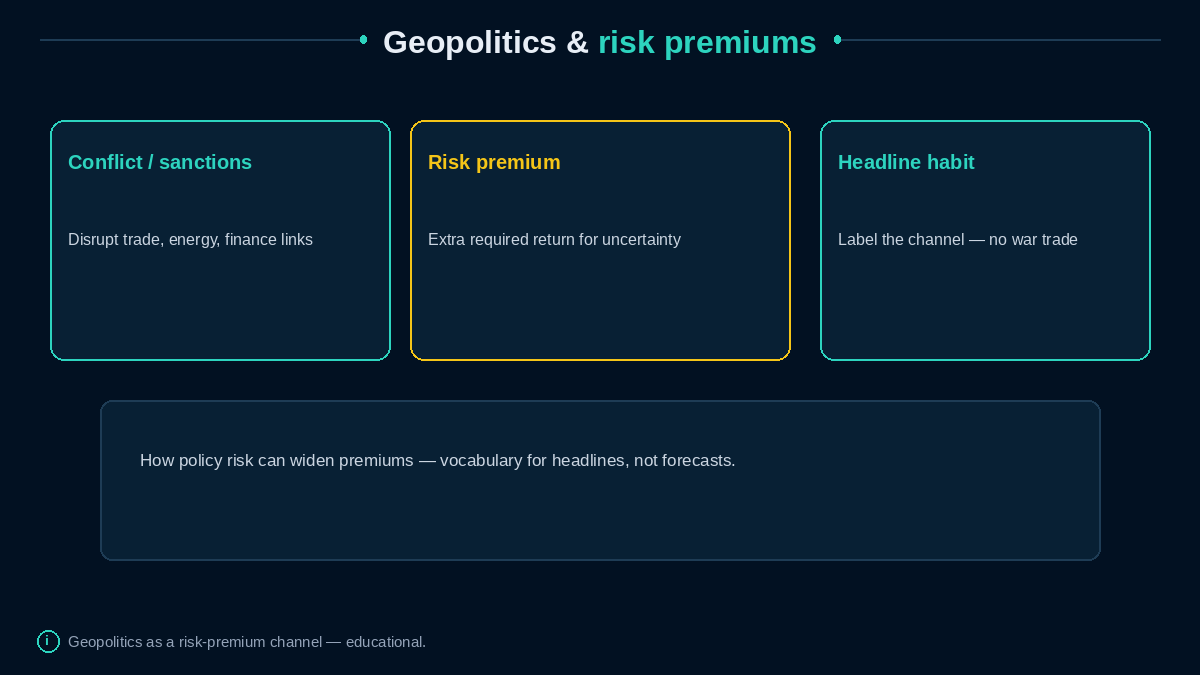
Diagram: Geopolitics as a risk-premium channel — label it, don’t trade the war.
Risk premium in one line
A risk premium is extra required return (or wider spread) for bearing uncertainty or loss risk. Geopolitical shocks can widen premiums across equities, credit, FX, and commodities when investors demand more compensation—or flee to safer claims (Credit spreads, Financial conditions, Risk assets 101).
Sometimes the premium move is short-lived noise. Sometimes it persists. This site does not time which.
Channels (not a checklist to trade)
- Energy and shipping — disruptions feed inflation and growth stories (Energy shocks and inflation)
- Sanctions and finance — payment and capital-flow frictions (Capital flows for beginners)
- Trade policy — relative-price shocks (Tariffs as a macro shock)
- Uncertainty itself — delayed investment (Policy uncertainty as a shock)
Gold often appears in haven narratives (Gold as a macro asset)—still not an allocation recipe.
Evergreen, not horse-race
Conflicts and sanctions recur across decades. Learn the premium channel language. Do not turn this primer into campaign coverage or rooting interest.
Common confusions
- “Geopolitics always equals risk-off forever.” Markets habituate; channels differ.
- “If oil jumps, buy everything energy-related.” Not advice we give—ever.
- “Premiums are observable one true number.” Multiple gauges; judgment required.
- “Labeling a channel predicts the winner.” No.
In practice
Write: event → channel (energy / finance / trade / uncertainty) → premium language → what would falsify the story. Then stop. Pair with Diversification and regimes for humility about correlations in stress.
Premiums can show up as wider credit spreads, softer equity multiples, higher option-implied volatility language in the press, or safer-haven bids for certain currencies and bonds. You do not need a dealer’s dashboard; you need to recognize which premium gauge a journalist means (Credit spreads, US dollar and FX).
Habituation matters: repeated scares sometimes produce smaller market moves as hedging adapts—until a threshold event resets attention. That pattern is descriptive, not a license to ignore risks (Risk, luck, and narratives).
Sanctions regimes create compliance and payment frictions that act like financial plumbing shocks for targeted flows—sibling to sudden-stop intuition without identical mechanics.
Separate humanitarian attention from market-premium language. Caring about outcomes and analyzing risk premia are compatible; turning suffering into a trade ticket is not something this curriculum teaches.
Watch for in headlines: sanctions, shipping disruptions, or conflict escalation paired with wider spreads or haven language. Label the premium channel; do not invent a position from this page.
Insurance, freight, and compliance costs can rise even when spot prices look calm—hidden premium channels in the real economy. Ask about those frictions when headlines focus only on equity futures. Keep premium language descriptive and time-limited in your notes.
How this connects
- Risk assets 101 · Financial conditions
- Policy uncertainty as a shock · Tariffs as a macro shock
- Energy shocks and inflation · Gold as a macro asset
Related reads
Telegram
Geopolitical-headline macro days: Join Macro Simplified.