
Credit cycles
Educational only. This primer maps credit cycles in plain English. It is not a crash timer, not a call on banks or credit ETFs, and not advice to lever or delever a personal portfolio.
Site vs Telegram
Cycle maps live here. When credit-spread or lending headlines spike, Telegram carries the live gloss: Macro Simplified on Telegram.
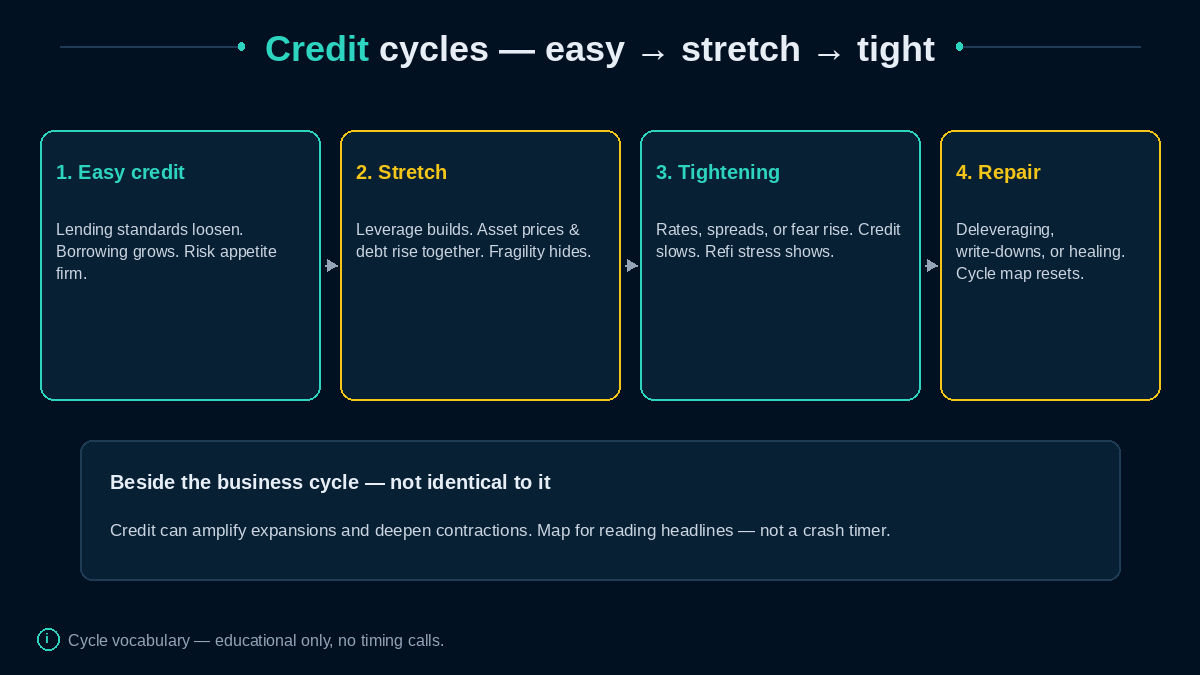
Diagram: Easy → stretch → tight → repair — beside the business cycle, not identical to it.
Credit as an amplifier
The business cycle tracks expansion and contraction in activity. A credit cycle tracks how easy or hard it is to borrow—and how much leverage builds—across that landscape. Credit often amplifies booms and busts: easy lending fuels spending and asset prices; tightening squeezes refinancing and investment.
Sibling vocabulary lives in Debt and leverage and Credit spreads. Private and public debt stories overlap but are not identical (Deficits, debt, and debt-to-GDP).
A four-stage teaching map
- Easy credit — Standards loosen; volumes grow; risk appetite firms; spreads can look calm.
- Stretch — Leverage builds; asset prices and debt rise together; fragility hides under good news.
- Tightening — Policy rates, lender caution, or fear raise the cost/availability of credit; refinancing stress appears.
- Repair — Deleveraging, write-downs, tighter standards that later re-loosen—maps reset unevenly.
Real cycles blur, skip stages, or differ by sector (household mortgages vs corporate loans vs shadow credit). Use the map to organize headlines, not to declare which stage the world is in today.
How it shows up in markets (context only)
- Wider credit spreads often accompany caution
- Bank lending surveys and charge-off talk show up in policy briefings
- Housing credit links rates to activity (Housing, mortgages, and rates)
- Risk mood labels (Risk assets 101) often move with credit stress—without becoming buy/sell instructions here
Financial-conditions indexes fold credit in beside yields and the dollar (Financial conditions).
Beside—not identical to—the business cycle
Activity can slow while credit still looks easy for a while—or credit can tighten first and drag activity later. That is why separate maps help. Recession labels remain vocabulary (Recession vocabulary); credit-cycle language adds the leverage lens.
Common confusions
- “Credit cycle = guaranteed crash next.” Maps describe patterns; they do not date disasters.
- “If spreads are tight, risk is gone.” Calm pricing can coexist with building leverage.
- “Only banks matter.” Nonbank credit and market-based finance matter too.
- “This page tells me when to buy high-yield.” It does not.
In practice — what to listen for
Lending-standard surveys, charge-off commentary, high-yield spread moves, and mortgage-credit availability all speak “credit cycle” even when the phrase never appears. Sort them as easy / stretching / tightening / repairing best-guess labels—then refuse to date the turn.
If spreads blow out while official activity data still look fine, you may be seeing credit lead the business cycle—or a false alarm. Humility is part of the toolkit.
Short debt-cycle intuition in popular teaching (easy credit feeding asset gains that collateralize more borrowing) is a story template. Use it to recognize feedback language in the press—then return to data and to Debt and leverage without treating any book as a market timer.
How this connects
- Debt and leverage · Credit spreads
- Business cycle · Financial conditions
- Diversification and regimes
- Money and banking
Related reads
Telegram
Credit-stress and lending headlines: Join Macro Simplified.