
Energy shocks and inflation
Educational only. This primer maps energy shocks as inflation and growth vocabulary. It is not an oil, gas, or gasoline trade; not a forecast of the next barrel price; not advice to buy or sell energy equities.
Site vs Telegram
Shock explainers live here. When energy headlines move CPI chatter, plain-English context is on Telegram: Macro Simplified on Telegram.
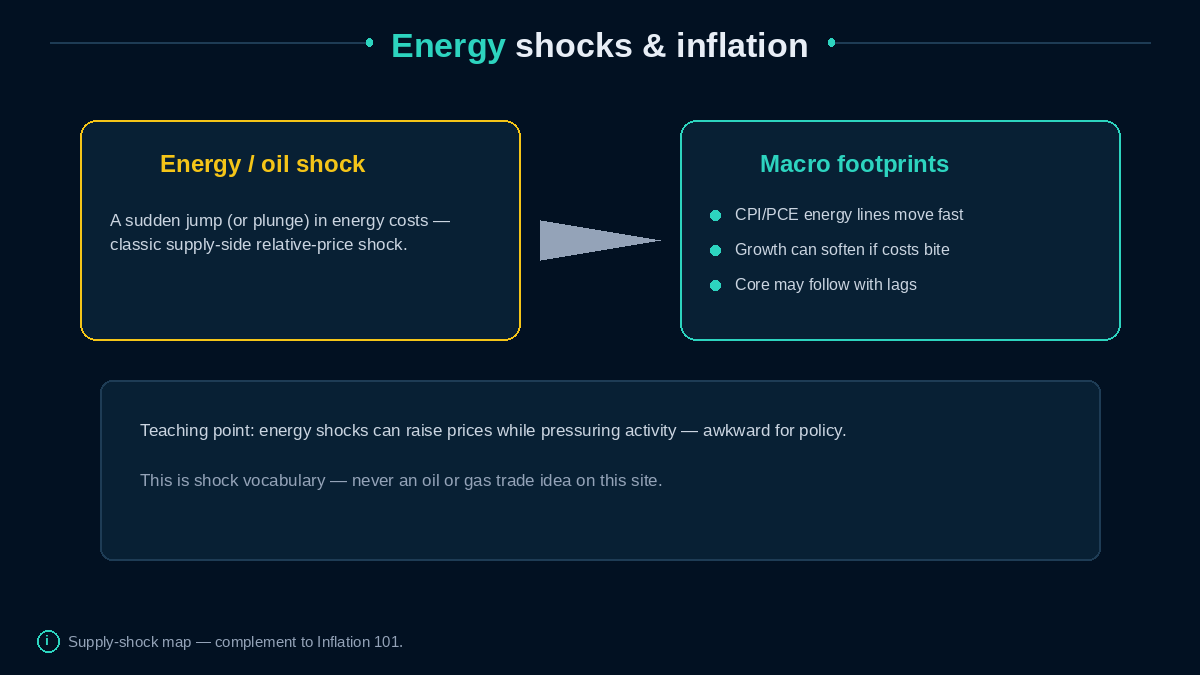
Diagram: Energy/oil shock → price and activity footprints — supply-shock vocabulary only.
Energy as a classic supply shock
A sudden jump in oil or broader energy costs is a textbook supply shock: producing and transporting goods gets more expensive. Households feel it at the pump and in utility bills; firms feel input costs. The mirror image—a plunge in energy prices—can ease headline inflation quickly.
Unlike a pure demand boom, adverse energy shocks can raise prices while pressuring activity—awkward for the dual mandate. That is why commentators reach for stagflation vocabulary carefully (Inflation regimes) without this site dating a regime.
Build the basics in Inflation 101 and Demand shocks vs supply shocks. Commodities–dollar context (not trades) sits in Commodities and the dollar.
How it shows up in the inflation basket
Energy lines in CPI/PCE can swing fast. Headline inflation often jumps when gasoline does; core measures that exclude food and energy are designed to highlight underlying inflation—but energy can still leak into core later through transport, plastics, and broader cost pass-through.
Second-round risk is partly about inflation expectations and anchoring: do wages and other prices chase the energy spike, or does the spike fade as a relative-price change?
Growth and policy footnotes
Higher energy costs can squeeze real incomes and margins, softening consumption and some investment (Consumption and saving, Investment and capital spending). Policymakers debate how much to “look through” temporary energy spikes versus respond if expectations wobble (Monetary policy transmission).
Geopolitics often sits behind the shock narrative—still educational channels, not a prediction market on conflict (Tariffs as a macro shock for another relative-price cousin).
Common confusions
- “Energy up always means hike tomorrow.” Mandate tradeoffs and “look-through” debates exist.
- “Core ignores energy, so energy never matters.” Pass-through and expectations still can.
- “This page is a long oil tip.” Explicitly not.
- “One gasoline print equals the inflation regime.” Composition and persistence matter (Sticky services and shelter inflation).
In practice — reading an energy week
Separate: (1) the relative-price move in energy, (2) the headline CPI arithmetic, (3) any claim about lasting core inflation, (4) growth drag stories. Keep those trays distinct so you do not collapse four debates into one panic sentence. Use Sources and habits for primary releases.
Dollar moves can amplify or mute local energy prices for some countries; oil is globally quoted in dollars for much of the market (US dollar and FX). Producers and consumers sit on opposite sides of the same shock. When reading a global growth note, ask who is hurt and who is helped before accepting a single world GDP arrow. Still no futures trade—just cleaner sorting.
How this connects
- Demand shocks vs supply shocks · Inflation 101
- Inflation expectations and anchoring · Inflation regimes
- Commodities and the dollar · Dual mandate
Related reads
Telegram
Energy and CPI headline days: Join Macro Simplified.