
Financial conditions
Educational only. This page teaches what people mean by “tight” or “easy” financial conditions. It is not a forecast of the next Fed move, not a trading signal, and not advice to buy or sell any asset.
Site vs Telegram
Conditions vocabulary stays evergreen here. Live decoding when a print reshapes the mood: Macro Simplified on Telegram.
“Financial conditions” is broadcaster shorthand for: how easy or expensive is it for households, firms, and markets to get money and take risk right now? It is bigger than the Fed’s policy rate alone. The policy rate is one lever; conditions are the felt backdrop that includes market yields, credit spreads, the dollar, equity volatility, and lending appetite.
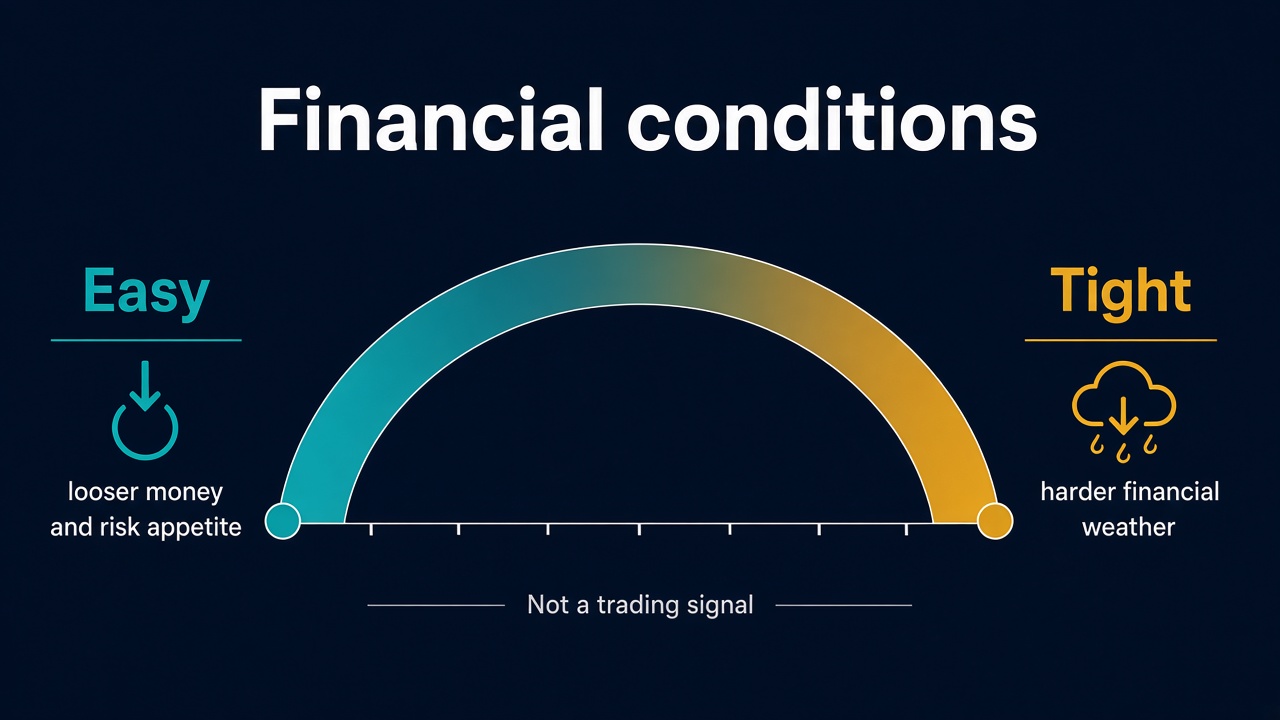
Diagram placeholder: easy ↔ tight conditions dial — educational map only.
Tight vs easy (plain English)
Easier financial conditions roughly means: borrowing feels less costly or more available; risk appetite is firmer; markets are more willing to fund growth and speculation. Headlines may mention falling yields, tighter credit spreads (less extra yield demanded for riskier borrowers), a softer dollar in some stories, or calmer equity volatility.
Tighter financial conditions roughly means: money and credit feel dearer or scarcer; caution rises; funding and risk-taking get harder. Headlines may mention rising yields, wider credit spreads, a stronger dollar, or sharper risk-off moves in stocks and crypto.
Neither label is a moral judgment. Tighter conditions can be part of a deliberate cool-down when inflation is hot. Easier conditions can support activity when growth is soft. Officials and commentators argue endlessly about how tight is tight enough—this site teaches the language, not the verdict.
What feeds the conditions story
Think of several channels that often move together (not always, not one-for-one):
- Policy rate & guidance — The Fed toolkit. Hikes and “higher for longer” talk lean toward tighter; cuts and dovish guidance lean toward easier—all else equal.
- Market yields — Interest rates and yields. Mortgage rates, corporate borrowing costs, and discount rates people use in valuation talk often follow market yields more than the overnight policy rate alone.
- Credit & liquidity — willingness to lend, bank conditions, and the “plumbing” story around reserves and QE/QT. See also Risk assets 101.
- Risk assets & mood — equity drawdowns and crypto stress can tighten conditions by themselves (wealth and confidence channels), even if the Fed has not moved that week.
- Dollar — a sharply stronger dollar can tighten global dollar funding conditions; see US dollar and FX.
Indexes you may see named on TV (“financial conditions index”) are summaries of several market prices. Treat them as teaching gadgets, not oracles.
Link to the Fed and liquidity
The Fed cares about conditions because they are part of how policy transmits into the real economy. Raising the policy rate is meant, over time, to cool demand partly by tightening financial conditions. Cutting is meant to ease them.
But markets can tighten conditions ahead of the Fed (yields jump on an inflation scare) or ease them against a still-high policy rate (risk assets rally on soft landing hopes). That gap—policy setting vs market backdrop—is why beginners hear “the Fed is tight but financial conditions are easy.” It is a description of two layers, not a conspiracy, and not a signal to fade either layer.
Liquidity language (reserves, balance-sheet policy, private credit) sits inside this same conversation. Easy liquidity often travels with easier conditions; draining liquidity or stressed credit often travels with tighter ones. Still: educational map only.
Link to risk assets (anti-signal)
Risk assets—broad equities, credit, and crypto in many headline narratives—often prefer easier conditions and struggle when conditions tighten abruptly. That correlation is why macro desks watch conditions language on CPI and FOMC days.
What we will not say: “Conditions eased → buy risk.” “Conditions tightened → sell everything.” Surprises, positioning, and priced-in expectations routinely scramble short-term reactions. Use conditions as context for why a mood label appeared, not as a trigger.
Everyday feel
You do not need an index to notice conditions in daily life:
- Mortgage quote sticky-high while the Fed is on hold → housing transmission still tight—see Housing, mortgages, and rates.
- Credit-card and small-business lending standards in the news → private credit channel.
- “Everything dumped together” days → risk-off mood feeding tighter conditions.
Notice. Label. Do not treat the notice as a trade ticket.
Related reads
| If you want… | Read |
|---|---|
| Fed levers | The Fed toolkit |
| Yields and the curve idea | Interest rates and yields |
| Risk-on / risk-off framing | Risk assets 101 |
| Dollar channel | US dollar and FX |
| Four dials overview | How to read macro |
Live decoding lives on Telegram
Site = durable primers. Telegram = live event decoding.