
Treasury General Account (TGA)
Educational only. The Treasury’s checking account at the Fed—and how TGA swings can move reserves. Not financial advice, not a forecast, and not a recommendation to buy, sell, or hold any asset.
Site vs Telegram
Durable primers live here. Live headline decoding belongs on Telegram: Macro Simplified on Telegram.
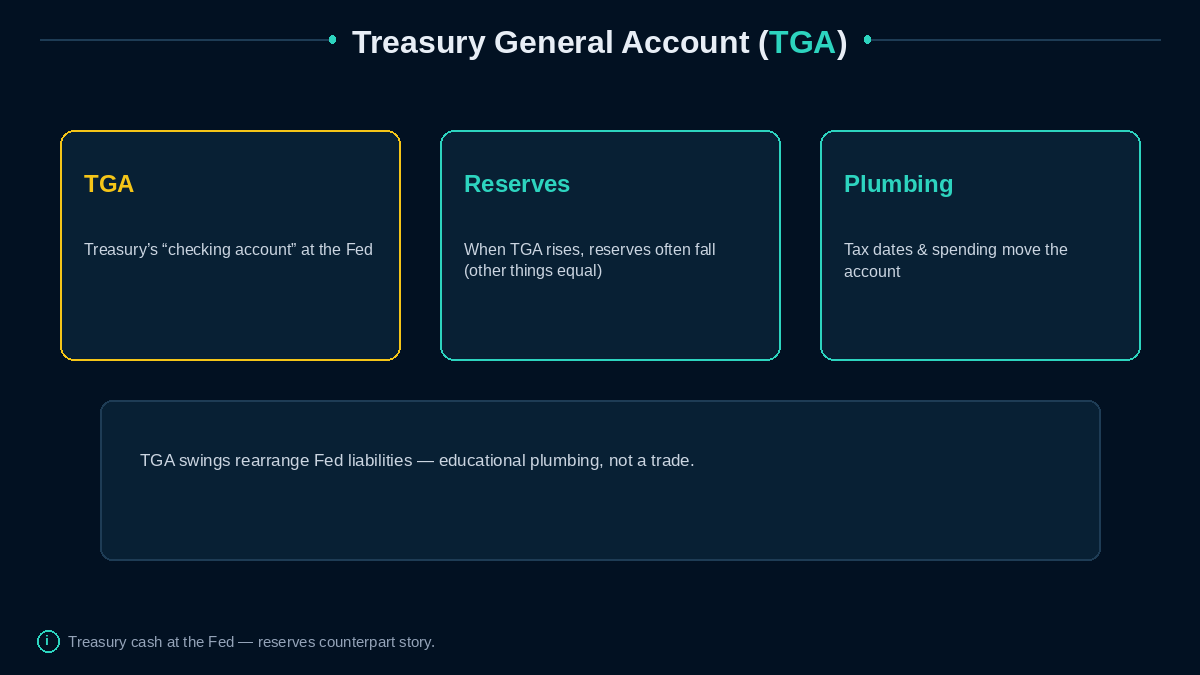
Diagram: TGA vs bank reserves — Treasury cash at the Fed rearranges liabilities.
The Treasury’s Fed account
The Treasury General Account (TGA) is essentially the U.S. Treasury’s checking account at the Federal Reserve. Tax receipts, borrowing proceeds, and spending all move through government cash management that shows up in TGA balances.
On the Fed’s balance sheet, the TGA is a liability—like bank reserves and ON RRP in the teaching T-account (Fed balance sheet and reserves, Overnight RRP plumbing).
Why TGA swings matter for reserves
Other things equal, when the Treasury builds cash in the TGA (collects taxes or issues debt faster than it spends), funds often leave bank reserves and sit in the TGA. When the Treasury spends down the TGA, reserves tend to rise in the banking system.
That is a rearrangement of Fed liabilities, not magic money from nowhere. It interacts with QE and QT stories because runoff and TGA changes can both move reserve levels—sometimes in opposite directions in the same quarter.
Calendar intuition
Tax deadlines, debt-ceiling workarounds, and large settlement dates can produce visible TGA jumps in the financial press. Learners should treat those as plumbing footnotes unless accompanied by broader stress gauges (SOFR vs federal funds, Financial conditions).
Common confusions
- “TGA up means QT.” Related reserve arithmetic possible; different policy tools.
- “TGA is QE.” No—Treasury cash management vs Fed asset purchases.
- “I should trade TGA charts.” This site never turns plumbing into a signal.
- “TGA is your personal IRS refund account.” It is the government’s Fed account.
In practice
When a blog blames every risk-asset wiggle on TGA, demand a fuller liquidity map: reserves, RRP, QT pace, bill supply (Treasury issuance basics). Plumbing literacy is multi-gauge.
Debt-ceiling theater sometimes forces the Treasury into extraordinary cash-management steps that yank TGA around—and with it, reserve arithmetic in the commentary. Separate the legal debt-limit story from the plumbing TGA story even when they coincide in time (Policy uncertainty as a shock for uncertainty framing without campaign coverage).
Bill supply and TGA interact with money-market rates: large cash builds funded by bills can reshape short-rate relative value talk among specialists. Beginners only need the headline: Treasury cash location at the Fed is part of the same liability family as reserves and RRP. Multi-gauge literacy beats single-chart obsession (Leading vs lagging indicators mindset applied to plumbing).
For learners coming from QE/QT charts, add TGA as a third moving piece beside reserves and RRP. When all three shift, ask which was policy and which was cash management before inventing a market narrative.
Watch for in headlines: TGA rebuilds after tax dates, cash drawdowns after spending waves, and commentary linking overnight rates to Treasury cash. Demand the reserves/RRP/QT context in the same paragraph.
How this connects
- Fed balance sheet and reserves · QE and QT explained
- Overnight RRP plumbing · Treasury issuance basics
- SOFR vs federal funds
Related reads
- Fed balance sheet and reserves
- QE and QT explained
- Overnight RRP plumbing
- Treasury issuance basics
- Glossary
Telegram
TGA and reserves plumbing headlines: Join Macro Simplified.