
SOFR vs federal funds
Educational only. This page compares two overnight rate concepts beginners see in the same week’s news. It is not a recommendation to trade futures, loans, or basis packages.
Site vs Telegram
Rate-definition primers stay here. When SOFR or fed funds chatter spikes after a print or FOMC, use Telegram: Macro Simplified on Telegram.
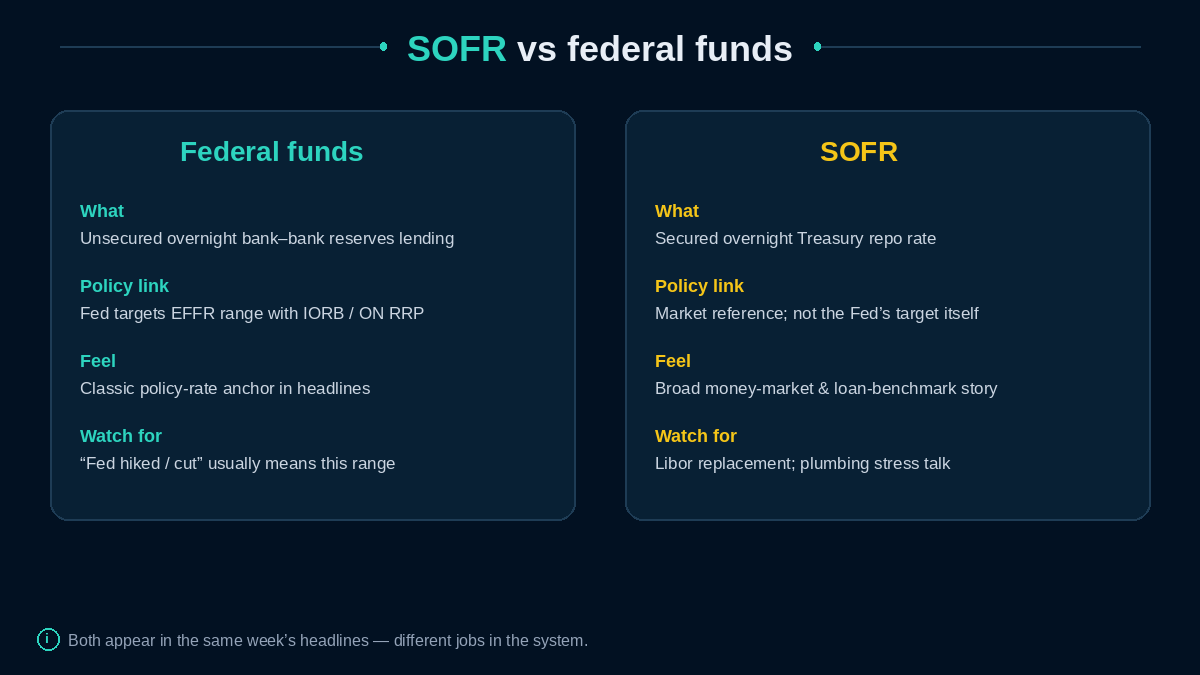
Diagram: Unsecured fed funds policy anchor vs secured SOFR reference rate.
Federal funds — the policy anchor
The federal funds rate is the interest rate banks charge each other for overnight loans of reserves. The Fed sets a target range for the effective federal funds rate (EFFR) and steers it with administered rates and open-market plumbing.
When headlines say “the Fed hiked 25 basis points,” they almost always mean that target range moved. Mortgage rates and Treasury yields are related through a chain of markets—not typed in by the Fed as your APR. See Interest rates and yields and Housing, mortgages, and rates.
Forward guidance and the Statement of Economic Projections then shape where markets think that range might go next—see Reading the Fed and Priced in / expectations.
SOFR — the secured overnight reference
SOFR (Secured Overnight Financing Rate) is a broad measure of the cost of overnight borrowing secured by Treasury collateral in the repo market. It is a transaction-based reference rate widely used in loans and derivatives after the Libor transition.
Key teaching contrast:
| Federal funds | SOFR | |
|---|---|---|
| Collateral | Unsecured (bank credit) | Secured (Treasuries) |
| Policy role | Fed’s target anchor | Market reference rate |
| Headline job | “Hike / cut” language | Benchmark & plumbing stress talk |
SOFR can print a little soft or firm versus fed funds when collateral is scarce or abundant, when balance-sheet constraints bind, or around reporting dates. Those wiggles are money-market microstructure—not automatically a new FOMC decision.
Why both show up together
Policy and money markets sit in one system. The Fed’s administered rates (including the ON RRP offering rate) help keep overnight rates in a corridor. SOFR reflects secured overnight financing conditions; EFFR reflects unsecured bank reserve lending. Related, not identical.
You do not need to arb the spread. You need the habit: fed funds = policy story; SOFR = secured money-market benchmark story. Pair both with Overnight RRP plumbing and Fed balance sheet and reserves when headlines get technical.
A calm reading checklist
When a chart shows SOFR jumping:
- Did the Fed’s target range change?
- Is this a known calendar effect (month-end, quarter-end)?
- Are other stress gauges (credit spreads, equity volatility) also flashing—or is it mostly plumbing?
That checklist keeps you in learning mode instead of jump-to-trade mode. See Credit spreads and Financial conditions for the wider mood map.
Myths to drop
- “SOFR is what the Fed sets.” The Fed sets a fed funds target range. SOFR is a market reference.
- “If SOFR ticks up, the Fed just hiked.” Not automatically—check whether the target range changed.
- “Learning SOFR lets me predict stocks.” Overnight benchmarks are plumbing vocabulary, not equity signals.
- “Fed funds and SOFR must always match exactly.” They usually sit near each other in calm ample-reserves regimes; small gaps can be normal.
How this connects
Related reads
Telegram
Rate-decision and money-market days: Join Macro Simplified.