
Priced in / expectations
Educational only. This page teaches how expectations and surprises shape market reactions to data. It is not a trading system, not a way to “fade the move,” and not advice to buy or sell anything when a print hits.
Site vs Telegram — strong pairing
The habit of reading surprise vs level belongs with the Event playbook. Live “what was expected vs what printed” language on FOMC, CPI, and NFP days belongs on Telegram: Macro Simplified on Telegram.
You have seen it: the same kind of number—say a CPI reading—sometimes barely moves markets and sometimes sets off a storm. The missing piece is usually expectations. Macro literacy means asking not only “what printed?” but “what was already priced in?”
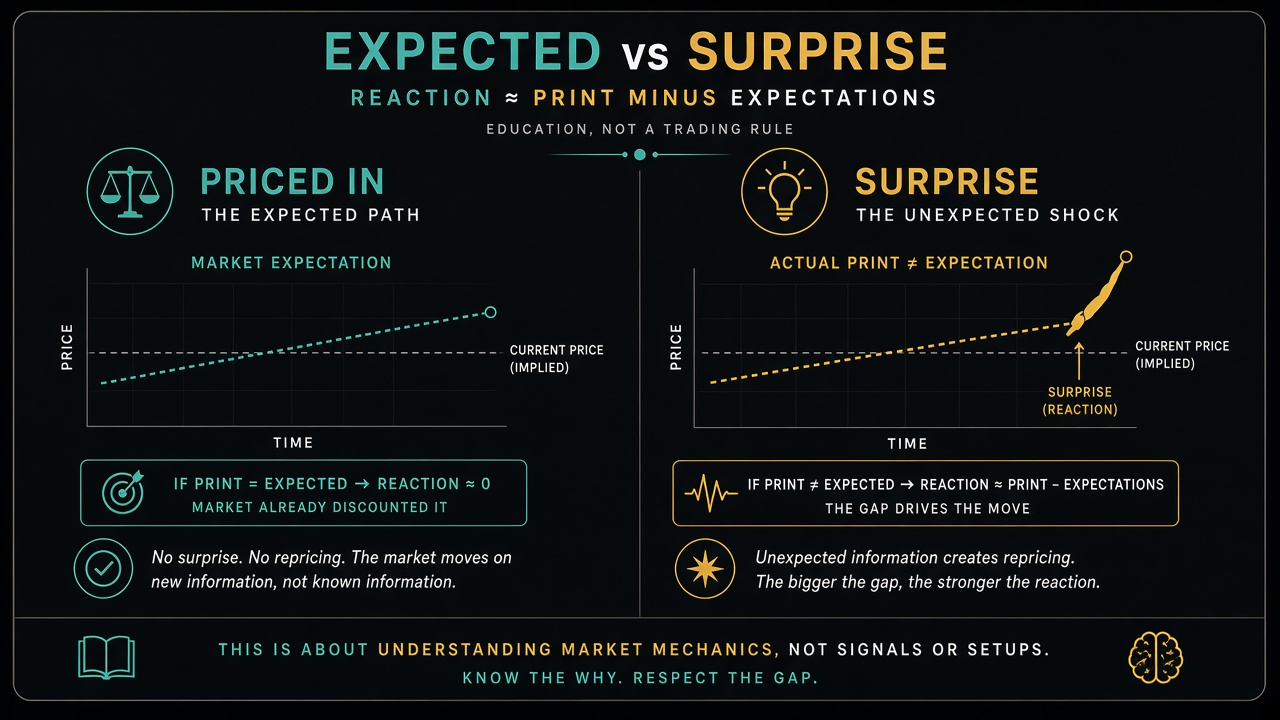
Diagram placeholder: level vs surprise — why the same number can feel quiet or loud.
Markets react to surprise vs level
A level is the raw print: inflation at X%, payrolls at Y thousand, the Fed holding rates in a given range. A surprise is how that level compares with what investors (and the economists they watch) had been assuming beforehand.
In plain English:
- If everyone already expected a hot CPI, a hot CPI can look like confirmation—interesting, but not new information.
- If everyone expected a cool CPI and the print is hot, that is new information—guesses about the Fed path, yields, the dollar, and risk mood may all update at once.
Markets are machines for updating guesses. They care about the gap between what arrived and what was assumed. That is why “in line with estimates” often travels with calmer tape language, while “missed estimates” travels with volatile language—even when the absolute level would have looked shocking a year earlier.
This is mechanism for understanding headlines. It is not a tip to trade the gap.
“Priced in” in everyday language
Priced in means: the possibility is already reflected in asset prices and in the stories investors tell. If a Fed cut is “priced in,” many people are already acting as if that cut is likely—so when the cut is delivered, the reaction can be muted, or even reverse (“buy the rumor, sell the news” is a cliché describing that pattern, not a rule we endorse as a strategy).
Everyday analogies:
- If your whole street expected rain and rain arrives, nobody is shocked.
- If the forecast said sun and a storm hits, plans change fast.
In markets, the “forecast” is not one weather app—it is a messy blend of surveys, fed-funds futures style pricing, analyst notes, and positioning. You do not need those tools to grasp the idea. You only need the question: Did this print change the story, or did it stamp the story people already had?
Why the same CPI can be calm or chaotic
Walk through two fictional moods around the same headline style of number. (These are teaching sketches, not live calls.)
Scenario A — Calm
Surveys and market pricing already leaned toward a firm inflation print. The Fed had been sounding cautious. CPI arrives roughly where people guessed. Commentary says “as expected.” Bond yields barely budge; risk assets chop without a narrative reset. The level may still matter for households’ lived inflation—but the surprise was small.
Scenario B — Chaotic
The same style of firm print arrives after markets had convinced themselves inflation was cooling fast and cuts were near. Suddenly the policy-path guess shifts. Yields jump; the dollar strengthens in the usual narrative; risk-off language appears in crypto and equity headlines. The number’s level looks familiar from last month; the gap vs hopes is what hurt.
Flip the stories for cooler-than-expected prints. The teaching point is identical: expectations set the fuse; the surprise lights it. For how to sit with CPI days without turning them into signals, see Inflation 101 and the Event playbook.
The same logic applies to NFP (Jobs and growth) and to FOMC decisions and wording (The Fed toolkit): a widely expected hike can move markets less than a mild sentence in the press conference that was not expected.
Connect this to the Event playbook
The Event playbook’s before / during / after process pairs naturally with expectations literacy:
- Before: Note the consensus or the prevailing story—as a benchmark for surprise, not as something to bet.
- During: Separate “what printed” from “vs expectations” and from “vs your own hope.”
- After: Watch how the narrative settles; first takes reverse often. Re-open the matching primer; use Telegram for the live decode.
Macro Simplified’s split stays firm: site = durable map, Telegram = same-day language. Neither layer is a signal desk.
Strong anti-signal framing
Do not use this page to:
- invent a rule like “always fade the first move after a surprise,”
- treat consensus as truth you must trade against,
- assume that “priced in” means “nothing can happen”—positioning and second-round narratives still move prices,
- turn one calm CPI into a green light or one chaotic CPI into a forced exit.
Expectations explain why reactions differ. They do not tell you what you personally should buy or sell. For rates channels that often reprice on surprises, see Interest rates and yields. For risk mood language, see Risk assets 101.
A short checklist (learning only)
- What was the print (the level)?
- What was the prevailing expectation?
- Was the surprise hot, cool, or roughly in line?
- Which dial updates—growth, inflation, policy, liquidity (How to read macro)?
- Where is the evergreen explainer? Where is Telegram for live context?
That checklist is a reading habit. It is not an order ticket.
Related reads
- Event playbook
- How to read macro
- Inflation 101
- Interest rates and yields
- Risk assets 101
- The Fed toolkit
- Glossary
Telegram
Surprise-vs-expectations decoding on FOMC / CPI / NFP days: Join Macro Simplified.