
Fed balance sheet and reserves
Educational only. This page is a teaching T-account for the Fed’s balance sheet. It is not a forecast of runoff speed, not advice, and not a liquidity trade signal.
Site vs Telegram
Plumbing primers stay here. Live “what did the Fed just say about the balance sheet?” context lives on Telegram: Macro Simplified on Telegram.
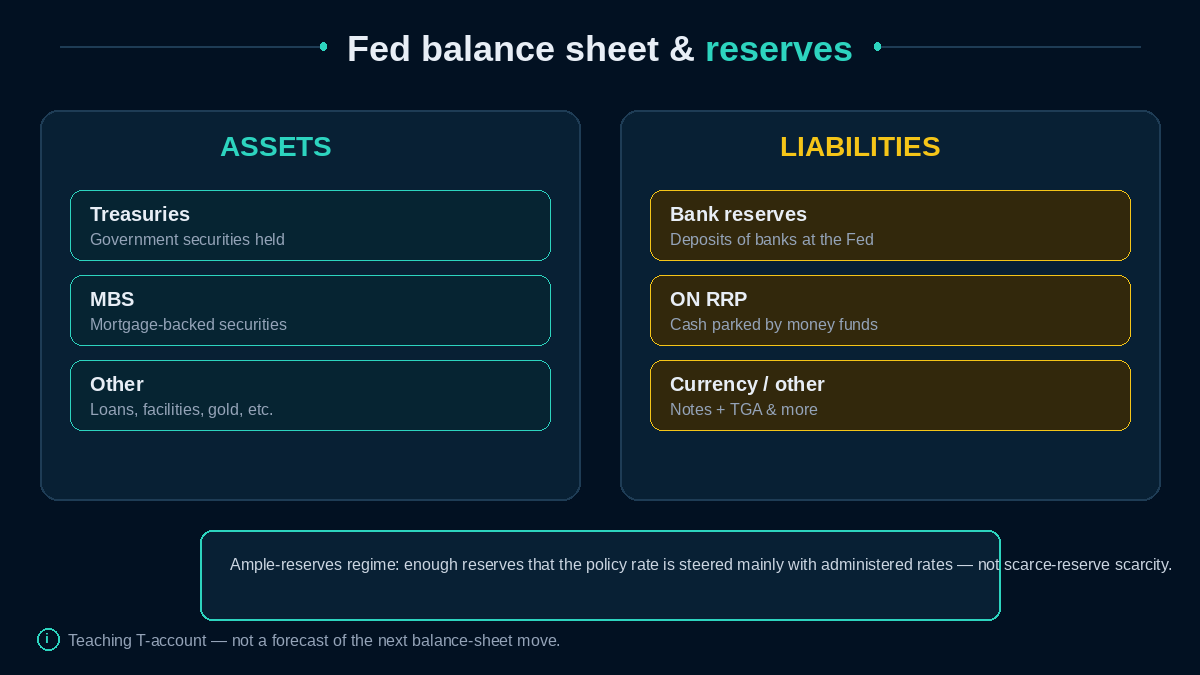
Diagram: Assets (Treasuries, MBS) vs liabilities (reserves, ON RRP, currency)—ample-reserves vocabulary.
Assets vs liabilities (beginner version)
A balance sheet always balances. On the Fed’s sheet, a simplified teaching view looks like this:
Assets (what the Fed holds)
- U.S. Treasuries
- Agency mortgage-backed securities (MBS)
- Smaller items (loans, facilities, gold certificates, and other accounts)
Liabilities (how those assets are funded)
- Bank reserves — deposits banks hold at the Fed
- Overnight reverse-repo (ON RRP) balances — cash parked by eligible nonbanks
- Currency in circulation and other accounts (including the Treasury’s account at the Fed in fuller maps)
When the Fed buys a security in QE, assets rise and reserves (a liability) typically rise too. When holdings run off in QT, both sides tend to shrink. See QE and QT explained.
You do not need to memorize every line item on the H.4.1 release. You need the habit: assets tell you what the Fed holds; liabilities tell you who holds claims on the Fed—including banks’ reserve accounts.
What bank reserves are
Reserves are electronic balances banks keep at the Fed. They are the core of overnight money-market plumbing. Banks use them to settle payments and meet liquidity needs. In everyday headlines, “liquidity in the system” often points at the level and distribution of reserves—not at cash in your wallet.
Reserves are not identical to the M1/M2 aggregates in Money and banking, though those stories sit next to each other. A banking system can have ample reserves at the Fed while households still care about deposit rates, loan standards, and risk appetite.
Ample-reserves regime (the big idea)
Older textbooks emphasized scarce reserves and active open-market operations to hit a funds-rate target. In the modern ample-reserves framing:
- There are enough reserves that the funds rate is steered mainly with administered rates (such as interest on reserves and the ON RRP offering rate)
- Day-to-day “scarce reserves theater” is less central
- The policy question becomes “enough reserves for control and resilience?” rather than “minimum reserves forever”
Ample means “enough to run the floor system,” not “infinite.” Officials still watch whether reserves are becoming scarce in pockets of the system—because scarcity can show up as overnight-rate volatility even when the headline sheet looks large.
Why beginners should care (context only)
Balance-sheet talk shows up beside:
- QE/QT debates and runoff caps
- Money-market stress or calm (SOFR vs federal funds)
- Broader Financial conditions
Treat the sheet as plumbing literacy. It helps you decode speeches and footnotes. It does not tell you what to buy on Monday.
Myths to drop
- “More reserves always equal higher stock prices.” Reserves are plumbing. Risk assets still price growth, profits, and mood.
- “The balance sheet size is the only Fed tool.” The policy rate remains the primary day-to-day lever.
- “Liabilities are ‘the debt the Fed owes you personally.’” Teaching liabilities are accounting counterparts—not a retail IOU.
- “Ample reserves means policy is always easy.” The stance still depends on the policy-rate path, guidance, and credit conditions.
How this connects
- Direction of the sheet: QE and QT explained
- Nonbank cash parking: Overnight RRP plumbing
- Rate anchors: SOFR vs federal funds
- Broader toolkit: The Fed toolkit
Related reads
Telegram
Plumbing and FOMC context: Join Macro Simplified.