
Money and banking basics
Educational only. This primer explains money and bank plumbing for learning. It is not a recommendation to buy or sell bank stocks, deposits, or any product.
Site vs Telegram
Plumbing explainers stay here. Live Fed and liquidity decoding belongs on Telegram: Macro Simplified on Telegram.
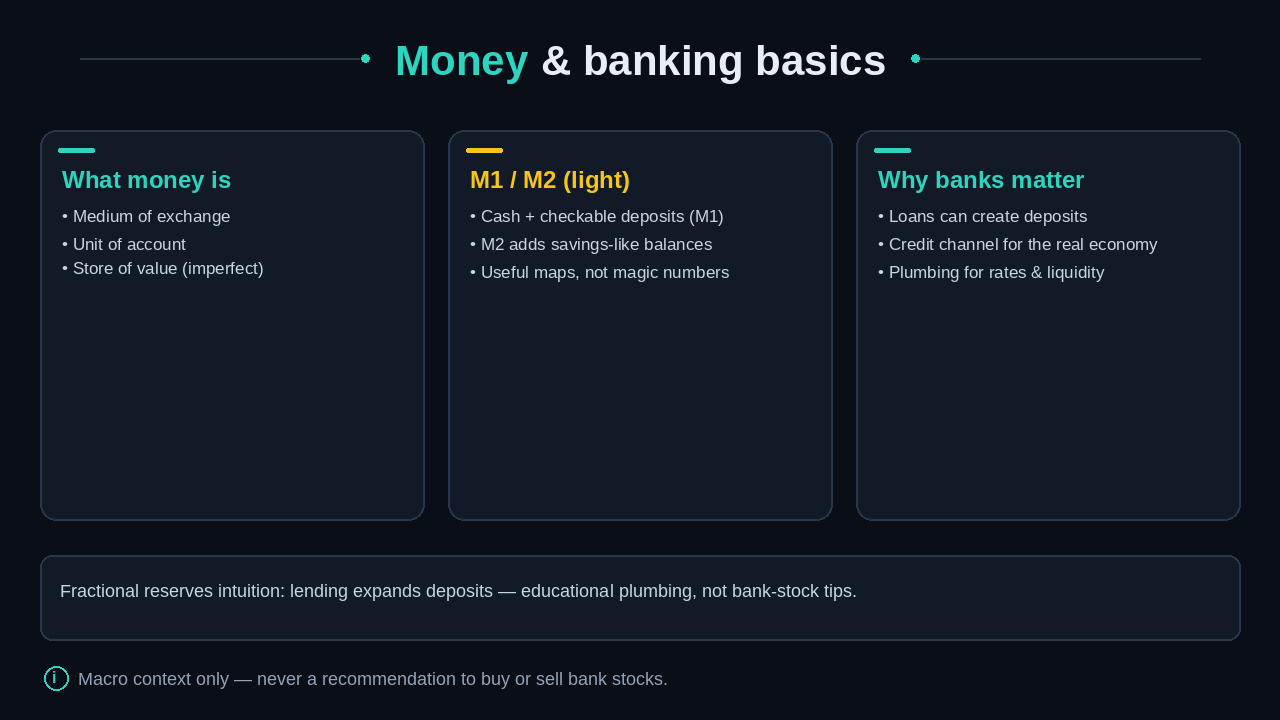
Diagram: money functions, aggregates light, and the bank credit channel — teaching only.
What counts as “money”?
In textbooks, money usually does three jobs:
- Medium of exchange — you can pay with it
- Unit of account — prices are quoted in it
- Store of value — it holds purchasing power imperfectly over time
Cash in your wallet and balances you can spend quickly sit near the center of that idea. Broader savings-like balances sit farther out. Crypto-curious readers: treat “is crypto money?” as a spectrum debate, not a slogan—and never as a token tip on this site. For crypto’s usual risk-asset behavior, see Crypto and macro liquidity.
M1 and M2 (light)
Statisticians publish money aggregates—rough maps of spendable balances:
- M1 — currency and closely spendable deposits (definitions have evolved; treat headlines as maps, not magic)
- M2 — M1 plus certain savings-like and short-term balances
You do not need to recite every line item. You need the habit: when someone says “money supply soared,” ask which aggregate, over what window, and compared with what? Aggregate growth is context beside rates, credit, and inflation—not a standalone trading rule. Link: Inflation 101 · The Fed toolkit.
Fractional reserves and “loans create deposits” (intuition)
Modern banking is not a simple piggy-bank warehouse. In everyday teaching language:
- When a bank makes a loan, it often credits a deposit for the borrower.
- That is how credit can expand the stock of deposits in the system.
- Reserves, capital rules, and funding markets constrain how far that process can run—so “banks print infinite money” is a slogan, not the full plumbing.
The point for macro learners: credit creation links the financial system to spending and investment. Soft banks or tight credit standards can cool activity even if the policy rate has not moved yet. That is why Financial conditions talk about credit alongside rates.
Why banks matter for macro (no stock tips)
Banks and related lenders:
- Transmit policy rates into loan and deposit pricing
- Shape who gets credit when conditions tighten or ease
- Sit inside liquidity and risk-mood stories that touch Risk assets 101
None of that is a cue to trade bank equities. It is a cue to notice the credit channel when you read FOMC language, loan-officer surveys, or “tightening financial conditions” headlines.
Next reads
- The Fed toolkit — policy rate, reserves, QE/QT plumbing
- Financial conditions — credit as part of tight vs easy
- Real vs nominal — rates after inflation
- Debt, leverage, and cycles — why borrowed money amplifies swings
- Glossary — M1, M2, liquidity
Related reads
Telegram
Liquidity and Fed days: Join Macro Simplified.