
Bonds for beginners
Educational only. This primer builds intuition for how bond prices and yields move, and what “duration” means in plain English. It is not a recommendation to buy or sell any bond, fund, or “bond alternative,” and not a forecast of the next move in yields.
Site vs Telegram
Bond vocabulary stays here. When Fed, CPI, or jobs prints reshape the rates conversation in real time, use Telegram: Macro Simplified on Telegram.
Bonds show up in almost every macro headline—“Treasury yields spiked,” “the 10-year is sending a signal,” “mortgage rates follow yields.” You do not need to become a fixed-income trader. You need the inverse price/yield relationship and a light sense of why some bonds wiggle more than others when rates move.
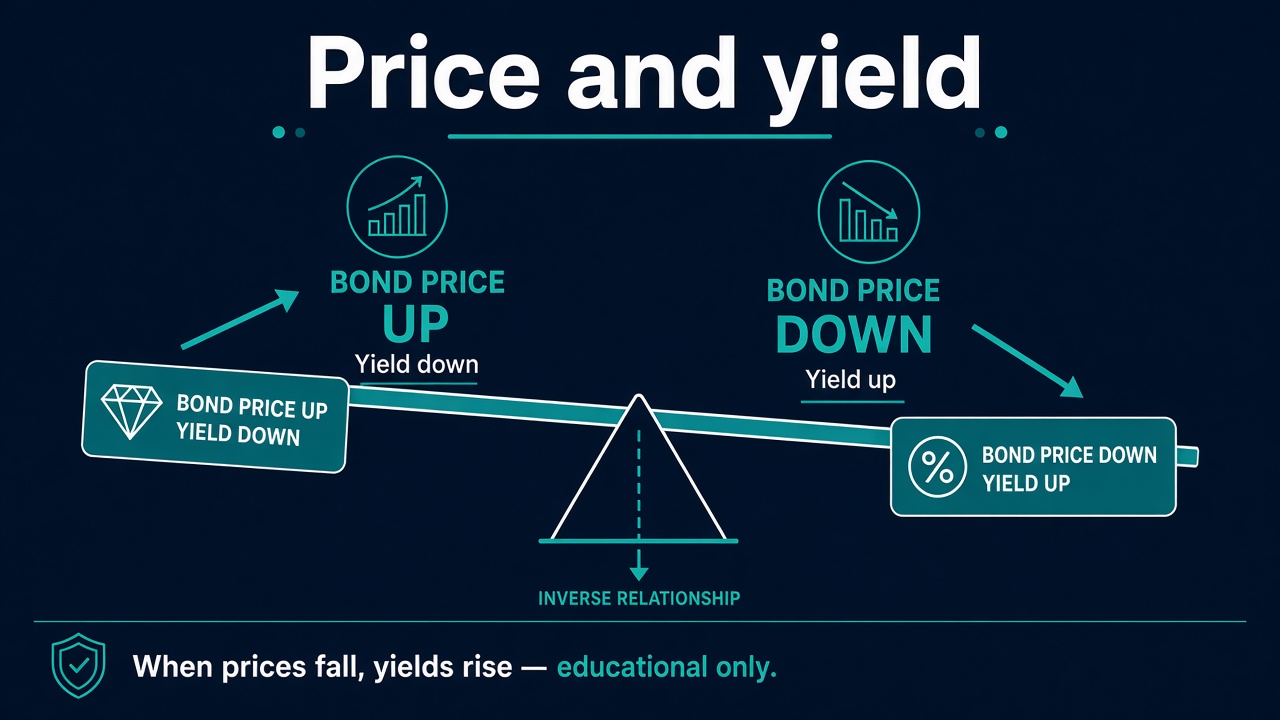
Diagram placeholder: price vs yield see-saw — educational intuition only.
What a bond is (30 seconds)
A bond is a loan. You (or a fund you own) lend money to a borrower—often a government or a company. In return, the bond typically pays coupons (interest payments) on a schedule and returns principal at maturity, if the borrower meets the terms.
For learning macro news, the important part is not memorizing every bond type. It is understanding that bonds trade, so their prices change before maturity, and those price changes show up as changing yields.
Price vs yield (the see-saw)
Everyday rule of thumb taught on this site:
- When a bond’s price goes up, its yield goes down.
- When a bond’s price goes down, its yield goes up.
Why? Coupons are often fixed. If someone pays more today for the same future cash flows, the effective return (the yield) is lower. If the price falls, a new buyer gets a higher effective return for those same coupons.
Headline translation:
| Headline shorthand | Rough price story |
|---|---|
| “Yields rose” | Bond prices fell |
| “Yields fell” | Bond prices rose |
| “Bonds sold off” | Prices down → yields up |
| “Bonds rallied” | Prices up → yields down |
Pair this page with Interest rates and yields: the Fed’s policy rate is a short-term steering tool; market yields are set in trading across maturities. They relate; they are not the same dial.
Duration (light version)
Duration is a teaching shortcut for: how sensitive is this bond’s price to a change in yields?
- Longer-maturity bonds (all else equal) tend to have higher duration—their prices usually move more when yields shift.
- Shorter-maturity bonds tend to have lower duration—smaller price swings for the same yield move.
- Coupon size also matters in the full math; beginners can start with “longer → usually wiggles more.”
Why macro readers care: when the market reprices the path of policy rates or inflation, high-duration bonds often show larger percentage price moves than short bills. That is why a “rates shock” headline can dominate bond-fund stories even when the Fed has not changed the policy rate that day.
Duration is not a product picker. Saying a bond has high duration is like saying a boat is long—it tells you something about how it handles waves, not whether you should sail today.
Real yield (plain language)
Headline writers sometimes say real yield—roughly, a yield after subtracting an inflation measure or inflation expectation. The idea: a 5% nominal yield feels different if inflation is running near 2% than if it is running near 6%.
This site uses real-yield language as context for how people debate the attractiveness of bonds versus cash or risk assets. We do not publish “real yields say buy X” calls. See also Inflation 101 for price-index vocabulary.
Bonds in the macro chain
Common (not guaranteed) narrative links:
- Fed signals a higher-for-longer policy path → markets may push yields up → existing bond prices soften → financial conditions can feel tighter.
- Growth scare or cut expectations rise → yields may fall → bond prices rise → risk mood still depends on why yields fell.
- Hot inflation surprise → longer yields often jump as inflation premium and policy-path guesses adjust.
None of those chains is a trade recipe. Surprises get reinterpreted as details arrive—see Priced in / expectations.
What this page will never do
- No “best bond for 2026.”
- No ladder vs barbell portfolio designs.
- No corporate vs Treasury vs “crypto bond” pitches.
- No duration-targeting as advice.
If you need a personal fixed-income plan, that is outside Macro Simplified’s educational scope.
Related reads
| If you want… | Read |
|---|---|
| Policy rate vs market yields | Interest rates and yields |
| Asset roles without allocation advice | Cash, stocks, and bonds |
| How conditions tighten or ease | Financial conditions |
| Mortgage-rate transmission | Housing, mortgages, and rates |
| Fed tools | The Fed toolkit |
Live decoding lives on Telegram
Site = durable primers. Telegram = live event decoding.