
How to read macro
Educational only. This page teaches ideas. It is not financial advice and not a recommendation to buy, sell, or hold anything.
Macro sounds like a subject for people with Bloomberg terminals. It isn’t. At its core, macro is just a way to notice how money, rates, jobs, and prices move together — and why markets (including crypto) often react when those pieces shift.
This page gives you a mental model. The other primers on this site go deeper on the Fed, inflation, jobs, risk assets, and big data releases. Live decoding of FOMC, CPI, and NFP prints lives in our Telegram community — this site stays evergreen.
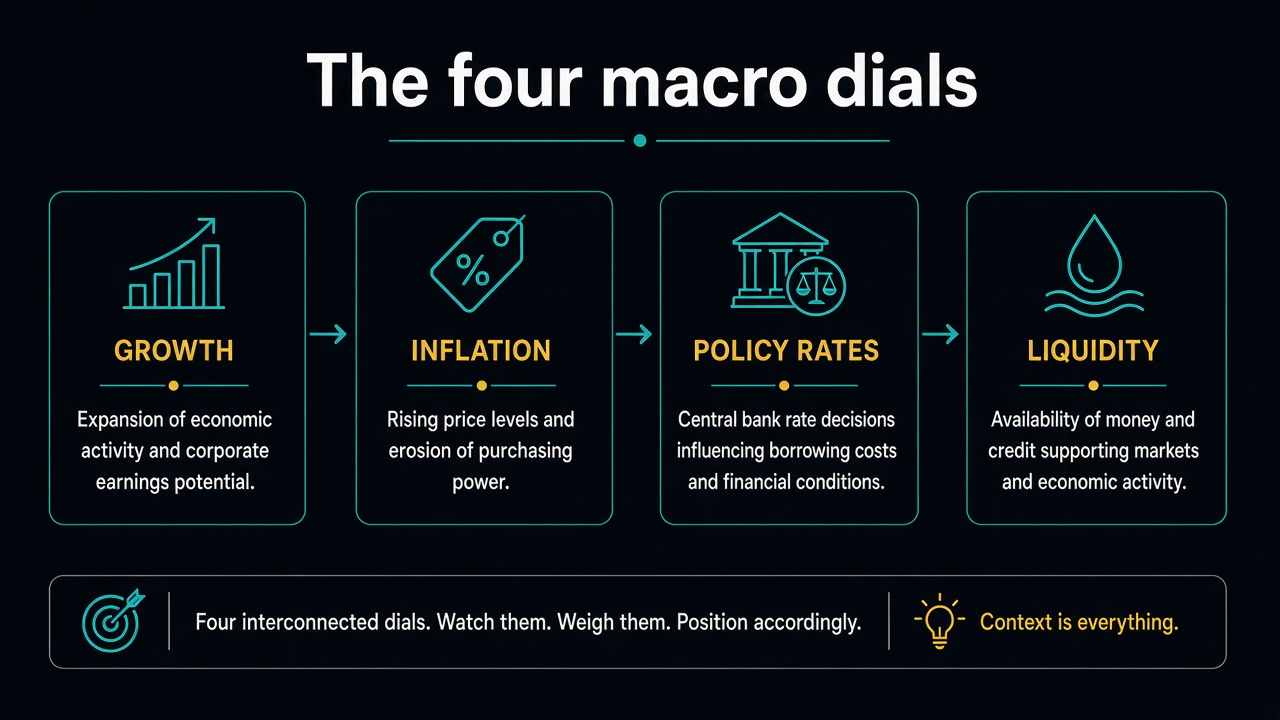
Diagram placeholder: the four dials mental model — educational map only.
Macro in one picture
Think of the economy as a system with four connected parts:
- Growth — Are businesses hiring and spending? Is activity expanding or slowing?
- Inflation — Are prices across a typical basket of goods and services rising quickly, slowly, or falling?
- Policy rates — What is the central bank (in the U.S., the Federal Reserve) doing with short-term interest rates?
- Liquidity — How easy or tight is money and credit in the financial system?
You do not need to forecast these perfectly. You only need to notice when a headline is really about one of these dials — and which other dials might move next.
When growth is hot and inflation is sticky, the Fed often talks about keeping policy tighter. When growth cools and inflation eases, markets usually debate cuts and easier financial conditions. That chain is the heart of “reading macro.” It is context for understanding news — not a signal to trade.
The four dials
Growth
Growth answers: is the economy expanding? Job reports, GDP figures, and business surveys all speak to this. Strong growth can support incomes and corporate earnings. Very hot growth can also keep inflation elevated, which feeds into the Fed dial.
Inflation
Inflation answers: are prices rising in a broad way? One viral price spike is not the same as inflation. Official measures like CPI and PCE try to capture a basket. High inflation erodes cash’s buying power and often pushes the Fed toward higher rates. Inflation 101 walks through the measures in plain English.
Policy rates
The Fed’s main tool is the policy rate — the short-term rate that influences borrowing costs across the economy. Higher rates tend to cool demand over time. Lower rates tend to ease financial conditions. The Fed toolkit explains rates, the balance sheet, and forward guidance without the jargon wall.
Liquidity
Liquidity is the “how easy is money?” dial. When credit is flowing and financial conditions are easy, risk appetite often rises. When conditions tighten, investors often become more cautious. You will see this idea again in Risk assets 101.
Keep the four dials in mind whenever you read a macro headline. Ask: which dial is this about, and which other dials might people argue about next?
Leading vs lagging
Not every number tells you about today the same way.
- Leading-ish clues tend to move earlier in a turn — for example, weekly jobless claims can shift before the big monthly unemployment rate does.
- Lagging measures confirm what already happened — unemployment and some wage measures often move after the cycle has already turned.
You do not need a spreadsheet model. You only need the habit: “Is this number telling me about the recent past, or hinting at a turn?” When in doubt, read the release as a clue, not a verdict.
From headline to meaning
Here is a calm walkthrough of a common headline: “CPI hotter than expected.”
- What printed? Inflation came in above what economists surveyed had expected.
- Which dial? Inflation — and maybe the Fed dial next.
- What usually gets debated? Whether the Fed needs to stay tighter for longer; how bond yields might react; whether risk assets and crypto see a more cautious mood.
- What this is not? A buy or sell instruction. Surprises get reinterpreted as more details arrive (core vs headline, one-off categories, revisions).
Flip it for “payrolls much weaker than expected”: that is mostly the growth/jobs dial, with follow-on debate about demand, the Fed’s next move, and risk mood. Same process — different dial.
For a repeatable checklist on FOMC, CPI, and NFP days, use the Event playbook. For live plain-English decoding when the number drops, use Telegram.
Your reading habit
Before you react to any macro print, run this short list:
- What released? Name the report (CPI, jobs, FOMC statement, etc.).
- Versus expectations? Was it hotter, cooler, or roughly in line?
- Versus last time? Is the trend still the same story, or did the story change?
- Which dial? Growth, inflation, policy, or liquidity?
- What does the Fed care about? Dual mandate = jobs and inflation in plain terms — see The Fed toolkit.
- Where is the evergreen explainer? Open the matching primer on this site. Where is the live take? Telegram.
That habit beats hot takes. It also keeps this site honest: we teach the map; live commentary belongs in the community channel.
Where to go next
| If you want… | Read |
|---|---|
| How the Fed’s tools work | The Fed toolkit |
| CPI, core, and PCE in plain English | Inflation 101 |
| Payrolls, unemployment, and GDP language | Jobs and growth |
| How rates and liquidity show up in stocks and crypto | Risk assets 101 |
| A calm checklist for big release days | Event playbook |
| Quick definitions | Glossary |
Live decoding lives on Telegram
This page will not update every CPI morning. For live, plain-English takes on FOMC, CPI, NFP, and related prints — and how people are discussing financial and crypto markets in the moment — join Telegram: https://t.me/MacroSimplified.
Site = durable primers. Telegram = live event decoding.