
Exchange-rate regimes
Educational only. This primer maps exchange-rate regimes in plain English. It is not an FX trade, not a call on DXY, and not advice to buy or sell any currency.
Site vs Telegram
Regime vocabulary lives here. When peg or devaluation headlines hit, Telegram carries the live gloss: Macro Simplified on Telegram.
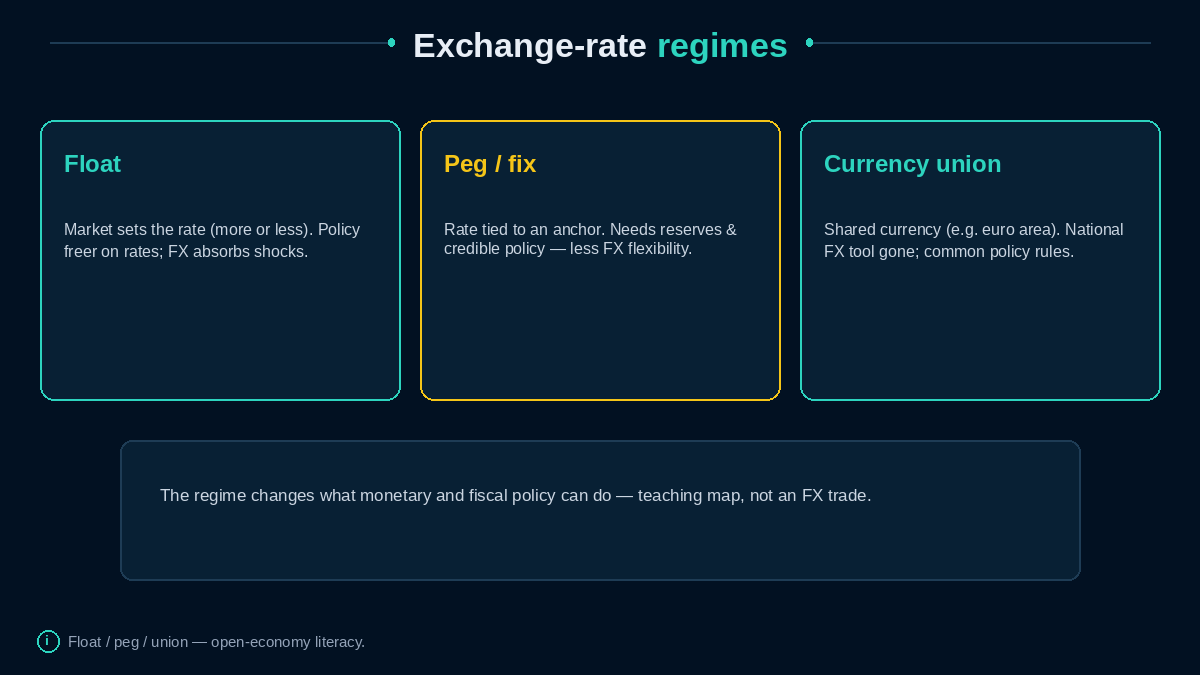
Diagram: Float / peg / union — the regime changes what policy can do.
Why the regime matters
An exchange-rate regime is the rule (formal or de facto) for how a currency’s value is determined. The regime shapes what monetary and fiscal policy can do when shocks hit—more than any single day’s candle on a chart.
Neighboring primers: US dollar and FX, Trade and the balance of payments, Capital flows for beginners.
Three teaching buckets
Float (flexible rate)
Markets play a large role in setting the rate. The currency can appreciate or depreciate as rates, growth, and risk appetite shift. Monetary policy often has more room to focus on domestic goals—though imported inflation and financial conditions still bind (Monetary policy transmission).
Peg / soft peg / managed
The rate is tied (tightly or loosely) to an anchor—another currency or a basket. Defending a peg can require reserves, interest-rate moves, and capital-flow management. Credibility is the scarce resource; speculative pressure is the stress test in historical teaching cases.
Currency union
Members share a currency (for example, the euro area). National exchange-rate adjustment inside the union disappears; policy rules and fiscal arrangements become central. Asymmetric shocks are harder to offset with a national FX tool.
Hybrids and “dirty floats” fill the space between pure types. Learn the spectrum; do not force every country into one cartoon.
Impossible trinity (light)
A classic teaching triangle: you cannot simultaneously have a fixed exchange rate, free capital mobility, and fully independent monetary policy. Something gives. That idea helps decode why pegs sometimes break when capital flows surge (Capital flows for beginners).
Common confusions
- “Float means chaos; peg means safety.” Pegs can be stable—or snap. Floats can be noisy—or absorb shocks.
- “The U.S. pegs the dollar to gold today.” Modern USD floats in the usual teaching sense (with plenty of global dollar influence).
- “Regime talk is an FX signal.” Not on this site.
- “Unions never face stress.” Shared currencies shift where stress appears.
In practice — reading a peg headline
Ask: What is the anchor? Are reserves falling? Are rates being used to defend? Are capital controls in the story? Translate drama into regime mechanics—then stop before the trade idea. Pair with Financial conditions when FX moves feed back into domestic mood.
Reserve adequacy and credibility tools (swap lines, communication, capital-flow measures) appear in peg-defense stories. Learners only need the category names to follow news without pretending to run a central bank. For tariff and trade shocks that interact with FX adjustment, see Tariffs as a macro shock. Regime literacy is knowing which adjustment valve exists—not predicting tomorrow’s candle.
How this connects
- US dollar and FX · Capital flows for beginners
- Trade and the balance of payments · Tariffs as a macro shock
- The Fed toolkit · Interest rates and yields
Related reads
- US dollar and FX
- Capital flows for beginners
- Trade and the balance of payments
- Financial conditions
- Glossary
Telegram
FX-regime and peg-stress headlines: Join Macro Simplified.