
Capital flows for beginners
Educational only. This primer introduces cross-border capital flows. It is not an EM trade, not a carry-trade setup, and not advice to chase yield abroad.
Site vs Telegram
Flow vocabulary lives here. When “hot money” or sudden-stop language hits headlines, use Telegram: Macro Simplified on Telegram.
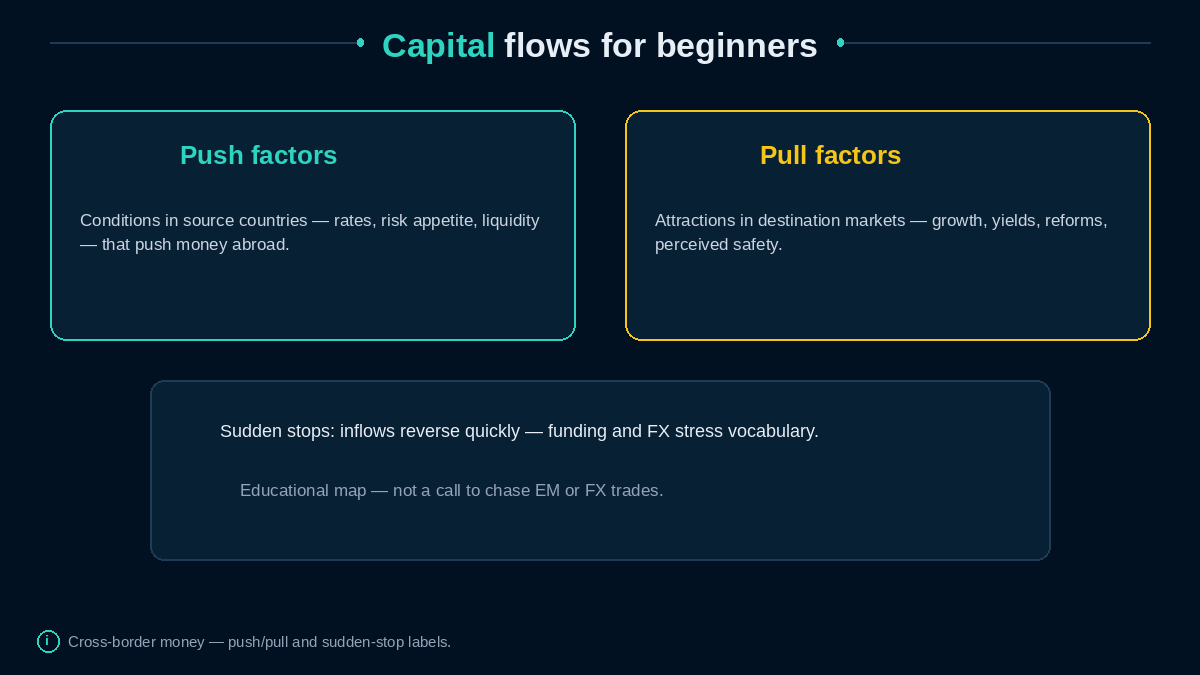
Diagram: Push vs pull — and sudden-stop stress vocabulary.
Money crossing borders
Capital flows are cross-border purchases of financial and real assets—portfolio bonds and stocks, banking flows, direct investment, and related categories in the balance of payments (Trade and the balance of payments). When people say “money flooded in” or “outflows hit the currency,” they are pointing at this layer.
Flows interact with exchange-rate regimes: a float may absorb pressure via the currency; a peg may absorb it via reserves and rates.
Push and pull (teaching shorthand)
Push factors — conditions in source countries that send capital abroad: low yields, abundant liquidity, high risk appetite, or regulatory shifts (Financial conditions, QE and QT explained as global liquidity footnotes).
Pull factors — attractions in destinations: higher yields, growth stories, reforms, or perceived safety.
Most live episodes mix both. The shorthand keeps you from blaming only the destination or only the Fed for every swing.
Sudden stops
A sudden stop is teaching language for a sharp reversal of inflows—funding disappears quickly, FX and credit stress rise, and domestic demand can compress. Historical EM cases are the usual classroom; advanced economies can feel related funding-stress cousins. Pair with Liquidity vs solvency when banking headlines blur cash vs capital, and with Credit cycles when leverage was built on cheap foreign funding.
Dollar footnotes
Because so much global finance is dollar-linked, U.S. rate and dollar moves often show up as push factors in commentary (US dollar and FX, Monetary policy transmission). That is a map of channels—not a mandate to short EM on every hike.
Common confusions
- “Capital flows equal the trade balance.” Related accounts; not identical.
- “Inflows are always good; outflows always bad.” Composition and sustainability matter.
- “Sudden stop means I should panic-trade.” Vocabulary for reading—not a signal service.
- “Only emerging markets have flows.” Advanced economies are deep hosts and sources too.
In practice — a calm flow checklist
Who is buying/selling? Debt or equity? Bank or portfolio? Is the FX regime absorbing or resisting? Any reserve loss or rate defense? Answer those before accepting a one-word narrative.
Gross vs net flows matter in advanced discussion: large two-way gross traffic can sit under a calm net number. Beginners can start with net narratives in the press, then remember that banking-system gross exposures sometimes carry the risk. Direct investment tends to be stickier than hot portfolio flows in many teaching comparisons—useful when sorting “what kind of money left?”
Safe-haven inflows into deep markets can push currencies stronger even when trade balances look soft—another reminder that the financial account has its own drama. Read FX moves with both trade and flow lenses (US dollar and FX).
Policy news can flip pull factors overnight; that is uncertainty as a flow shock, not a reason to chase headlines.
How this connects
- Exchange-rate regimes · US dollar and FX
- Trade and the balance of payments · Financial conditions
- Liquidity vs solvency · Credit cycles
Related reads
- Trade and the balance of payments
- US dollar and FX
- Exchange-rate regimes
- Financial conditions
- Glossary
Telegram
Flow and FX-stress headline days: Join Macro Simplified.