
The multiplier effect
Educational only. This primer explains the multiplier as a teaching chain. It is not a forecast model, not a fiscal scorecard for any party, and not advice to trade stimulus headlines.
Site vs Telegram
Multiplier vocabulary stays here. When spending or fiscal packages dominate the news, Telegram carries the live gloss: Macro Simplified on Telegram.
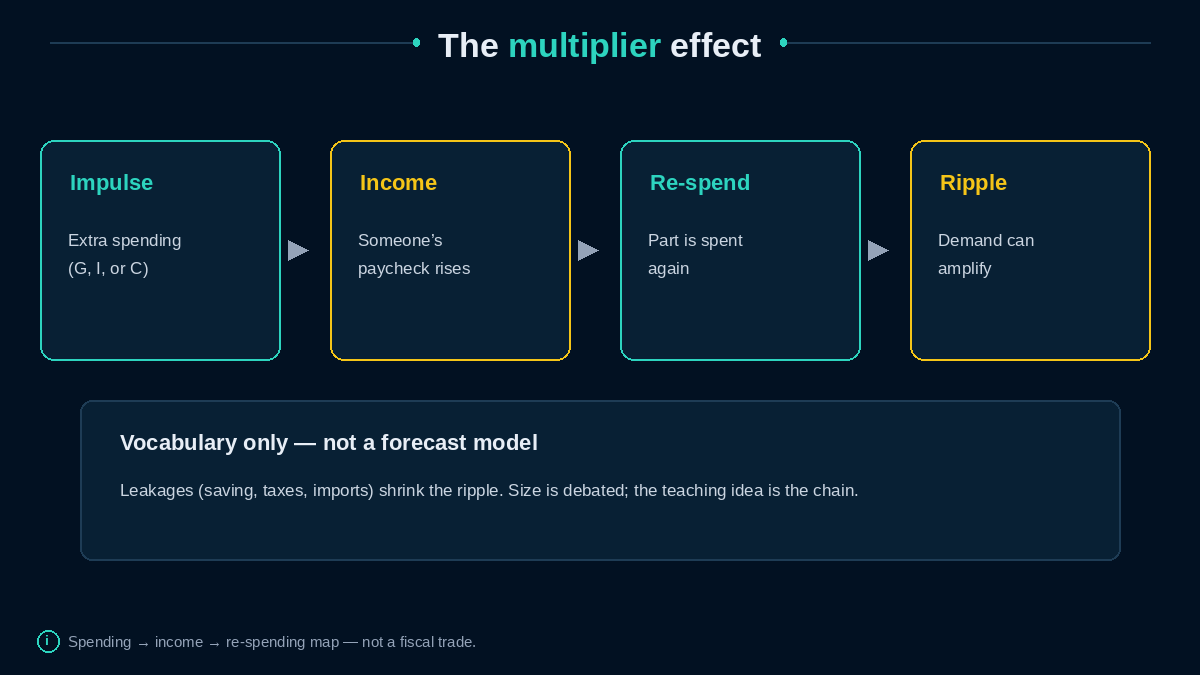
Diagram: Spending impulse → income → re-spending — size debated; chain is the lesson.
The chain in plain English
Suppose someone spends extra—government purchases, business capex, or household consumption. That spending is income for someone else. They save some and spend some; the spent part becomes income again. The idea that an initial impulse can ripple through demand is the multiplier intuition.
Teaching sketch:
- Impulse — extra spending lands
- Income — recipients earn more
- Re-spend — a fraction is spent again
- Ripple — total demand can rise by more than the first round—in the simple story
Leakages shrink the ripple: saving, taxes, and imports siphon purchasing power away from domestic re-spending. That is why textbook multipliers are not a single magic number.
Why beginners still learn it
The multiplier helps you decode phrases like “fiscal impulse,” “second-round effects,” and “demand support.” It sits beside Consumption and saving, Investment and capital spending, and Fiscal policy basics. It does not tell you the exact GDP bump from a bill in the news.
Slack vs overheating matters: extra demand into a large output gap differs from extra demand into an already hot economy (Demand shocks vs supply shocks). Monetary offset or accommodation also changes outcomes (Monetary policy transmission).
What this page refuses to do
- Publish a “true” multiplier for today’s economy
- Score political platforms
- Turn stimulus headlines into buy/sell rules
Size and timing are empirical debates. Your literacy win is recognizing the chain and the leakages.
Common confusions
- “Multiplier means money printers guarantee boom.” Accounting ripples ≠ automatic real boom.
- “If there is any leakage, multipliers are zero.” Leakages reduce; they do not always erase.
- “Multipliers only apply to government spending.” Any autonomous demand impulse can be discussed in multiplier language.
- “Learning this times the stock market.” No.
In practice — hearing “multiplier” in commentary
When an analyst says the multiplier is large, they usually claim small leakages and spare capacity. When they say it is small, they point to imports, saving, inflation leakage, or monetary pushback. Translate to those assumptions—then keep Priced in / expectations in mind so you do not confuse a model claim with a locked-in market outcome.
Open-economy leakages deserve a second beat: if a large share of the impulse is spent on imports, more of the ripple lands abroad (Trade and the balance of payments). That is one reason the same fiscal package can feel different in a closed textbook island than in a trading economy. Capacity constraints and inflation leakage are the other classic limits—pair with Inflation 101 when commentators say “the multiplier is mostly prices now.”
How this connects
- Consumption and saving · Investment and capital spending
- Fiscal policy basics · Deficits, debt, and debt-to-GDP
- Output gap and potential GDP
Related reads
- Fiscal policy basics
- GDP and measurement
- Demand shocks vs supply shocks
- Consumption and saving
- Glossary
Telegram
Fiscal-impulse headline days: Join Macro Simplified.