
Liquidity vs solvency
Educational only. This primer separates liquidity problems from solvency problems. It is not a bank-stock tip, not a short recommendation, and not a prediction of the next crisis.
Site vs Telegram
Crisis vocabulary lives here. When funding-stress headlines hit, Telegram carries the live gloss: Macro Simplified on Telegram.
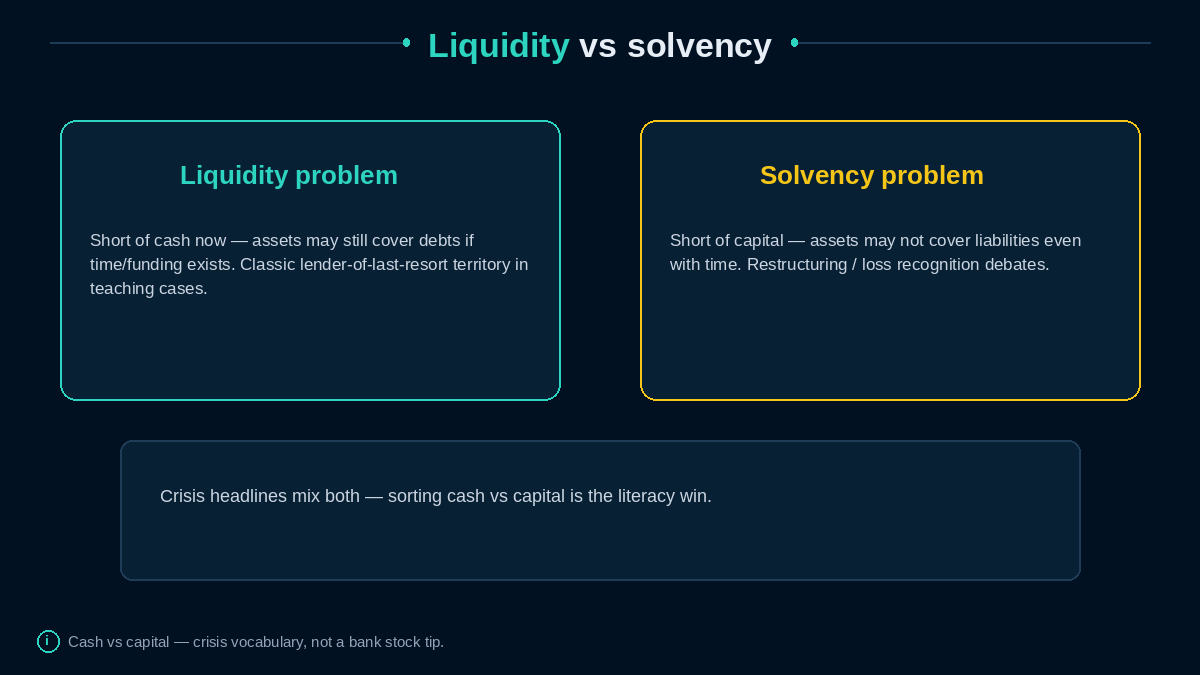
Diagram: Short of cash vs short of capital — sort the headline before the drama.
Two different shortages
Liquidity problem — short of cash (or funding) now, even if assets could cover debts given time and orderly markets. Classic metaphor: solvent on paper, illiquid in the queue. Lender-of-last-resort teaching cases often target this gap.
Solvency problem — short of capital: assets may not cover liabilities even with time. Losses need recognition, restructuring, recapitalization, or closure debates.
Headlines blur them because illiquidity can force fire sales that create insolvency—and fear of insolvency can trigger liquidity runs. Sorting the claim is still the literacy win (Credit cycles, Debt and leverage).
Why macro readers should care
Banking and shadow-banking stress shows up in financial conditions, credit spreads, and sometimes policy facilities (The Fed toolkit, Overnight RRP plumbing as plumbing cousins—not identical tools). Household and firm versions exist too: temporary cash crunch vs balance-sheet hole.
Cross-border funding sudden stops can present as liquidity stress first (Capital flows for beginners).
Policy vocabulary (labels only)
- Liquidity support — funding against collateral, standing facilities, emergency lending in teaching history
- Solvency support — capital injections, loss sharing, restructuring frameworks
Which tool fits which problem is a heated debate in every crisis. This site names the categories; it does not adjudicate a live case or tell you to buy the dip.
Common confusions
- “Illiquid means insolvent.” Not automatically—though the line can move fast.
- “Solvent firms never need cash help.” Timing mismatches happen.
- “Central banks can always fix solvency with liquidity.” Liquidity tools do not erase hole-in-capital math.
- “This page is a trading checklist.” Explicitly not.
In practice — three questions for a stress headline
- Is the claimed problem cash timing or capital shortfall?
- Are fire-sale prices making the gap look worse?
- Are commentators proposing liquidity tools, capital tools, or both?
Answer, then refuse the leap to personal trading instructions. Pair with Risk assets 101 anti-signal framing and Money and banking.
Mark-to-market spirals explain the blur: when funding vanishes, forced sales hit prices, capital ratios look worse, counterparties pull away, and liquidity worsens again. Breaking the spiral is why facilities and holidays appear in crisis histories. Your educational job is to spot spiral language early—not to time equity bottom ticks. Pair with Diversification and regimes for regime humility without portfolio recipes.
Collateral quality sits between the two ideas: yesterday’s liquid asset can become today’s unusable pledge if haircuts jump. That is why “high-quality liquid assets” language appears in banking regulation talk—and why this page stays conceptual rather than a Basel rulebook.
Household analogy (cash on hand vs net worth) can help beginners—then remember firms and banks have wholesale funding twists households do not.
How this connects
- Debt and leverage · Credit cycles
- Credit spreads · Financial conditions
- Money and banking · Fed balance sheet and reserves
Related reads
Telegram
Funding-stress headline days: Join Macro Simplified.