
Interest rates and yields
Educational only. This primer teaches how interest rates and bond yields fit into macro conversation. It is not financial advice, not a forecast of the next move in rates, and not a recommendation to buy or sell bonds, stocks, crypto, or anything else.
Site vs Telegram
Durable explainers live here. For live decoding when the Fed, CPI, or jobs data reshapes the rates conversation, join Telegram: Macro Simplified on Telegram.
When headlines say “rates jumped” or “yields fell,” they are often mixing two related ideas: the Fed’s policy rate and market yields on bonds. This page separates those ideas so you can read the news without treating every move as a trade cue.
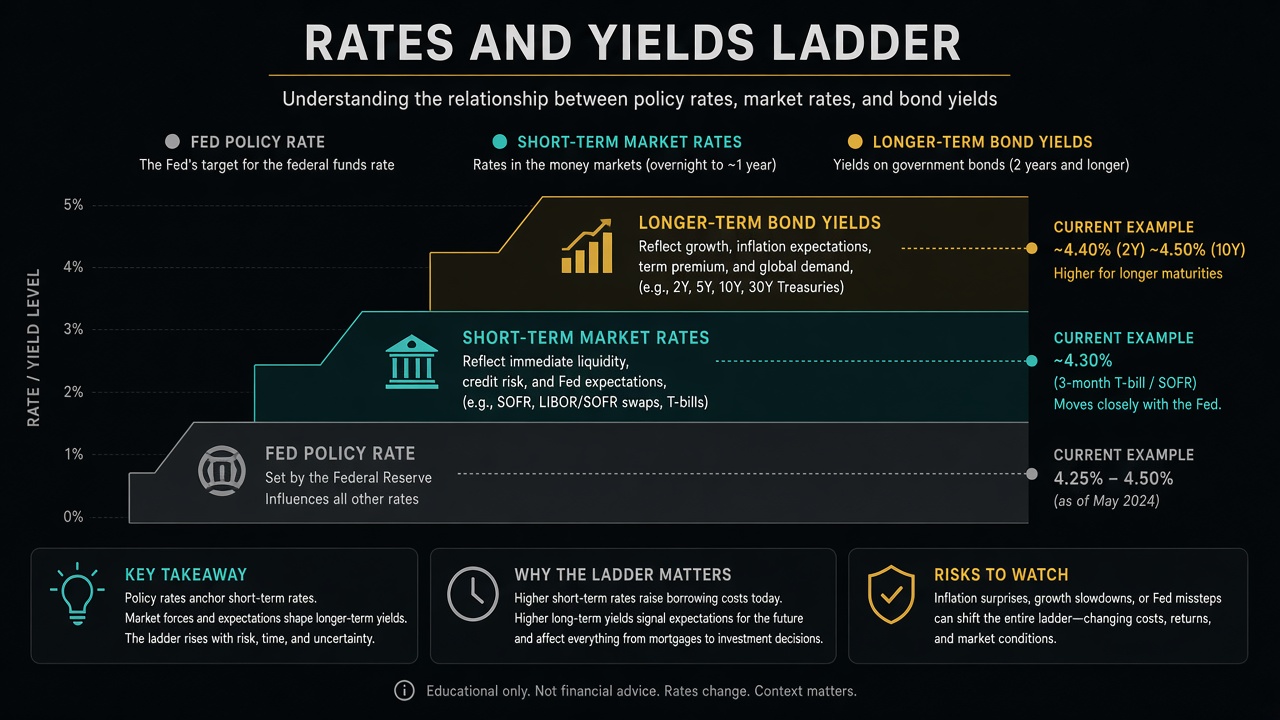
Diagram placeholder: policy rate vs market yields along a short-to-long ladder — educational map only.
Policy rate vs market yields
The policy rate (in the U.S., the federal funds rate target range) is the short-term benchmark the Fed sets. Banks lend reserves to each other overnight near that range. When people say “the Fed hiked” or “the Fed cut,” they usually mean this tool. The Fed toolkit covers how that lever works alongside the balance sheet and forward guidance.
Market yields are different. They are the returns implied by prices of bonds that trade every day—Treasury notes and bonds, and many other fixed-income instruments. Nobody at the Fed types “10-year yield = X%” into a control panel. Investors collectively set bond prices; yields move as those prices move.
A calm split: policy rate = the official short-term steering wheel; market yields = what the bond market is pricing across maturities, informed by the policy path, growth, inflation, and risk appetite. They usually relate—if the Fed is expected to stay high for longer, longer yields often sit higher too—but they are not the same number and do not move in lockstep every hour.
What a yield is (plain English)
A yield is the return you would earn from a bond if you held it under a set of assumptions—often expressed as an annual percentage. For learning purposes, think of it as: when the bond’s price goes up, its yield goes down, and when the price goes down, its yield goes up.
Why the inverse relationship? A bond typically pays fixed coupon cash flows. If someone is willing to pay more for those same cash flows today, the effective return (the yield) is lower. If the price falls, the same coupons represent a higher return for the new buyer.
Headline shortcuts: “yields rose” usually means bond prices fell; “yields fell” usually means bond prices rose. Yield language shows up for government bonds, corporate credit, and mortgage rates people feel in daily life. This site uses yields as vocabulary for macro context, not a shopping list for which bond to own.
The yield curve idea (short vs long)
The yield curve is simply a picture of yields at different maturities—short-term bills on one end, longer-term notes and bonds on the other. Short yields sit closer to the policy-rate story. Longer yields fold in guesses about growth, inflation, and where policy might be years from now, plus whatever premium investors want for locking money up longer.
Useful beginner points:
- Upward-sloping: longer yields higher than short yields—often read as “you get paid more to wait,” though curves move for many reasons.
- Flat or inverted: short yields as high as, or higher than, long yields. Media often ties inversions to recession talk. This primer does not forecast recessions from the curve. Treat shape language as a map of what the market is pricing, not a dated prediction.
“2s/10s” is just shorthand for comparing a shorter yield to a longer one. Learn the vocabulary; scenarios stay labels for debate—see soft/hard landing language in Jobs and growth and the Business cycle primer.
How higher or lower yields show up
Yields connect to the rest of macro in a few repeatable ways:
Bonds themselves
Higher yields mean lower prices for existing bonds (and often higher quoted rates for new borrowing). Lower yields mean the opposite. That is arithmetic and market convention—not a buy/sell instruction.
Risk mood
When yields rise on tighter-policy or hotter-inflation guesses, risk assets sometimes see a more cautious mood—future cash flows get discounted more heavily and financial conditions feel tighter. When yields fall on growth scares or easier-policy bets, risk appetite can improve—or still struggle if the fall is about fear. Context matters; a single yield move is not a signal.
Everyday borrowing and crypto context
Mortgage quotes take cues from longer market yields and the broader rate environment, with lags. The Fed does not set your mortgage. Crypto-curious readers often hear “higher yields = less appetite for speculative assets”—a common narrative channel, not a timing rule. Pair with Risk assets 101.
Anti-signal framing (keep this)
Nothing on this page tells you to:
- buy or sell bonds because the curve inverted or steepened,
- “position for cuts” or “fade the rally in yields,”
- treat a one-day spike in the 10-year as a trade trigger.
Rates and yields help you understand headlines—especially after FOMC, CPI, and jobs prints—when markets update their guess of the policy path. For a calm process on those days, use the Event playbook. For same-day language when the number lands, use Telegram.
Related reads
Telegram
Live rates-and-data decoding lives on Telegram — not on this primer: Join Macro Simplified.