
Financial crises vocabulary
Educational only. This primer is a crisis word list drawn from teaching history. It is not a crisis timer, not a bank-stock tip, and not advice to panic or to “buy the dip.”
Site vs Telegram
Vocabulary lives here. When funding-stress language hits the tape, Telegram carries the live gloss: Macro Simplified on Telegram.
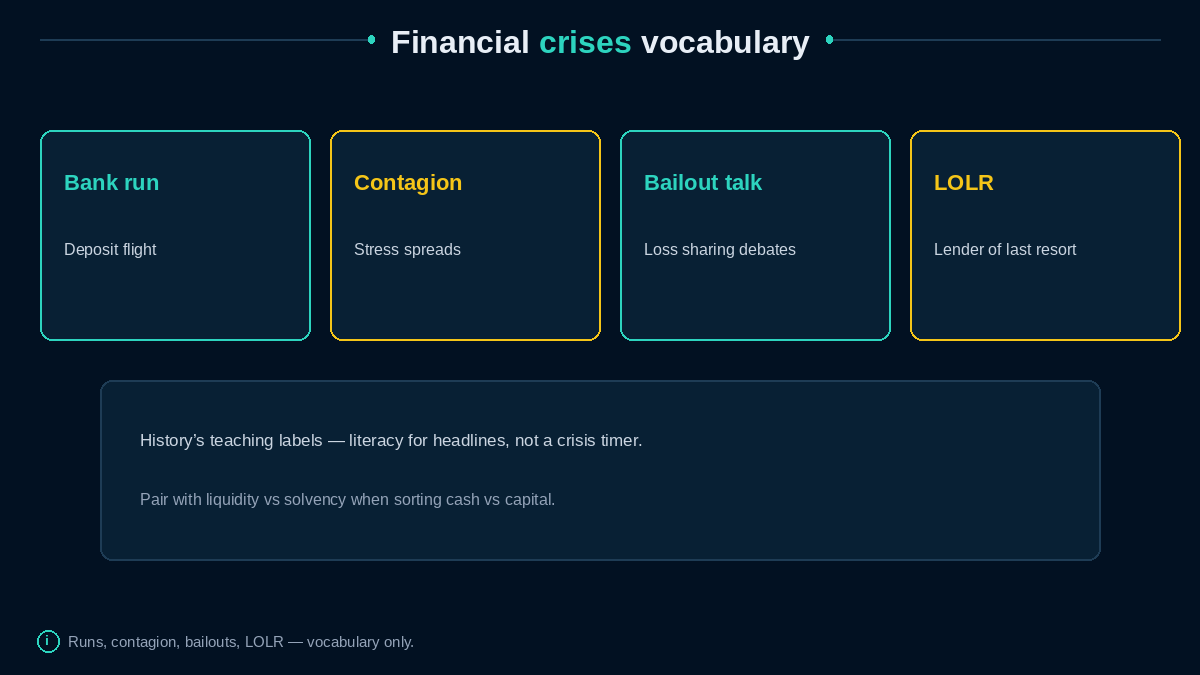
Diagram: Runs, contagion, bailouts, lender of last resort — labels, not a timer.
Why a vocabulary page
Crisis coverage is loud. Without shared words, every headline feels unique. With shared words, you can sort: Is this a run, contagion, a solvency hole, or political bailout debate? Pair with Liquidity vs solvency first—cash timing vs capital shortfall.
Core labels
Bank run — Depositors or short-term creditors rush for the exit because they fear others will. Even solvent institutions can break if funding vanishes overnight.
Contagion — Stress spreads across banks, markets, or countries through linkages, fire sales, or pure fear.
Bailout talk — Debates about public support, guarantees, or loss-sharing. The word is politically charged; treat it as a label for a policy debate, not a moral verdict this site issues.
Lender of last resort (LOLR) — Central-bank teaching role: lend against collateral to illiquid but (hopefully) solvent institutions in a panic (The Fed toolkit, Fed balance sheet and reserves).
Related: Credit cycles, Debt and leverage, Financial conditions.
Feedback and fire sales
Forced selling hits prices, which hits collateral values, which tightens credit—classic adverse feedback (Bubbles and feedback loops). Long-term debt-cycle templates zoom out further (Long-term debt cycles) without dating your calendar.
Common confusions
- “Every drawdown is a crisis.” Volatility ≠ systemic crisis vocabulary.
- “LOLR fixes insolvency.” Liquidity tools do not erase capital holes.
- “Bailout always means equity holders win.” Structures differ; politics differ.
- “Learning crisis words predicts the next one.” Literacy ≠ prophecy.
In practice
Translate a screaming headline into three boxes: liquidity, solvency, policy response. If only one box is filled, say so. Use Risk, luck, and narratives to resist neat storytelling that overfits one episode.
Cross-border versions often involve sudden stops (Capital flows for beginners) and dollar funding (Emerging markets and the dollar).
Shadow-banking and nonbank intermediaries complicate classic run maps: money funds, repo, and other short-term funding vehicles can experience run-like dynamics without retail deposit branding (Overnight RRP plumbing, Money and banking). The vocabulary still helps—flight from runnable claims—even when the legal form differs.
Resolution regimes (who takes losses, in what order) are part of modern crisis literacy. You need the idea that equity, wholesale creditors, insured depositors, and taxpayers sit in different loss stacks—without this page adjudicating fairness in a live case.
International lenders-of-last-resort and swap lines appear in global dollar stress teaching cases (Emerging markets and the dollar, Global central banks at a glance).
Accounting identities do not panic; people and runnable claims do. That human coordination problem is why crisis vocab emphasizes runs and contagion alongside balance-sheet arithmetic.
Watch for in headlines: run, contagion, bailout, and emergency-lending words. Sort liquidity vs solvency first, then match the label to the mechanism.
How this connects
- Liquidity vs solvency · Credit cycles
- Debt and leverage · Money and banking
- Bubbles and feedback loops · The Fed toolkit
Related reads
Telegram
Funding-stress vocabulary days: Join Macro Simplified.