
Policy uncertainty as a shock
Educational only. This primer treats policy uncertainty as a macro shock channel. It is not election horse-race coverage, not partisan campaigning, and not advice to trade polls or prediction markets.
Site vs Telegram
Evergreen shock framing lives here. When rule-change headlines move markets, Telegram carries calm context: Macro Simplified on Telegram.
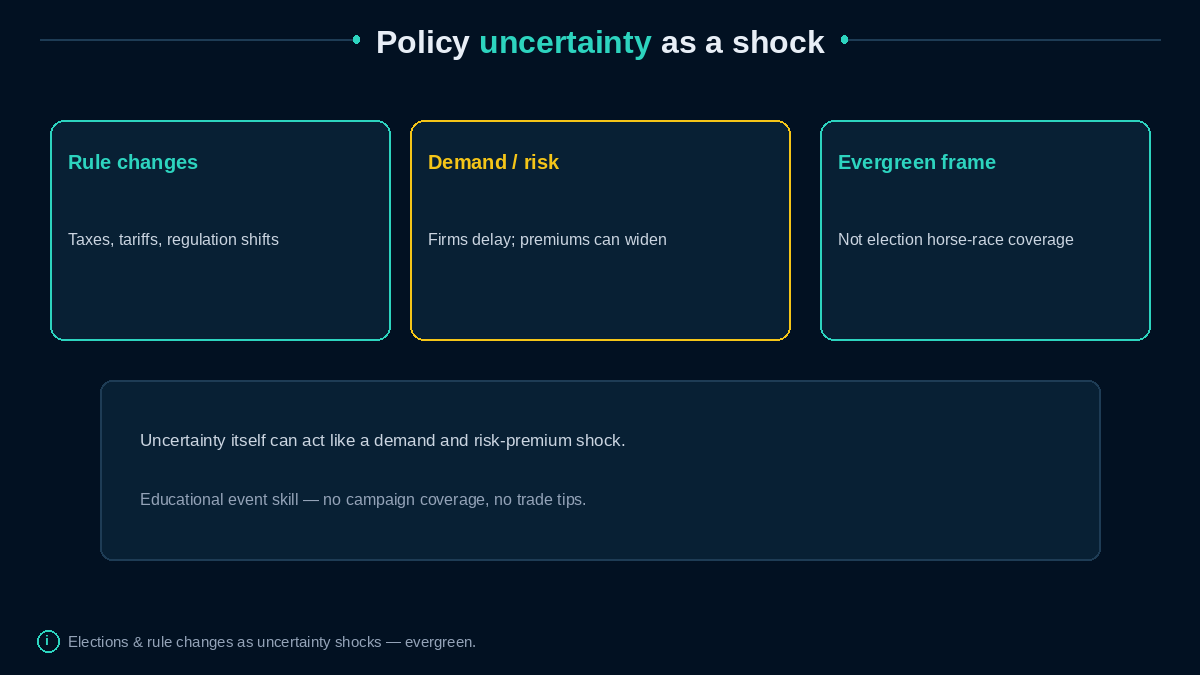
Diagram: Uncertainty itself can delay spending and widen premiums — no campaign coverage.
Uncertainty as the shock
Sometimes the news is not only a new tax, tariff, or regulation—it is that firms and households cannot tell which rules will stick. That fog can delay hiring and capex (Investment and capital spending), soften demand, and widen risk premiums (Geopolitics and risk premiums, Financial conditions).
In teaching language, uncertainty acts like a demand drag and/or a risk-premium shock, even before the final rule is known (Demand shocks vs supply shocks).
Where it shows up
- Tax and spending rule fights
- Trade and tariff regimes (Tariffs as a macro shock)
- Regulatory and sanctions shifts
- Election seasons as uncertainty episodes—without this site handicapping candidates
Central-bank reaction functions can also feel unclear after mixed guidance (Reading the Fed, Priced in / expectations).
Evergreen rules for this page
- No candidate rankings
- No “who will win” framing
- No trade on polls
- Translate politics into: what rule might change, for whom, with what timing uncertainty?
Common confusions
- “Uncertainty means always sell risk.” Not a rule we teach.
- “If a decision lands, uncertainty is zero.” Implementation and reversal risk remain.
- “Only elections create policy uncertainty.” Rule changes happen anytime.
- “This primer is campaign content.” Opposite of the design.
In practice
Rewrite a political headline into a shock worksheet: channel (demand / supply / premium), horizon, and what resolution would look like. Then use the Event playbook for process—not prediction-market theater. Pair with Risk, luck, and narratives so stories do not outrun evidence.
Fiscal–monetary tension language may appear nearby (Fiscal dominance vocabulary, Central bank independence)—keep definitions distinct from campaign noise.
Measured uncertainty indexes exist in research (news-based or survey-based). You do not need to trade them. Knowing they exist reinforces that “uncertainty” can be discussed as an economic object, not only a vibe (Sources and habits).
Capex surveys citing “wait and see” are qualitative cousins of the same shock. Hiring freezes ahead of rule clarity fit too (Labor force participation context). Resolution can itself be a positive shock even if the chosen rule is imperfect—because the fog lifts.
Keep election seasons inside this evergreen frame: the macro object is unclear future rules, not team jerseys. If a sentence needs a partisan cheer to work, it does not belong on Macro Simplified.
Implementation timelines matter: a law passed but not yet effective can keep uncertainty elevated. Watch effective dates, agency rulemaking, and court challenges as part of the fog—not as trading catalysts recommended here.
Watch for in headlines: delayed capex cited to unclear rules, election-season fog framed as risk-off, and tariff threats as uncertainty before they become relative-price shocks. Keep it evergreen and non-partisan.
How this connects
- Demand shocks vs supply shocks · Geopolitics and risk premiums
- Tariffs as a macro shock · Event playbook
- Investment and capital spending · Priced in / expectations
Related reads
- Event playbook
- Demand shocks vs supply shocks
- Geopolitics and risk premiums
- Risk, luck, and narratives
- Glossary
Telegram
Rule-change and uncertainty headlines: Join Macro Simplified.