
Saving, investment, and the financial system
Educational only. How saving meets investment through banks and markets—loanable-funds intuition without jargon overload. Not financial advice, not a forecast, and not a recommendation to buy, sell, or hold any asset.
Site vs Telegram
Durable primers live here. Live headline decoding belongs on Telegram: Macro Simplified on Telegram.
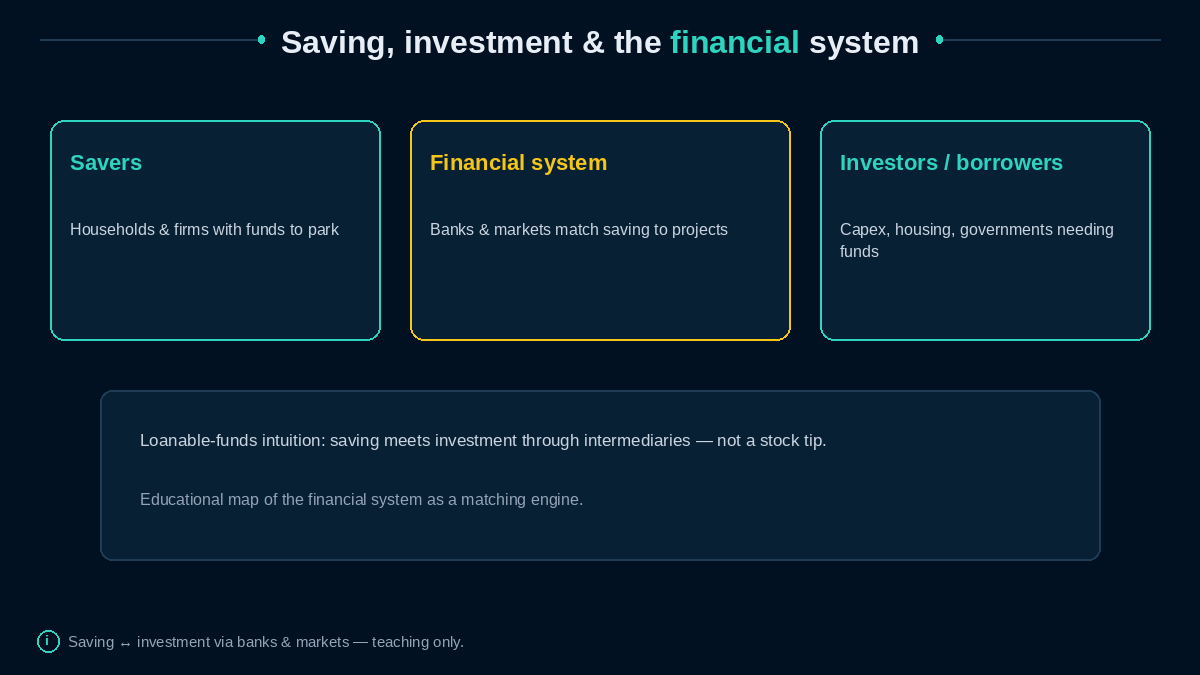
Diagram: Savers meet borrowers through banks and markets — matching engine, not a stock tip.
The matching problem
Households and firms that earn more than they spend create saving. Other households, firms, and governments want funds for homes, factories, inventories, or public projects—investment in the national-accounts sense (Investment and capital spending, Consumption and saving).
The financial system—banks, bond markets, equity markets, and related intermediaries—helps match savers to productive (and sometimes unproductive) uses of funds. In beginner textbook language this is often called loanable-funds intuition: desired saving and desired investment meet at a real interest rate, other things equal. Reality is richer—credit standards, risk, regulation, and global flows all matter—but the matching picture is the right starting map.
Banks vs markets (light)
Banks take deposits and make loans, transforming short-term liquid claims into longer, riskier credits (Money and banking). Markets let savers buy bonds or equity directly. Most modern economies use both. When banking freezes, market funding can seize too—and vice versa (Liquidity vs solvency, Credit cycles).
Interest rates and risk premia are the “prices” that help allocate funds. Policy rates influence the short end of that price system (Monetary policy transmission); longer yields fold in growth, inflation, and term premium stories.
Open-economy footnote
Saving need not equal domestic investment dollar-for-dollar when capital flows across borders (Capital flows for beginners, Trade and the balance of payments). A country can invest more than it saves by importing capital—or save more than it invests and export capital. That is accounting identity language, not a moral score.
Common confusions
- “Investment means I bought stocks.” In GDP, investment is mostly capex, inventories, and housing build.
- “Banks just warehouse cash.” They create credit within constraints—see money-and-banking literacy.
- “Financial system = casino only.” Matching and risk allocation are real functions; excesses are a separate critique (Bubbles and feedback loops).
- “This page picks funds or banks.” It does not.
In practice
When a headline says “credit is tight,” ask whether savers are scarce, intermediaries are constrained, risk appetite fell, or all three. That question links this primer to Financial conditions without becoming a trade.
Interest rates help clear the market for funds, but so do non-price rationing tools: collateral requirements, covenants, and quantity caps when risk appetite falls. That is why “credit is available but only to pristine borrowers” can coexist with low policy rates. Savers may still find deposits and bonds even when loan officers pull back—another reminder that the financial system is a set of pipes with valves, not a single faucet labeled “the interest rate.”
Public borrowing also competes for private saving in textbook crowding-out stories; magnitudes are debated and depend on slack, monetary offset, and global inflows (Fiscal policy basics, Deficits, debt, and debt-to-GDP). Keep the competition idea as vocabulary, not as a one-line bond trade.
How this connects
- Consumption and saving · Investment and capital spending
- Money and banking · Credit cycles
- Interest rates and yields · GDP and measurement
Related reads
Telegram
Saving–investment and credit headlines: Join Macro Simplified.