
Consumption and saving
Educational only. This primer teaches household consumption and saving as GDP vocabulary. It is not personal-finance advice, not a budget product pitch, and not a forecast of retail sales.
Site vs Telegram
Durable explainers live here. When consumer-spending prints hit the wire, plain-English context belongs on Telegram: Macro Simplified on Telegram.
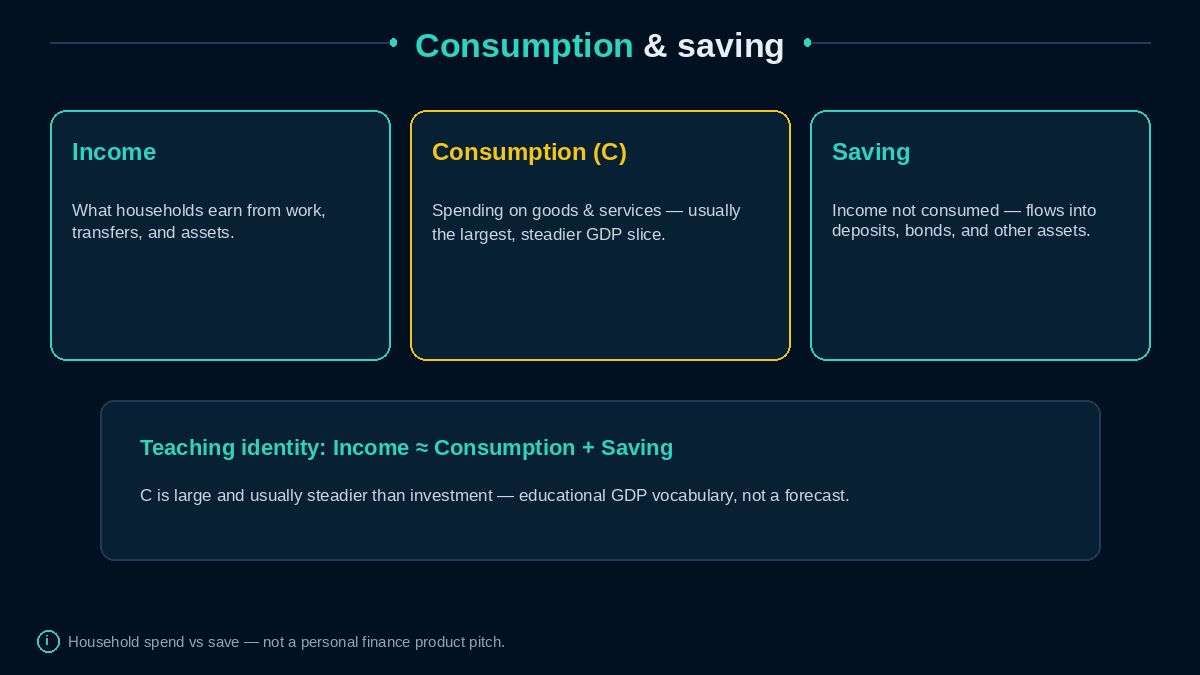
Diagram: Income ≈ consumption + saving — C as the large, usually steadier GDP slice.
The household split in one line
A teaching identity you can keep:
Income ≈ Consumption + Saving
- Consumption (C) — spending on goods and services (food, rent services, haircuts, cars, streaming).
- Saving — the part of income not consumed; it flows into deposits, bonds, retirement accounts, cash buffers, and other assets.
In the national accounts, consumption is usually the largest slice of GDP and often steadier than business investment. That is why “the consumer” shows up constantly in growth headlines. See GDP and measurement for the C+I+G+NX map.
Why C matters for macro readers
When growth is “led by consumers,” commentators are pointing at the C bucket. Soft retail or services spending narratives lean the other way. Consumption links to jobs and income (Jobs and growth), real purchasing power (Real vs nominal), and credit conditions that shape what households can borrow (Financial conditions, Credit cycles).
You do not need a consumption function equation. You need the habit: ask whether the story is about income, prices, credit, or confidence—then refuse to turn one retail print into a portfolio order.
Saving — the other side of the same coin
Saving rates can jump in crises (forced or precautionary) and fall when households spend more of each paycheck. Rising savings can fund investment through the financial system over time—a bridge you will meet again in later primers—but this page stays on the household split.
“Saving” in GDP talk is not identical to “I bought an index fund today,” though portfolio flows are one destination for saved income. Keep the accounting idea first.
Common confusions
- “Consumption means stock-market consumption.” In GDP, C is goods and services spending—not equity turnover.
- “A high saving rate is always ‘good’ or always ‘bad.’” Context matters: repair vs demand drag.
- “If I learn C, I can time recessions.” Useful vocabulary; not a timer (Recession vocabulary).
- “This page tells me how much to save.” It does not—educational macro only.
In practice — reading a consumer headline
When a report says spending rose “despite higher rates,” translate: households may still spend if real incomes, jobs, or credit buffers support them—or the mix may shift from goods to services. Pair with Monetary policy transmission for how rates reach borrowers, and with Demand shocks vs supply shocks when prices, not only desire to spend, are the constraint.
Saving and consumption also show up in real terms: if prices jump faster than nominal incomes, real consumption can soften even when dollar spending looks firm (Real vs nominal). Credit-funded spending can keep C elevated for a while—and unwind when standards tighten (Credit cycles). Those footnotes keep the household split connected to the rest of the curriculum without turning this page into a budgeting app.
How this connects
- GDP and measurement · Investment and capital spending
- The multiplier effect · Jobs and growth
- Financial conditions · How to read macro
Related reads
Telegram
Consumer and retail-print days: Join Macro Simplified.