
Overnight RRP plumbing
Educational only. This primer explains the Fed’s overnight reverse repurchase (ON RRP) facility in plain English. It is not a cash-management product pitch and not a trade on facility usage.
Site vs Telegram
Facility maps live here. When ON RRP usage spikes in the news, calm context belongs on Telegram: Macro Simplified on Telegram.
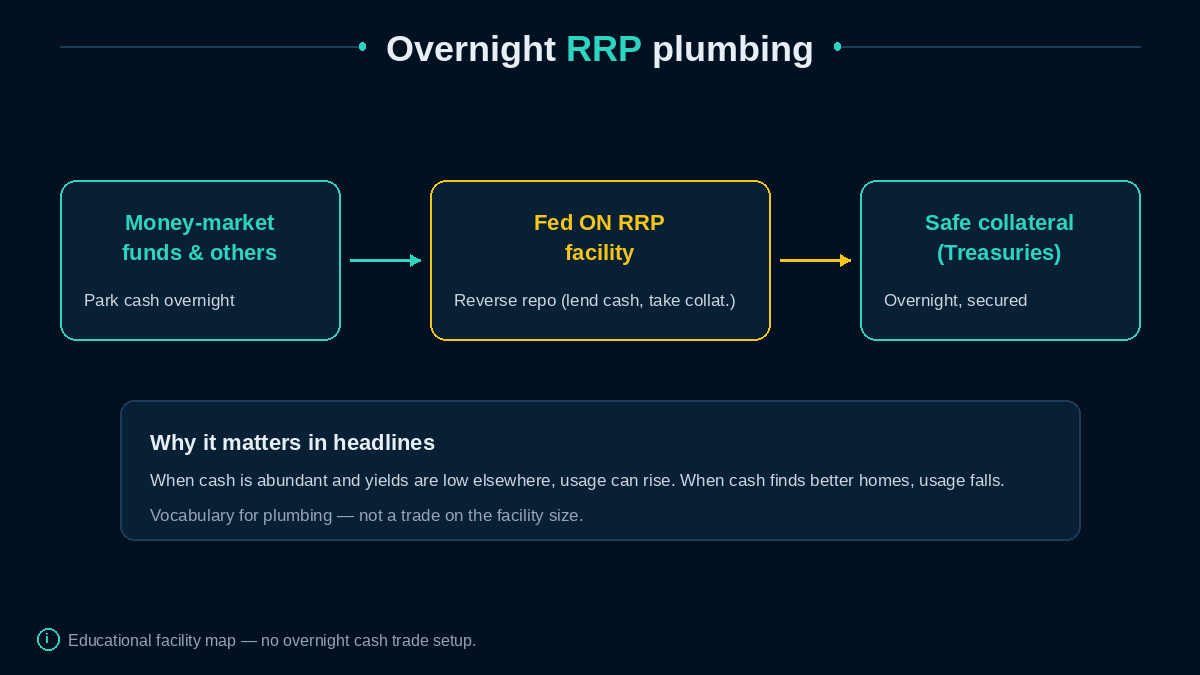
Diagram: Money-market cash → Fed ON RRP → Treasury collateral — plumbing map only.
What a reverse repo is (without the jargon fog)
In a repo, one party sells a security and agrees to buy it back later—effectively a secured loan. A reverse repo from the Fed’s point of view is the other side: the Fed takes in cash overnight and provides Treasury collateral.
The overnight RRP (ON RRP) facility lets eligible counterparties (notably many money-market funds) place cash at the Fed overnight at a set offering rate, secured by Treasuries. In plain language: a safe overnight parking spot for wholesale cash.
The offering rate on the facility is one of the administered rates that help keep overnight market rates near the Fed’s target range. It sits in the same toolkit family as interest on reserves—tools for a world with ample liquidity rather than scarce-reserve fine-tuning alone. See Fed balance sheet and reserves.
Why cash parks there
Usage tends to rise when:
- There is abundant cash looking for a home
- Other short-term yields are not more attractive after risk and convenience
- Money funds prefer a Fed facility to private alternatives at the margin
Usage tends to fall when cash finds better homes—Treasury bills, private repo, or deposit alternatives—depending on the rate landscape. Quarter-ends and settlement quirks can also nudge usage around. None of that is a retail “park here” instruction; it is wholesale plumbing.
How it sits next to reserves
Bank reserves live on the liability side of the Fed’s sheet as bank deposits at the Fed. ON RRP balances are also a Fed liability—but held by nonbank counterparties. Shifts between reserves and ON RRP can rearrange who holds Fed liabilities without changing the headline story of “ample liquidity” in a simple one-line way.
That is why charts of ON RRP take-up show up in the same blogs as reserve-level charts. They are sibling plumbing gauges. Pair them with QE and QT explained when the balance sheet is expanding or shrinking.
Reading headlines calmly
When a headline says “ON RRP hits a new high,” ask:
- Is cash abundant relative to private short-term assets?
- Did administered rates or bill supply change the relative attractiveness of the facility?
- Is anyone claiming a crisis without showing stress in other overnight rates?
Often the story is mechanical. Sometimes it is a stress footnote. This site teaches you to sort those stories—not to trade the facility size.
Common confusions
- “ON RRP is QE.” No. QE buys assets and creates reserves. ON RRP is an overnight facility for parking cash.
- “Rising ON RRP always means crisis.” High usage can simply mean abundant cash and an attractive facility rate—context required.
- “I should trade the facility size.” This site never turns plumbing charts into buy/sell rules.
- “ON RRP sets my savings-account rate.” Retail deposit rates are a different chain. Wholesale facilities shape the corridor money-market rates trade in.
How this connects
- SOFR vs federal funds — overnight rate family
- Interest rates and yields — where short rates sit in the ladder
- Financial conditions — liquidity as mood context
- The Fed toolkit — tools at a glance
Related reads
Telegram
Money-market plumbing headlines: Join Macro Simplified.