
Real vs nominal
Educational only. This primer teaches the real-vs-nominal lens. It is not wage advice, bond advice, or a signal to buy or sell anything.
Site vs Telegram
Durable definitions live here. Live inflation and rates decoding belongs on Telegram: Macro Simplified on Telegram.
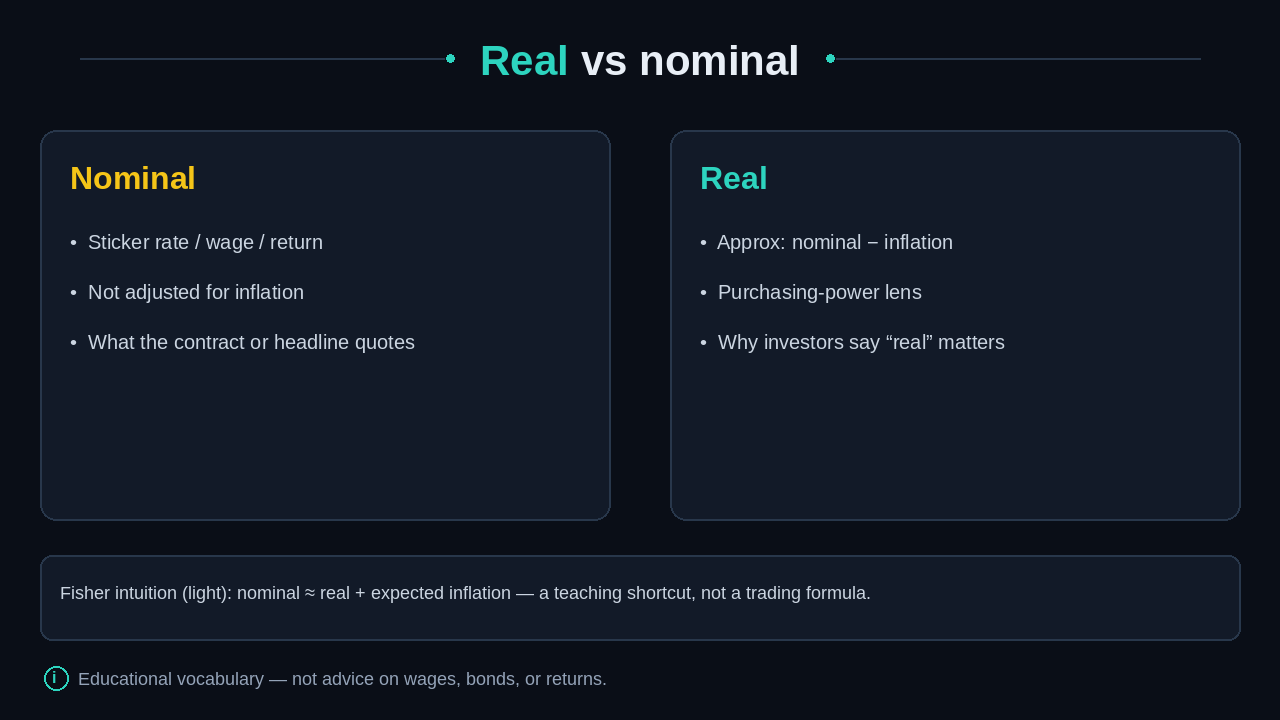
Diagram: sticker numbers vs purchasing-power lens — vocabulary only.
The one-sentence distinction
- Nominal — the sticker number: the wage on your contract, the interest rate quoted on a loan, the percentage return before inflation.
- Real — that number after adjusting for inflation (or expected inflation), so you can ask what happened to purchasing power.
If prices rose 4% and your wage rose 3%, your nominal wage is up and your real wage is roughly down. Same arithmetic habit applies to rates and many returns.
Why investors care about “real”
Markets and policy debates often care about whether people and firms are being compensated after inflation:
- A 5% deposit rate feels different when inflation is 2% than when inflation is 6%.
- Bond talk frequently shifts from nominal yields to real yields / real rates.
- Growth scoreboards prefer real GDP over nominal GDP for quantity comparisons (GDP and measurement).
This is a lens, not a portfolio recipe. For inflation measures themselves, stay with Inflation 101. For market-implied inflation stories, continue to Real rates and inflation expectations.
Fisher intuition (light)
A classroom shortcut—the Fisher idea in plain English—says roughly:
nominal interest ≈ real interest + expected inflation
It is a teaching approximation, not a law you trade. Expectations, risk, and taxes complicate the real world. Use it to ask better questions (“is this rate move about inflation fears or about real-rate fears?”), not to mint signals.
Everyday examples (no advice)
| Situation | Nominal view | Real-flavored question |
|---|---|---|
| Wage raise | “I got +3%” | “Did prices rise more or less than 3%?” |
| Savings rate | “Account pays 4%” | “What is 4% after expected inflation?” |
| Bond yield | “Yield is 4.5%” | “What does that imply after inflation/breakevens?” |
Cash, stocks, and bonds play different roles across inflation and rate backdrops—roles as vocabulary, not allocations: Cash, stocks, and bonds.
Next reads
- Inflation 101 — the price side of the adjustment
- Real rates and inflation expectations — breakevens and TIPS vocabulary
- Interest rates and yields — nominal market yields
- Bonds for beginners — price/yield intuition
- Glossary — real rate, real yield, TIPS
Related reads
- Inflation 101
- Interest rates and yields
- GDP and how we measure the economy
- Cash, stocks, and bonds
- Glossary
Telegram
Inflation and rates prints: Join Macro Simplified.