
GDP and how we measure the economy
Educational only. This primer teaches measurement vocabulary. It is not a GDP forecast, not a recession call, and not advice to buy or sell anything.
Site vs Telegram
Measurement explainers live here. When a GDP release hits the wire, plain-English context belongs on Telegram: Macro Simplified on Telegram.
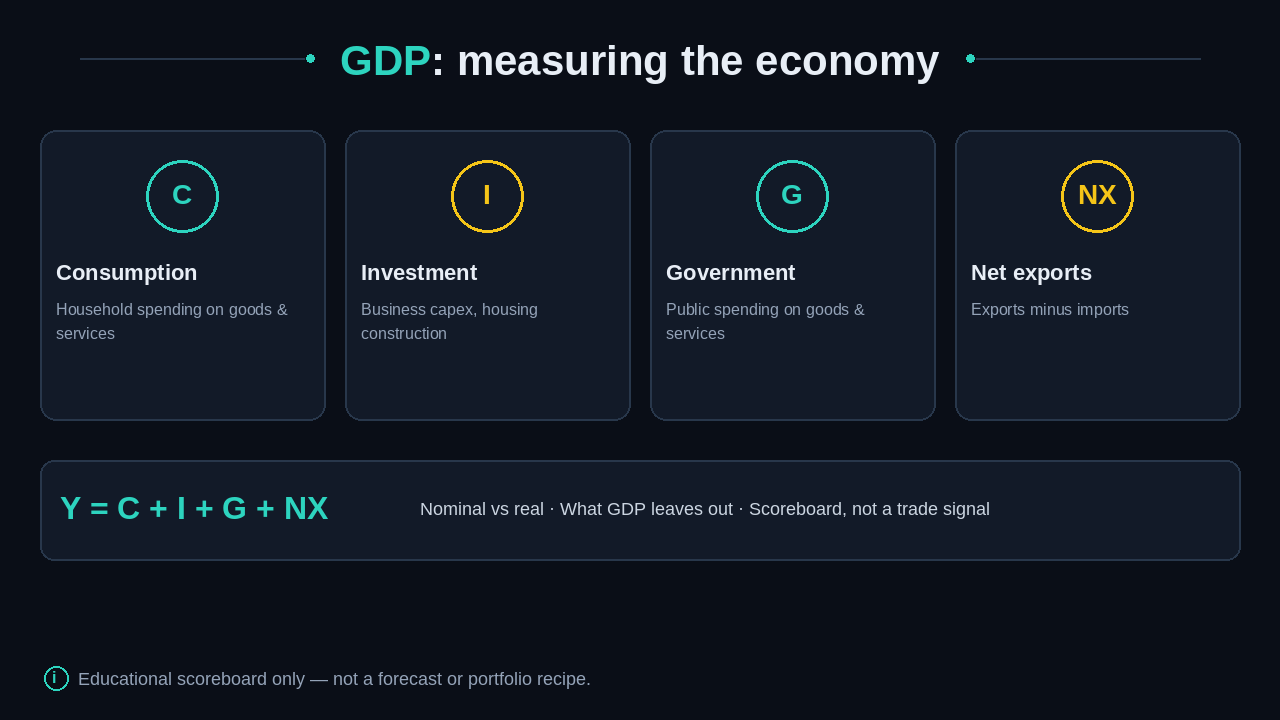
Diagram: GDP as C + I + G + NX — scoreboard vocabulary, not a trade signal.
What GDP is trying to count
GDP (gross domestic product) is the broadest common scoreboard for the market value of final goods and services produced inside an economy over a period—usually a quarter or a year.
Think of it as a production and spending map, not a happiness index and not your personal budget. When headlines say “the economy grew 2%,” they are usually pointing at real GDP growth (more below).
Official U.S. GDP is published by the BEA. For calm source habits, see Sources and habits.
Nominal vs real GDP
Two labels show up constantly:
- Nominal GDP — valued at current prices. If prices rise a lot, nominal GDP can look strong even when quantities barely moved.
- Real GDP — adjusted with a price index so you can compare volumes over time. This is the growth number most people mean in “how fast is the economy growing?” talk.
A cousin phrase is potential GDP—a teaching estimate of what the economy could sustainably produce without overheating. You will meet it again in Long-run growth and productivity.
The C + I + G + NX intuition
A classic teaching identity splits spending into four buckets:
| Letter | Name | Plain-English intuition |
|---|---|---|
| C | Consumption | Households buying goods and services |
| I | Investment | Business capex, inventories, and housing construction (not “I bought stocks”) |
| G | Government | Public spending on goods and services (not transfer checks counted the same way) |
| NX | Net exports | Exports minus imports |
You do not need to memorize every accounting quirk. You need the habit: when a headline says growth was “led by consumers” or “dragged by trade,” it is pointing at one of these buckets. Trade detail deepens in Trade and the balance of payments. Fiscal spending language sits in Fiscal policy basics.
What GDP leaves out (and why that matters)
GDP is powerful and incomplete. It does not fully capture:
- Unpaid household work and many informal activities
- Distribution — a rising average can hide uneven outcomes
- Environmental depletion or leisure
- Underground activity that never shows up in books
So treat GDP as a useful scoreboard, not a moral report card or a complete map of welfare. For cycle language around expansions and contractions, see Business cycle and Recession vocabulary.
Why investors still watch it (context only)
GDP helps frame the growth dial in How to read macro. Strong or soft growth stories feed debates about earnings, rates, and risk mood—but a single GDP print is quarterly, revised, and often less market-moving day-to-day than CPI or payrolls.
This site never turns a GDP headline into a buy/sell instruction. Use it as vocabulary for Jobs and growth and for asking whether a story is about demand, supply, or both (Demand shocks vs supply shocks).
Next reads
- Jobs and growth — labor pulse beside the GDP scoreboard
- Business cycle — where measurement meets cycle labels
- Growth and productivity — potential output and living standards
- Trade and the balance of payments — the NX bucket in more depth
- Glossary — GDP, potential GDP, BEA
Related reads
Telegram
GDP days and related prints: Join Macro Simplified.