
Global central banks at a glance
Educational only. A comparative skim of major central banks. Not a rate-call board, not synchronized-hike advice, and not a forecast of any meeting.
Site vs Telegram
Comparative literacy lives here. When global CB decisions stack in one week, use Telegram: Macro Simplified on Telegram.
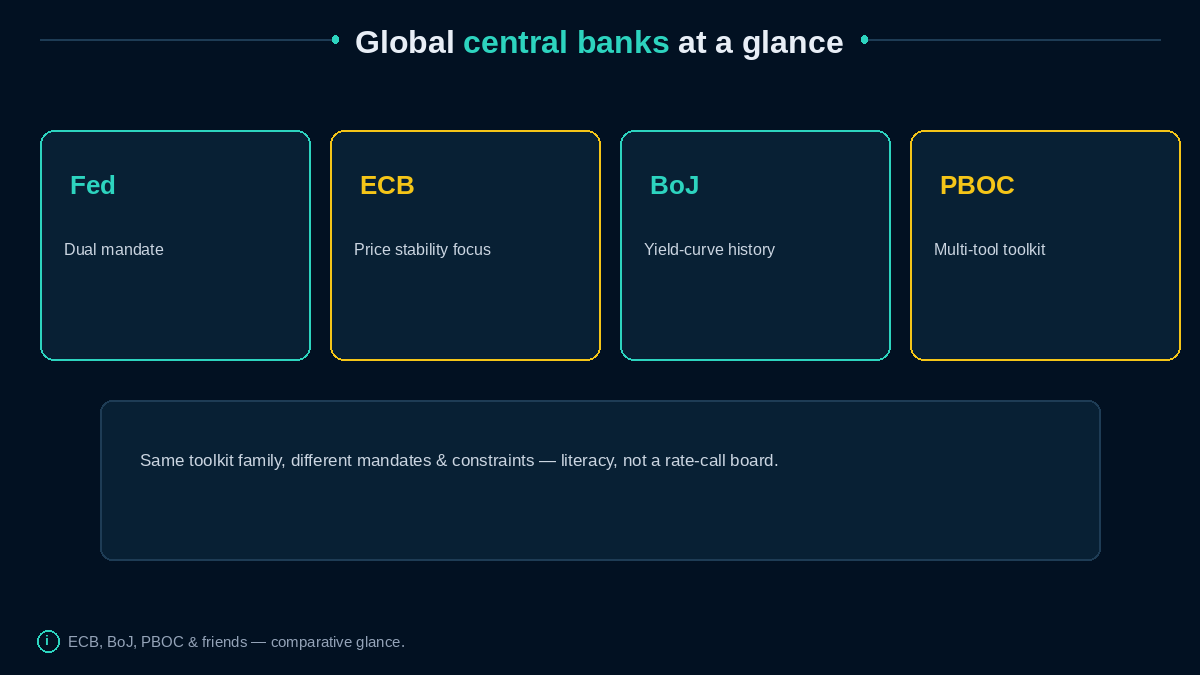
Diagram: Same toolkit family, different mandates — literacy glance, not a call sheet.
One toolkit family
Most modern central banks share a recognizable toolkit: policy rates, balance-sheet operations, lending facilities, and communication (The Fed toolkit, Monetary policy transmission). Mandates, politics, financial structures, and FX regimes differ—so outcomes differ (Central bank independence, Exchange-rate regimes).
Quick teaching sketches
- Fed (U.S.) — Dual mandate rhetoric; dollar at the center of global finance.
- ECB — Price-stability focused across a currency union; heterogeneous member economies.
- BoJ — Long history of low rates and yield-curve / balance-sheet experiments in teaching memory.
- PBOC — Multi-instrument toolkit inside a different financial and policy architecture; global spillovers via trade and commodities (China and global spillovers).
Others (BoE, SNB, RBA, EM central banks) matter too—this glance is a door, not an encyclopedia.
Why beginners watch more than one
Spillovers: if several large CBs tighten together, global financial conditions can firm more than any single hiking cycle implies. Divergences drive FX narratives (US dollar and FX). Still no “fade the ECB” instruction here.
Common confusions
- “All CBs have the Fed’s dual mandate.” Legal goals differ.
- “One hike abroad equals one hike at home.” Transmission differs by mortgage structure, FX regime, and credit culture.
- “PBOC is just like the Fed.” Instruments and governance differ—compare carefully.
- “A glance page replaces reading primary statements.” It does not (Sources and habits).
In practice
On a multi-CB week, list each decision, each guidance shift, and whether FX or commodities are the spillover story. Use Event playbook process discipline.
Mandate wording shapes communication: inflation-first frameworks sound different from dual mandates even when tools look similar (Dual mandate, Inflation expectations and anchoring). Currency-union constraints (ECB) differ from single-polity CBs; emerging-market CBs often juggle FX stability more visibly.
Balance-sheet footprints also differ: some CBs hold more foreign reserves; some ran larger QE relative to GDP. Comparative size talk is literacy—not a “whose QE wins assets” contest (QE and QT explained).
When several CBs pivot together, global risk mood can swing harder than domestic mortgage rates alone imply. Still refuse synchronized trading rules on this educational site (Risk assets 101).
Primary sources beat secondary summaries: read the home-language or official English statements when stakes are high. A glance page prepares your questions; it does not replace the statement (Sources and habits).
Watch for in headlines: multi-CB weeks, divergent guidance, and FX moves framed as policy gaps. Compare mandates and constraints—then refuse a single synchronized trade idea.
Swap lines, reserve management, and macroprudential tools sit in the broader toolkit family even when the policy rate grabs headlines. Knowing they exist keeps you from treating every CB as a single dial. Comparative literacy is preparation, not prediction.
How this connects
- The Fed toolkit · Central bank independence
- US dollar and FX · Emerging markets and the dollar
- China and global spillovers
Related reads
Telegram
Global CB decision weeks: Join Macro Simplified.