
Commodities and the dollar
Educational only. This page teaches how oil, gold, and other commodity headlines fit macro conversation alongside the U.S. dollar. It is not a recommendation to buy or sell oil, gold, crypto, FX, or any commodity product, and not a price-target note.
Site vs Telegram
Commodity-and-dollar context stays here. Live FOMC/CPI/NFP decoding: Macro Simplified on Telegram.
Commodity tickers move for many reasons—weather, wars, cartels, industrial demand, speculation. Macro readers mainly need two habits: (1) notice when a commodity headline is really about inflation or growth dials, and (2) notice when the dollar is part of the story. Pair this page with US dollar and FX.
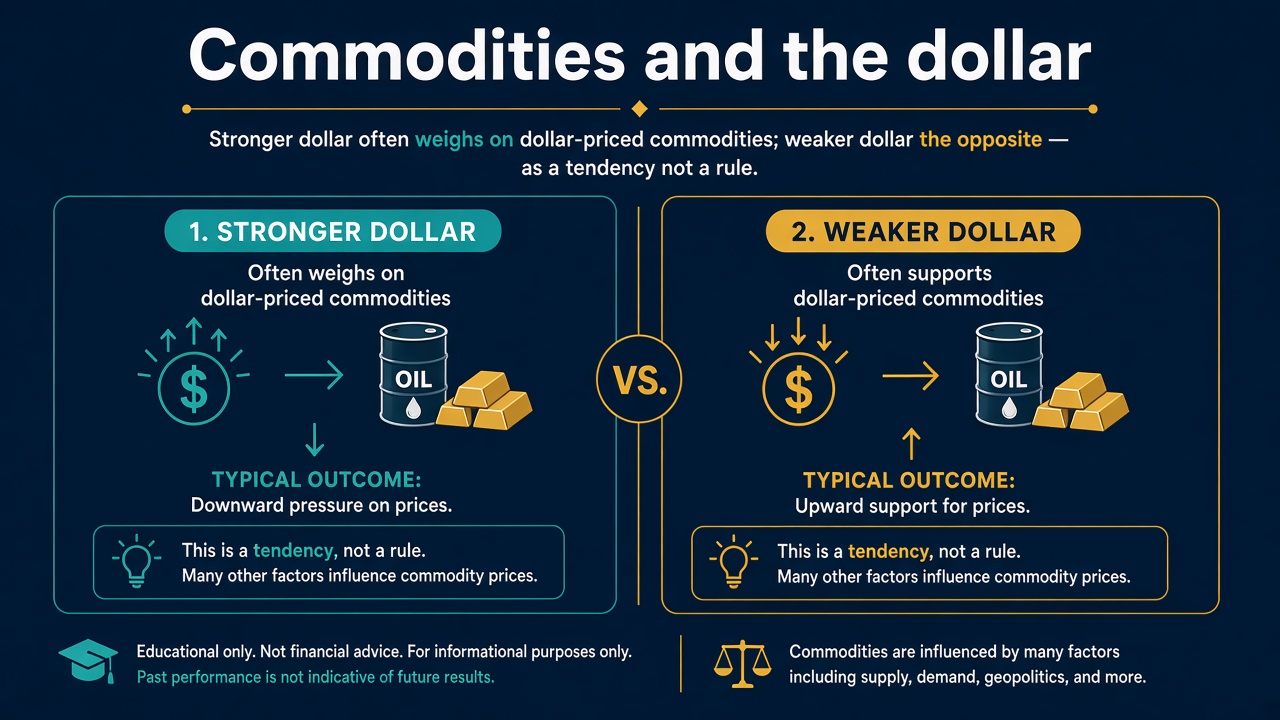
Diagram placeholder: commodities vs dollar context — educational map only, not a trading dashboard.
Why commodities show up in macro news
Oil and energy feed directly into headline inflation baskets and into everyday gasoline prices people feel. A sharp oil spike can lift CPI headlines even when “core” measures (excluding food and energy) tell a different story—see Inflation 101. Energy also affects growth: very high prices can act like a tax on consumers and firms; very low prices can ease that burden but hurt producers.
Industrial metals often travel in growth conversations—stronger manufacturing demand stories vs soft-demand stories. They are noisy and global; treat them as clues, not verdicts.
Gold shows up in inflation-hedge talk, rate talk (opportunity cost when yields rise), and risk-mood talk. Those narratives conflict with each other all the time. This site will not crown gold as “the” hedge or dismiss it. We only note why the headline writer reached for gold today.
Agricultural prices matter for food inflation and for specific economies; they are often more weather-and-supply than Fed-meeting in the short run.
The dollar link (plain English)
Many commodities are priced in U.S. dollars on global markets. A common teaching shorthand:
- When the dollar strengthens, a given dollar price can feel more expensive in other currencies—sometimes weighing on demand outside the U.S., all else equal.
- When the dollar weakens, the opposite relative-price story appears in many textbooks and newsletters.
“All else equal” does a lot of work. Oil can rise with a strong dollar if a supply shock dominates. Gold can fall with a weak dollar if real yields jump for other reasons. Use the dollar as one context layer, not a master switch. DXY is newspaper shorthand—see DXY—not a trading pitch.
Rate differentials and risk appetite also drive the dollar (US dollar and FX). So commodity-dollar stories often loop back to the same four dials in How to read macro.
Inflation, “supercycle” talk, and careful wording
Media sometimes say commodity supercycle—a long phase of strong demand and elevated prices across many commodities. Treat that phrase as a storytelling label, not a scientific law and not a signal to load a basket. Cycles in commodities are messy; this site does not date supercycles or recommend positioning for them.
For CPI mornings, ask:
- Was the surprise in energy, food, or broader categories?
- Is the commodity move a one-month blip or part of a trend people are debating?
- How might the Fed’s inflation dial read this—and is that already priced in?
Those questions beat “oil up → buy/sell X.”
Soft assets vs hard assets (headline slang)
Broadcaster slang sometimes splits:
- Hard assets — physical or commodity-linked claims (gold, oil, real estate in some talks).
- Soft assets — financial claims more tied to paper markets and duration (long bonds, growth equities in some talks).
These are fuzzy marketing categories, not accounting terms. Useful only so you recognize the phrase; useless as an automatic allocation rule. See Cash, stocks, and bonds for role language without a recipe.
Crypto-curious note
Crypto headlines sometimes borrow gold’s “hard asset” rhetoric or oil’s risk-mood correlation stories. Correlations flip. Macro Simplified treats crypto primarily under risk assets and liquidity mood, not as a commodity primer. No coin picks here.
When you see a commodity headline next to a Fed or CPI story, ask one more teaching question: is the writer claiming a supply shock, a demand/growth story, or a dollar story? Naming the channel keeps you from treating every oil print as the same dial.
What we will never do
- No oil or gold price targets.
- No “buy commodities when the dollar falls” rules.
- No supercycle investment menus.
- No FX carry-trade ideas dressed up as education.
Related reads
| If you want… | Read |
|---|---|
| Dollar and DXY basics | US dollar and FX |
| CPI/PCE vocabulary | Inflation 101 |
| Risk mood framing | Risk assets 101 |
| Rates backdrop | Interest rates and yields |
| Conditions dial | Financial conditions |
Live decoding lives on Telegram
Site = durable primers. Telegram = live event decoding.