
Inflation 101
Educational only. This primer explains inflation concepts for learning. It is not financial advice, a forecast of the next print, or guidance to buy or sell anything.
Site vs Telegram
Durable explainers live here. When CPI or PCE hits the wire, the live walkthrough belongs on Telegram: Macro Simplified on Telegram.
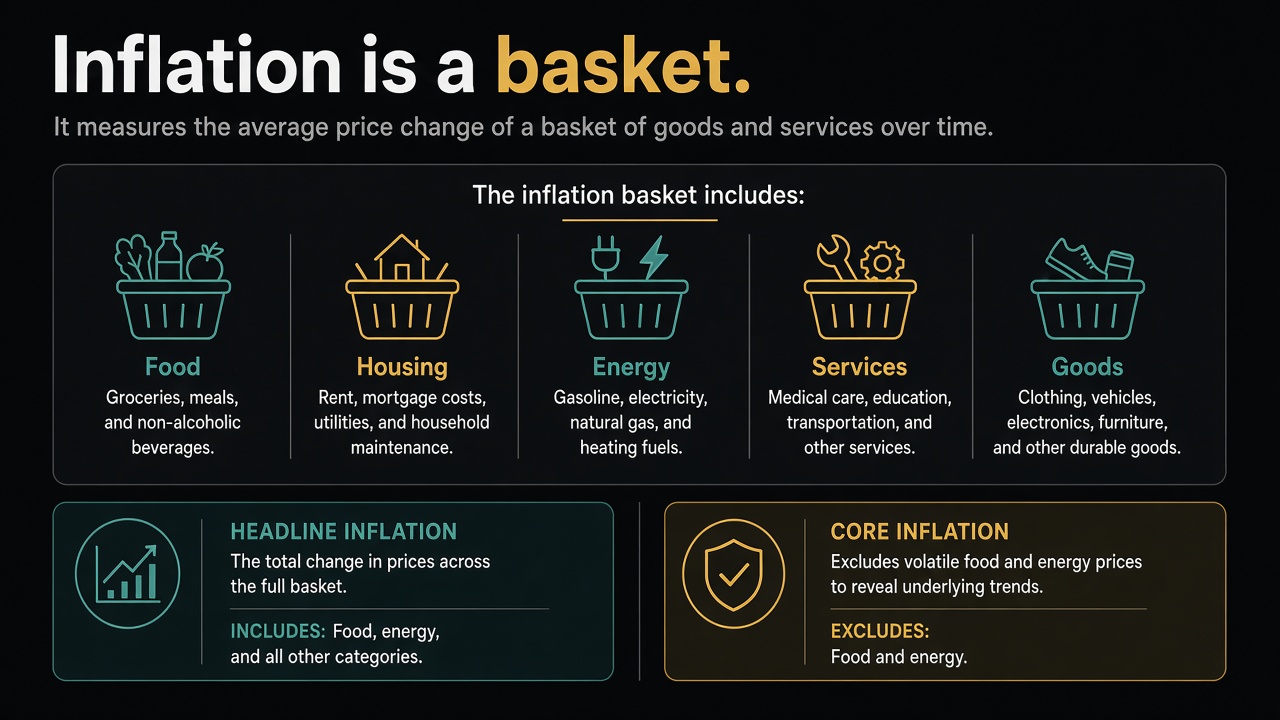
Diagram placeholder: inflation as a broad basket, not one viral price.
Inflation in daily life
Inflation means the general level of prices for goods and services is rising over time. In daily life it shows up as groceries that cost more than last year, a dinner out that feels pricier, or rent that resets higher at renewal.
A few calm distinctions help:
- One item getting expensive is not the same as inflation. Inflation is about the broad basket.
- A temporary spike (a supply shock that fades) can look loud in headlines and still settle.
- Your personal inflation depends on what you buy. Official indexes average across many households.
You do not need to become an economist to notice the feeling. The skill this site teaches is connecting that feeling to the numbers investors and the Fed watch—without turning every print into a prediction game.
How it’s measured (CPI, core CPI, PCE)
Three labels dominate U.S. inflation talk:
CPI (Consumer Price Index)
Published by the Bureau of Labor Statistics. It tracks the price of a fixed basket of goods and services that urban consumers buy—food, housing, energy, medical care, and more. Headline CPI includes food and energy, which can swing a lot month to month.
Core CPI (Core Consumer Price Index)
Same survey family, but food and energy are stripped out. The idea is to see underlying pressure without the noisiest categories. Core is not “more true” than headline; it answers a different question: what is happening underneath the volatile bits?
PCE (Personal Consumption Expenditures Price Index)
Published with the personal income and spending data. The Fed has long preferred PCE for its dual-mandate inflation goal. PCE weights shift with what people actually spend on, and it covers a slightly different mix than CPI. Headline and core PCE versions exist for the same reason as CPI.
You will also hear year-over-year (this month vs the same month last year) and month-over-month (this month vs last month). Both matter: year-over-year shows the bigger arc; month-over-month shows the freshest pulse and can be noisy.
For definitions you can deep-link later, see the Glossary entries for CPI, core CPI, and PCE.
Two simple stories (demand-pull vs cost-push)
Inflation does not have a single cause. Two classroom stories cover a lot of ground:
Demand-pull
Too much spending chasing too few goods. When demand runs hot—strong incomes, easy credit, big fiscal support—sellers can raise prices and still find buyers. In this story, cooling demand (including via higher interest rates) is the usual policy response people discuss.
Cost-push
Costs rise first—energy, shipping, wages in a tight labor market, disrupted supply chains—and firms pass those costs through. Here the “fix” is not only about demand; it is also about whether the cost shock fades or spreads into broader price-setting.
Real episodes often mix both. A supply shock can raise prices; if households and firms then expect ongoing inflation, behavior can keep pressure alive even after the original shock eases. You do not need to pick a team. You need a habit of asking: is this print mostly about demand, costs, or a bit of both?
Why investors watch it (context not playbook)
Inflation matters for markets because it sits inside the Fed’s dual mandate. Persistent high inflation can push the Fed toward tighter policy (higher rates, slower balance-sheet growth or QT). Cooling inflation can open room for easier policy—or for holding steady longer if other risks dominate.
That is context, not a playbook:
- A hotter-than-expected print does not automatically mean “sell everything.”
- A cooler print does not automatically mean “buy risk assets.”
- Markets care about the number relative to expectations, the details inside the report, and what it implies for the path of policy—not a single headline alone.
Crypto-curious readers often ask whether inflation “causes” crypto moves. Sometimes inflation news and liquidity/rate expectations move together with risk assets; sometimes they do not. Treat inflation literacy as a way to understand the macro weather—not as a timing rule. For that framing in more depth, see Risk assets 101.
Reading a print calmly
When CPI or PCE drops, try this sequence instead of refreshing a chart every second:
- What was expected? Know the consensus ballpark before the release (without treating consensus as truth).
- Headline vs core. Did food/energy drive the surprise, or was the underlying measure the story?
- Breadth. Were many categories firm, or just a few?
- Trend vs noise. One month is a data point. Several months start to look like a path.
- Policy implication, not position. Ask what this might mean for the Fed’s dual-mandate balance—then stop. Turning that into a trade is outside what this site does.
On print day, keep Event playbook open for process, and use Telegram for the live decode.
Next reads
- The Fed toolkit — how inflation feeds into rates and guidance
- Jobs and growth — the other half of the mandate
- Event playbook — how to sit with CPI day without chaos
- How to read macro — the habit layer behind every primer
- Glossary — CPI, core CPI, PCE, and friends
Related reads
Telegram
CPI and PCE days are decoded live on Telegram: Join Macro Simplified.