
Dual mandate
Educational only. This primer explains the Fed’s dual mandate in plain English. It is not a forecast of the next hike or cut, and not advice to position around FOMC meetings.
Site vs Telegram
Mandate vocabulary stays here. When officials weigh jobs vs inflation in live language, join Telegram: Macro Simplified on Telegram.
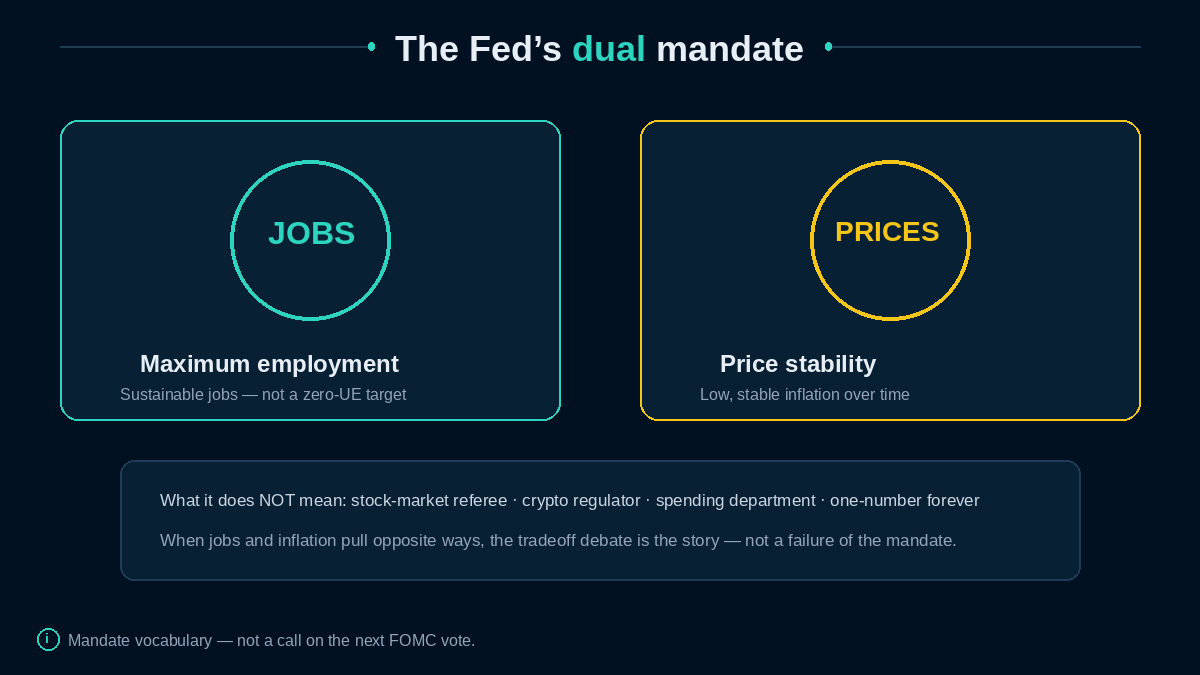
Diagram: Maximum employment and price stability — goals, not a stock-market referee.
What Congress assigned
The Federal Reserve’s Congressionally assigned dual mandate is usually summarized as:
- Maximum employment — the highest level of employment the economy can sustain without unwanted inflation pressure
- Price stability — low, stable inflation over time (the Fed has long described a 2% inflation goal in PCE terms)
Those two goals sit behind almost every serious conversation about the federal funds rate, the balance sheet, and forward guidance. See The Fed toolkit.
“Maximum employment” is not a promise of zero unemployment. Labor markets always have frictional churn—see Unemployment types. “Price stability” is not a promise that no individual price ever rises.
How the two goals interact
Sometimes jobs and inflation move in comfortable company: soft demand cools both activity and prices, or a healthy expansion keeps inflation near goal with solid employment.
Sometimes they pull in opposite directions—for example, when inflation is still high while the labor market looks firm, or when a supply shock lifts prices while activity struggles (Demand shocks vs supply shocks). That tension is why FOMC meetings feel consequential. Officials weigh risks to both sides of the mandate; markets debate which risk they are emphasizing.
This site does not score whether the committee “should” prioritize one side today. It teaches why the tradeoff language appears.
What the dual mandate is not
Drop these sticky myths:
- Stock-market referee — The Fed influences financial conditions; it does not exist to set equity prices.
- Crypto regulator — Different institutional lane.
- Fiscal authority — Spending and taxes are Congress and the administration (Fiscal policy basics).
- One-number forever — Mandates are goals pursued over time with imperfect data, not a single monthly print to hit exactly.
Reading mandate language in practice
When you hear “we need to see further progress on inflation” or “the labor market remains solid,” translate back to the two goals. Pair jobs prints with Jobs and growth, inflation prints with Inflation 101, and meeting days with the Event playbook.
Sticky services and shelter often dominate late-cycle inflation debates—see Sticky services and shelter inflation. Output-gap language (“slack” vs “overheating”) sits in Output gap and potential GDP.
In practice — one week, two dials
Imagine a hot CPI week beside a soft payrolls week (or the reverse). Mandate language will show up immediately: which risk is more salient for the next meeting? Your learning job is to label the dials—prices vs jobs—and to remember both remain in force even when markets obsess over one print.
Use How to read macro for the four-dial mental model and the Event playbook for process. Mandate literacy is knowing what the institution is aiming at, not predicting the vote count.
How this connects
- Tools that pursue the mandate: The Fed toolkit · Reading the Fed
- Prices half: Inflation 101 · Inflation regimes
- Jobs half: Jobs and growth · Unemployment types
- Mental model: How to read macro
Related reads
Telegram
FOMC / CPI / NFP through a mandate lens: Join Macro Simplified.