
Sticky services and shelter inflation
Educational only. This primer explains why services and shelter components often dominate inflation debates. It is not a CPI trade, not a rent forecast, and not advice on housing decisions.
Site vs Telegram
Inflation microstructure lives here. When a CPI print splits goods vs services vs shelter, live decoding is on Telegram: Macro Simplified on Telegram.
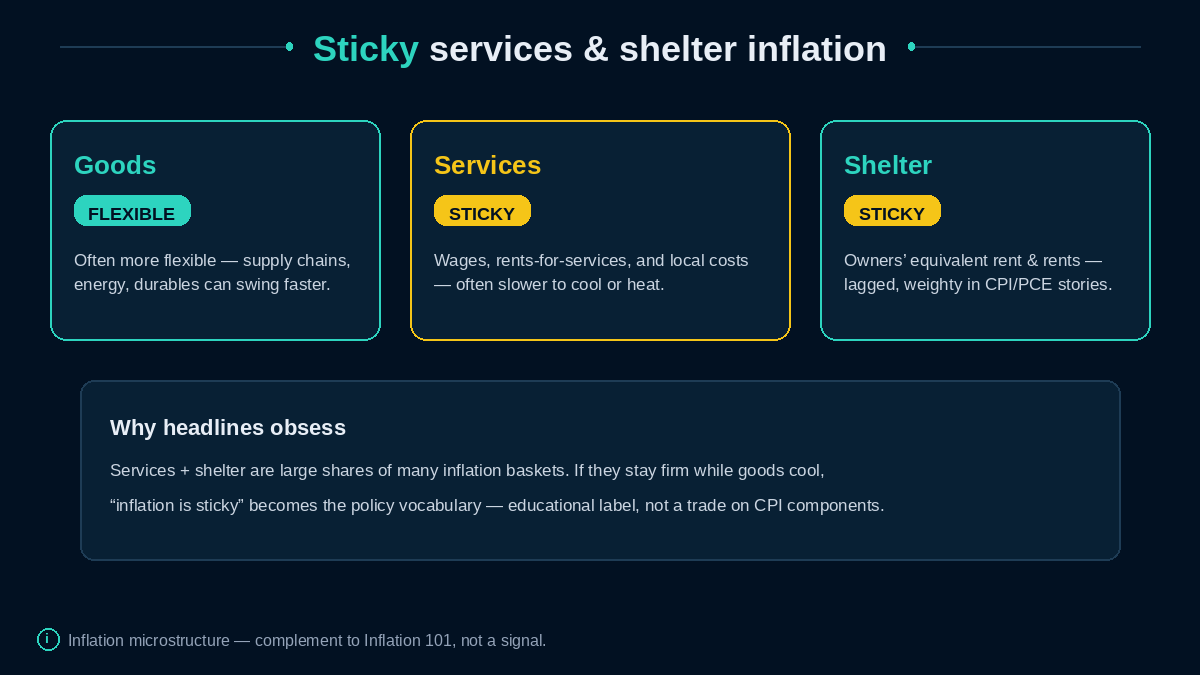
Diagram: Flexible goods vs stickier services and shelter — vocabulary for reading CPI/PCE.
Goods can swing; services often crawl
A helpful beginner split inside inflation baskets:
- Goods — durables, many commodities, items more exposed to global supply chains and energy. Prices can jump or cool relatively quickly when shocks hit.
- Services — haircuts, healthcare, restaurants, and many local services. Costs often lean on wages, rents for business space, and slower-moving local conditions.
When commentators say inflation is sticky, they often mean services (and shelter) are not cooling as fast as goods did after a shock. That is a description of components, not a trading slogan. Build the basics first in Inflation 101.
Shelter — heavy weight, lagged feel
In U.S. CPI and related measures, shelter (including rent of primary residence and owners’ equivalent rent) carries a large weight. Measurement is carefully designed—and famously lagged relative to what you might see in fresh lease listings.
So you can get a confusing-looking stretch where:
- New asking rents soften in private datasets, while
- Official shelter inflation in CPI/PCE still looks firm (or the reverse, with leads and lags)
The teaching takeaway: shelter is weighty and slow. Headline obsessiveness is partly math (weight) and partly policy (services/shelter as a read on underlying inflation). For housing-rates transmission—not rent calls—see Housing, mortgages, and rates.
Why policy debates fixate here
After energy and goods shocks fade, officials and markets often ask: is the remaining inflation mostly sticky services and shelter? That question feeds dual mandate debates and inflation regime labels (disinflation vs re-acceleration talk).
Supply-shock stories can still matter (Demand shocks vs supply shocks). Sticky does not mean “only demand” or “only wages.” It means slow-moving pieces with large basket weight.
Common confusions
- “Sticky inflation means every price is rising fast.” It usually points at which categories remain firm.
- “Owners’ equivalent rent is what I pay my landlord.” OER is a measurement construct for owner-occupied housing services—not your personal check.
- “If goods are cheap, inflation is solved.” Goods cooling helps; services/shelter can keep the debate alive.
- “This page tells me when to buy REITs.” It does not. Educational vocabulary only.
In practice — reading a CPI table
Open a CPI release summary and find major groups: food, energy, commodities less food and energy, services less energy, and shelter lines. Ask: what cooled, what stayed firm, and which firm pieces are heavy? That habit beats reacting only to the top-line percent.
Core measures strip food and energy to highlight underlying inflation—but core still includes sticky services and shelter. Headline vs core is a complement pair, not a rivalry. For calm source habits, bookmark BLS via Sources and habits.
How this connects
- Basket basics: Inflation 101 · Inflation regimes
- Mandate frame: Dual mandate · The Fed toolkit
- Event process: Event playbook · Priced in / expectations
- Sources: Sources and habits
Related reads
Telegram
CPI / PCE component days: Join Macro Simplified.