
Term premium
Educational only. This primer explains term premium as a teaching decomposition of long-term yields. It is not a bond trade, duration recommendation, or forecast of the next move in Treasuries.
Site vs Telegram
Yield-vocabulary primers live here. When long yields jump and commentators say “term premium,” calm context belongs on Telegram: Macro Simplified on Telegram.
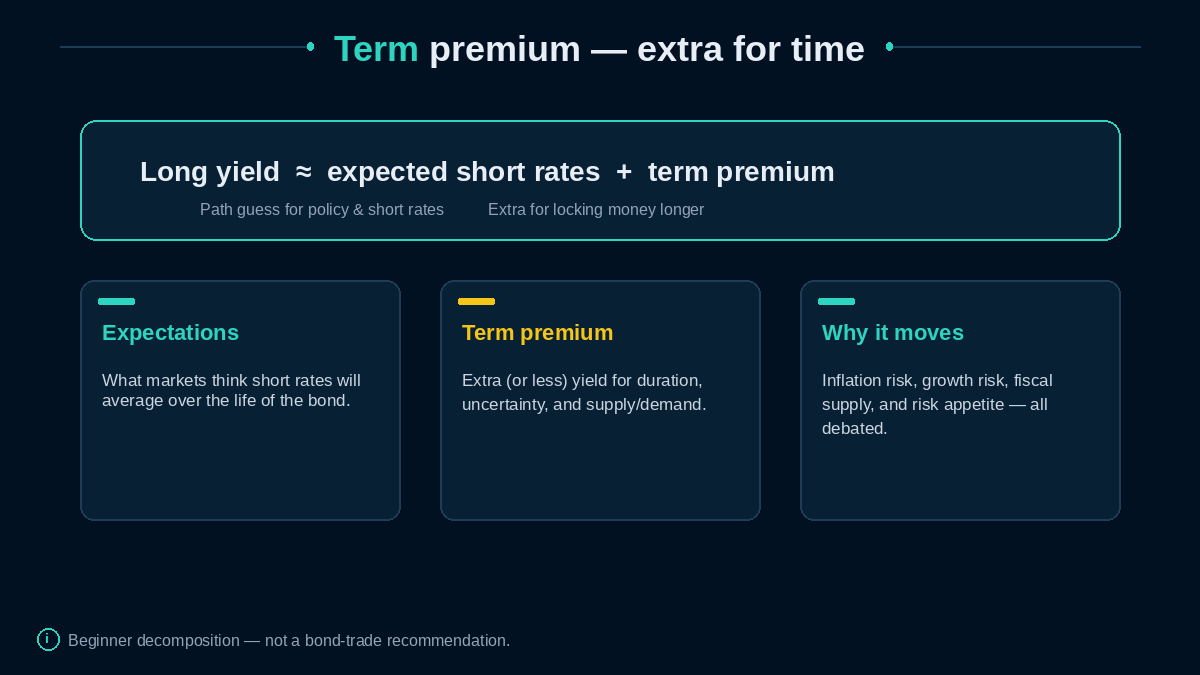
Diagram: Expectations path versus term premium — beginner decomposition, not a trade.
A simple equation to keep
A useful teaching split for a long-term bond yield is:
Long yield ≈ average expected future short rates + term premium
- Expected short rates — the market’s guess of where overnight / policy-related rates will average over the life of the bond.
- Term premium — the extra (or sometimes reduced) yield investors require for locking money up longer, bearing uncertainty, and absorbing supply/demand imbalances.
You will never see a perfect, official “the” term premium on a highway billboard. Economists estimate it with models. Treat the phrase as a way to organize debate, not as a single true number you must memorize.
Why locking money longer can demand extra yield
Holding a longer bond means more exposure to:
- Inflation turning out hotter than expected
- Growth or policy paths shifting
- Rate volatility along the way
- Shifts in who must absorb Treasury (or other) supply
That bundle of risks and frictions is what “term premium” gestures at. It can rise when uncertainty or supply worries grow, and fall when investors are eager to lock in duration (for example, in some flight-to-quality or strong demand episodes). History is rich; this page does not date the next swing.
Expectations vs premium — why the split helps
Suppose long yields rise. Two different stories (often mixed) are:
- Markets raised their guess of future short rates (policy will stay higher / inflate more).
- Markets demanded more extra yield for duration risk (term premium up) even if the path guess barely moved.
Commentators argue about which channel dominates. Your job as a learner is to hear both channels—not to pick a trade. Pair this with The yield curve for beginners and Interest rates and yields.
Common confusions
- “Term premium is the Fed funds rate.” No. Fed funds is the overnight policy anchor. Term premium is about longer yields’ extra component.
- “If term premium rises, always sell bonds.” This site does not give sell rules. A rising premium is a vocabulary label for a debate.
- “One model’s term premium is gospel.” Estimates differ. Use the concept; don’t overfit a chart.
- “QE killed term premium forever.” Balance-sheet policy can influence premiums in some regimes (QE and QT explained); it is not a permanent off switch.
In practice — reading a yield move
When the 10-year yield jumps on an otherwise quiet day, ask which story dominates in the commentary:
- Did fed-funds futures or the dot plot conversation shift (expectations channel)?
- Did speakers emphasize uncertainty, issuance, or risk appetite (premium channel)?
- Did both move together?
You will rarely get a clean laboratory split in real time. The win is noticing that “yields up” is not one story. Pair speeches with Reading the Fed and keep Bonds for beginners open for price–yield intuition. Still no duration recommendation—just cleaner listening.
How this connects
- Curve shapes: Yield curve
- Real-rate cousin language: Real rates and breakevens
- Fiscal supply debates: Deficits, debt, and debt-to-GDP · Fiscal policy basics
- Fed path talk: Reading the Fed · Priced in / expectations
Related reads
Telegram
Yield and FOMC decoding: Join Macro Simplified.