
Housing, mortgages, and rates
Educational only. This page explains how central-bank policy and market yields show up in mortgage-rate conversations and everyday housing costs. It is not real-estate advice, not a mortgage recommendation, and not a call to buy, sell, or refinance a home.
Site vs Telegram
Housing-and-rates transmission stays here. Live macro print decoding: Macro Simplified on Telegram.
Housing is where macro stops feeling abstract. When mortgage quotes jump, monthly payments change for new borrowers, lock-in effects show up for existing owners, and “affordability” enters every dinner-table debate. Understanding transmission—how a Fed decision becomes a lender quote—helps you read the news. It does not tell you whether your next housing move is wise.
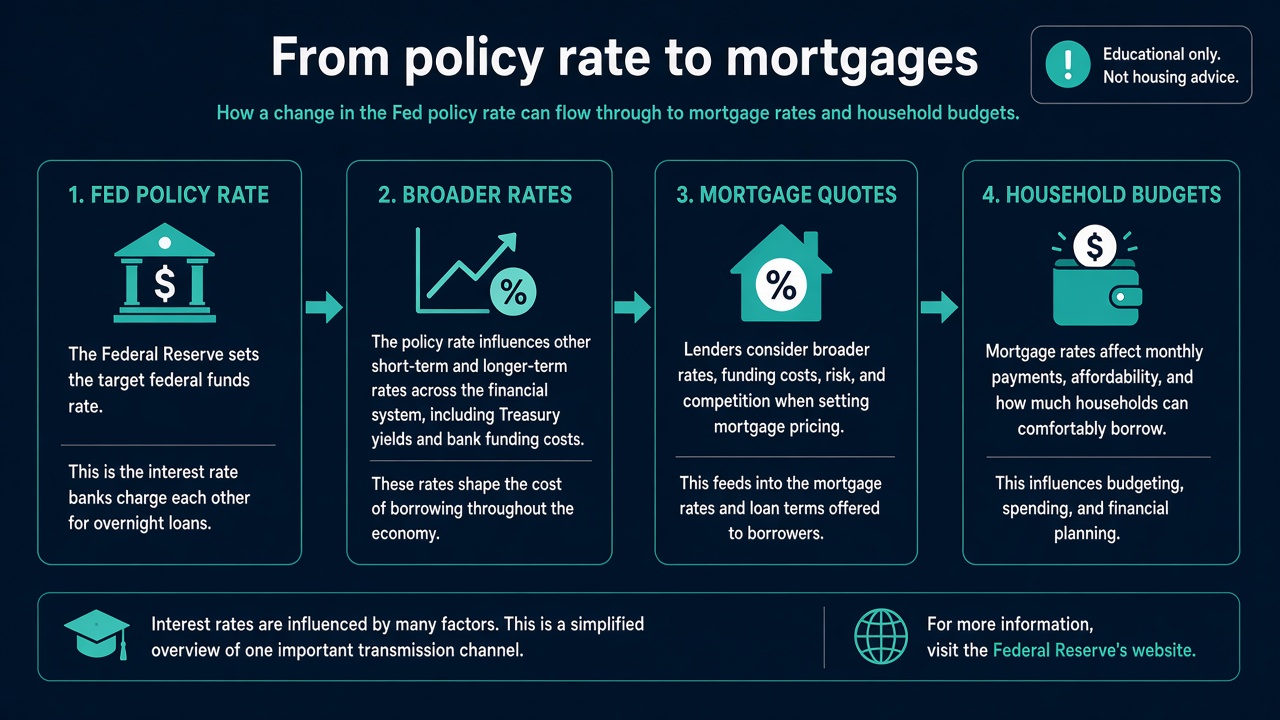
Diagram placeholder: policy → yields → mortgage quotes → household impact — teaching flow only.
From policy rate to mortgage quotes
The Fed sets a short-term policy rate (fed funds target range). Your mortgage lender does not charge you “the fed funds rate.” Instead:
- The Fed moves (or signals) the policy path.
- Market yields—especially intermediate-term yields that mortgage markets care about—reprices as investors update growth, inflation, and policy-path guesses. See Interest rates and yields.
- Mortgage rates (and lender fees, credit overlays, and product details) adjust with those market rates plus lender margins and borrower-specific factors.
- The quoted rate becomes a monthly payment story for anyone shopping for a loan.
So: policy rate ≠ mortgage rate, but they are connected through the market-yields channel and through expectations. Sometimes mortgage rates rise even when the Fed is on hold—because longer yields moved. Sometimes they fall on cut hopes before any cut arrives. That is priced-in behavior, not a glitch.
Why housing shows up in Fed debates
Housing is interest-sensitive demand. When mortgage costs rise, fewer households can stretch to a given home price at the same payment, all else equal. Softer housing activity can cool related jobs and goods demand over time. That is one reason officials watch housing when inflation and growth are both in play.
Conversely, easier mortgage rates can support activity—eventually. Lags are long and uneven. This primer does not date turning points in home sales.
Lock-in effect (teaching idea): owners with much lower old fixed rates may be reluctant to move and take a higher new rate. That can reduce listings even when demand exists. Again: description of a mechanism, not advice to stay or sell.
Everyday impact (without personal advice)
Macro headlines that touch housing often mention:
- Monthly payment math — higher rates raise payments for the same loan size; lower rates ease them.
- Affordability indexes — media summaries combining prices, rates, and incomes.
- Rent vs own debates — inflation baskets include shelter concepts that confuse newcomers; see Inflation 101 for CPI/PCE framing, remembering that owners’ equivalent rent is not your personal lease.
- Builders and housing-related stocks — risk-asset mood stories, covered with anti-signal framing in Risk assets 101.
None of that says what you should do with a lease, a listing, or a refinance application. Local prices, credit score, down payment, taxes, and life plans dominate personal decisions.
Financial conditions and housing
Mortgage rates are a front-door channel of financial conditions. Tighter conditions often include sticky-high mortgage quotes; easier conditions often include softer quotes. Credit availability (how willing lenders are to approve) matters alongside the headline rate.
A stronger dollar or global stress can also spill into U.S. rate markets indirectly. Keep multiple dials in view—do not reduce housing to a single Fed meeting.
Shelter in the inflation debate (light)
CPI and PCE include shelter concepts that are not the same as last month’s Zillow screenshot or your personal rent check. Official shelter measures can lag or smooth what you feel locally. When headlines say “shelter is keeping inflation sticky,” read Inflation 101 for basket vocabulary—and remember this page still is not telling you to rent or buy.
Explicit boundaries
Macro Simplified will not:
- Recommend buying, selling, or waiting on property.
- Pick mortgage products (fixed vs ARM, points, etc.).
- Forecast national home prices or “the bottom.”
- Treat housing data as a day-trading signal.
For personal mortgage or real-estate choices, talk to licensed professionals and do your own local homework.
Related reads
| If you want… | Read |
|---|---|
| Yields and policy rate | Interest rates and yields |
| Bond price/yield intuition | Bonds for beginners |
| Tight vs easy backdrop | Financial conditions |
| Inflation basket context | Inflation 101 |
| Fed tools | The Fed toolkit |
Live decoding lives on Telegram
Site = durable primers. Telegram = live event decoding.