
Emerging markets and the dollar
Educational only. This primer maps dollar channels into emerging-market (EM) stories. It is not an EM trade, not a FX call, and not advice to buy or sell any country ETF.
Site vs Telegram
Channel maps live here. When dollar–EM headlines spike, Telegram carries the live gloss: Macro Simplified on Telegram.
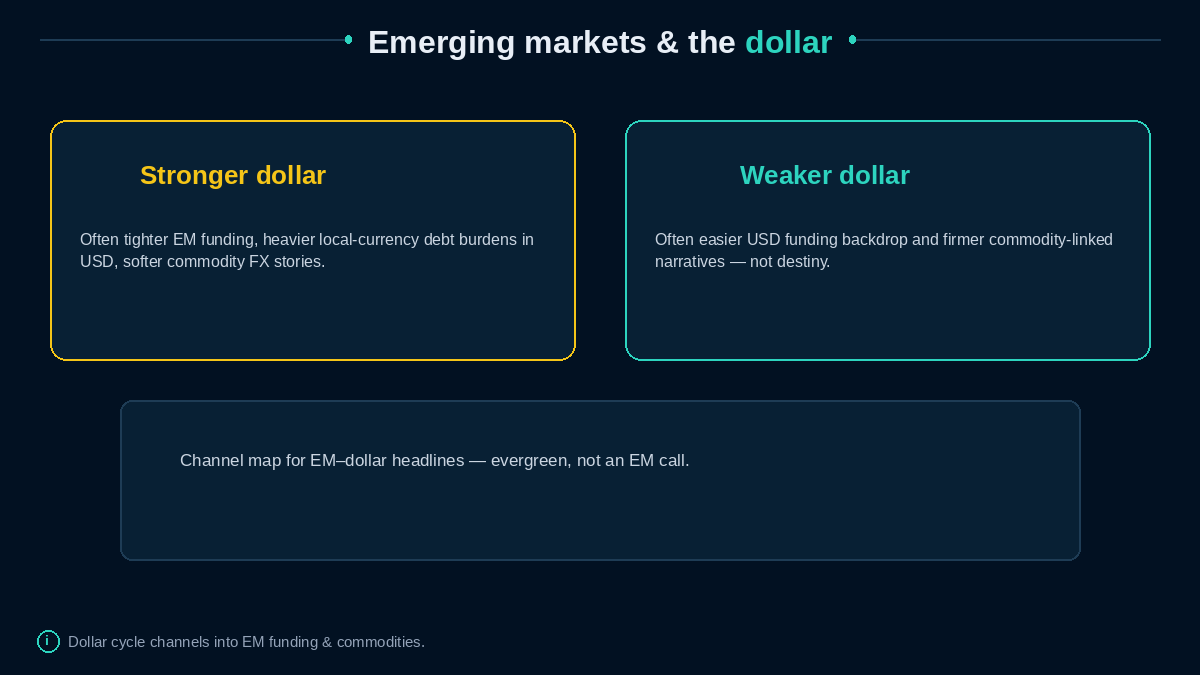
Diagram: Stronger/weaker dollar footprints in EM funding and commodities — not an EM call.
Why the dollar shows up in EM talk
Much cross-border borrowing, trade invoicing, and commodity pricing links to the U.S. dollar. When the dollar strengthens or U.S. rates rise, funding conditions for many EM borrowers can tighten; when the dollar softens, the backdrop often eases—on average, with huge country differences (US dollar and FX, Capital flows for beginners).
This is a channel map, not destiny for every EM asset.
Common channels
- USD funding costs — dollar debt service feels heavier when local currencies weaken against USD.
- Capital flows — push factors from U.S. rates and risk appetite (Monetary policy transmission, Financial conditions).
- Commodities — many commodity prices are dollar-quoted; dollar moves interact with exporter/importer stories (Commodities and the dollar).
- FX regimes — pegs vs floats change how stress appears (Exchange-rate regimes).
Sudden stops remain the sharp version of inflow reversals.
What this page refuses
- Ranking countries to long or short
- “Dollar up = always sell EM” rules
- Crisis dating
- Political scorecards of EM governments
Common confusions
- “EM is one trade.” Heterogeneous credits, commodities, and institutions.
- “Local-currency debt is immune.” Still faces domestic rate and growth risk.
- “Only hikes matter, never risk appetite.” Both push factors matter.
- “This primer is a carry-trade guide.” Explicitly not.
In practice
Split the headline: Is the stress about dollar strength, local politics, commodity terms of trade, or banking plumbing? Then open Liquidity vs solvency if bank-funding language appears. Keep Risk assets 101 anti-signal framing on.
Global dollar spillovers also sit beside China demand channels (China and global spillovers)—related, not identical.
Not all EM stress is imported from the Fed. Domestic inflation, fiscal deficits, political shocks, and bank credit booms can dominate (Credit cycles, Fiscal policy basics). The dollar channel is a frequent amplifier, not the only plot.
Commodity exporters and manufacturing exporters sit on different sides of China and dollar shocks (China and global spillovers). Hard-currency reserves and FX regime choice shape defense options when flows reverse (Exchange-rate regimes). Learners should ask “which EM, which liability currency, which export mix?” before accepting a bloc-level slogan.
Local-currency bond markets have deepened in some countries, changing who bears FX mismatch—progress that still does not erase global dollar funding links in banking systems.
Reserve buffers, swap-line access, and local investor bases change resilience. Two countries with similar dollar debt ratios can fare differently when the dollar spikes—institution quality is part of the channel map, still without ranking trades.
Watch for in headlines: dollar spikes paired with EM FX stress, sovereign spread moves, or commodity-exporter mixed blessings. Ask funding currency and export mix before a bloc-level conclusion.
How this connects
- US dollar and FX · Capital flows for beginners
- Exchange-rate regimes · Commodities and the dollar
- Financial conditions · Geopolitics and risk premiums
Related reads
- US dollar and FX
- Capital flows for beginners
- Exchange-rate regimes
- Commodities and the dollar
- Glossary
Telegram
Dollar–EM headline days: Join Macro Simplified.