
US dollar and FX
Educational only. This page explains how the U.S. dollar shows up in macro headlines. It is not foreign-exchange trading advice, not a call on where the dollar “should” go, and not a recommendation to buy or sell any currency, crypto, or other asset.
Site vs Telegram
Evergreen dollar and FX vocabulary lives here. Live event context when FOMC, CPI, or jobs prints reshape the dollar conversation belongs on Telegram: Macro Simplified on Telegram.
“The dollar is strong” is one of the most common phrases in global markets news. This primer translates that phrase into plain English, introduces DXY as a newspaper shorthand, and connects dollar moves to rates and risk mood—as context, not as a trading system.
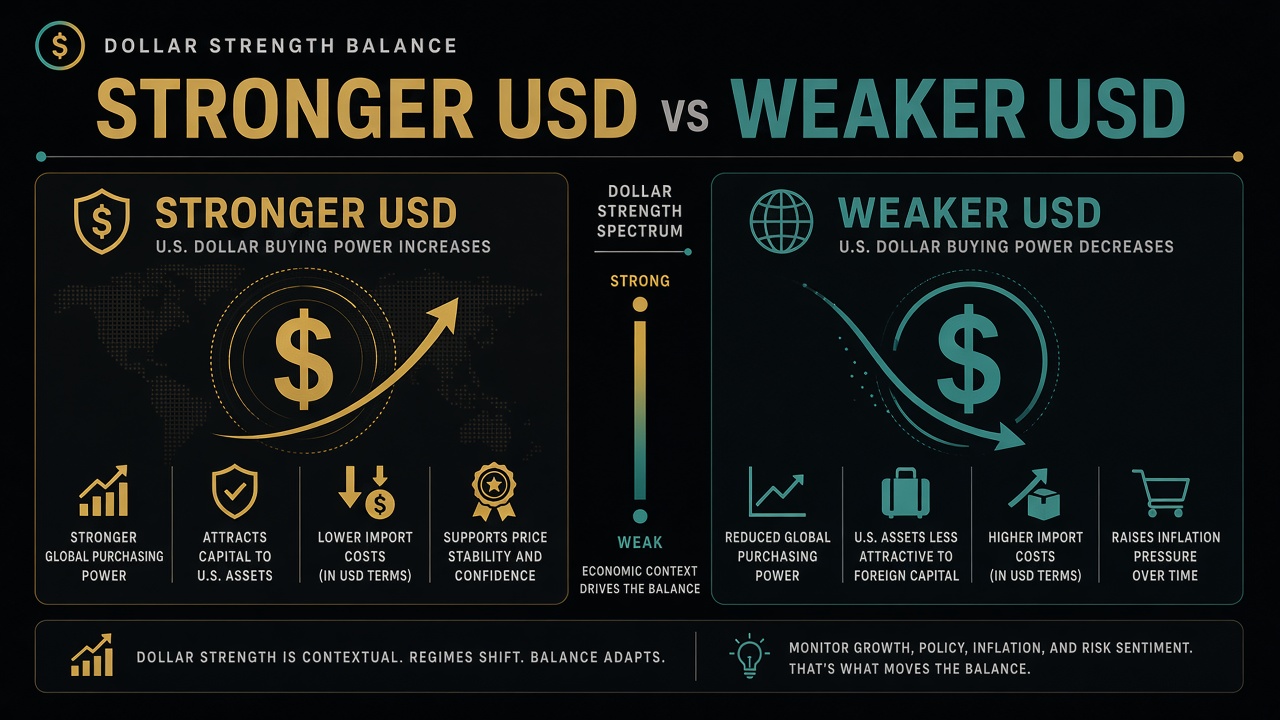
Diagram placeholder: dollar strength as a relative balance vs other currencies — teaching picture only.
What stronger or weaker dollar means
Currencies are relative. The dollar is “stronger” when it buys more of other currencies than before; “weaker” when it buys less. Headlines almost never mean “the dollar is strong forever” or “the dollar is weak in every city.” They mean: versus a set of major trading partners, the dollar’s exchange value moved.
In everyday terms:
- A stronger dollar can make U.S. imports feel cheaper in dollar terms and make U.S. goods more expensive for foreign buyers. Multinationals’ overseas earnings can look smaller when converted back into dollars.
- A weaker dollar can do the reverse: imports cost more in dollars; U.S. exports can look more competitive abroad; foreign earnings convert into more dollars.
Those are mechanical translation effects and competitiveness stories—not instructions to hedge, short, or long anything. Households feel exchange rates most clearly when traveling or buying goods priced from abroad; investors feel them in earnings translations and in global portfolio math.
DXY as newspaper shorthand
DXY (often called the U.S. Dollar Index) is a widely quoted gauge of the dollar against a basket of major currencies. Journalists and market summaries use it the way weather reports use “temperature”: a single number that compresses a complicated picture.
Important beginner corrections:
- DXY is shorthand for headlines and charts in the press, not a pitch to trade that index (or any FX product).
- The basket is weighted toward certain currencies; it is not “the dollar vs the entire world.”
- A rising DXY usually tracks the “stronger dollar” story in U.S. financial media; a falling DXY tracks the “weaker dollar” story. Exceptions and nuances exist—treat the level and the change as context.
You can follow dollar talk without ever placing an FX trade. Macro Simplified teaches the vocabulary so crypto-curious and retail readers are not lost when a CPI surprise is described as “dollar-positive.”
Rates differentials and risk mood
Two channels show up again and again in dollar explanations:
Interest-rate differentials
When U.S. rates (policy and market yields) look higher relative to other major economies—or when investors expect that gap to stay wide—global capital often finds dollar assets relatively attractive. That demand can support a stronger dollar in the narrative. When U.S. rates are expected to fall faster than elsewhere, the opposite story appears. For the U.S. side of the rates map, see Interest rates and yields and The Fed toolkit.
Risk mood
In stress periods, the dollar sometimes acts as a preferred funding and safe-haven currency in global markets: investors and institutions scramble for dollar liquidity, and the dollar can strengthen even if the “rates story” is messy. In calmer risk-on moods, some capital flows toward higher-yielding or growth-sensitive assets outside the U.S., which can weigh on the dollar. These are tendencies discussed in textbooks and commentary, not switches you should trade.
Again: correlation and common narratives help you decode headlines. They are not signals.
Crypto and dollar liquidity (context only)
Crypto markets are often priced and discussed in dollars. When dollar funding feels tight—or when a strong dollar coincides with tighter global financial conditions—risk appetite in crypto can soften in the same weeks that other risk assets feel pressure. When dollar liquidity feels easier, crypto headlines sometimes sound more constructive.
That liquidity angle is context, not a rule like “DXY up → sell crypto.” Crypto has its own cycles, regulation news, and tech narratives. Pair this page with Risk assets 101 and keep the anti-signal framing from that primer.
What this page will not do
- Pitch FX pairs, futures, or “dollar trades.”
- Forecast DXY targets or call tops and bottoms.
- Turn every Fed meeting into a currency recommendation.
- Claim that a strong dollar is always “good” or “bad”—it depends on who you are (importer, exporter, traveler, overseas earner).
For how surprises vs expectations move markets on data days—including dollar reactions in the same breath as rates and stocks—see Priced in / expectations and the Event playbook.
How this connects
- Fed policy and the short-term rate path: The Fed toolkit
- Yields and the rates ladder: Interest rates and yields
- Risk mood language: Risk assets 101
- Inflation prints that reshape rate and dollar guesses: Inflation 101
- Definitions: Glossary
Related reads
- Interest rates and yields
- The Fed toolkit
- Risk assets 101
- Priced in / expectations
- Event playbook
- Glossary
Telegram
Dollar-and-data context on print days lives on Telegram: Join Macro Simplified.