
AI, productivity, and potential growth
Educational only. This primer maps hypotheses about AI, productivity, and potential growth. It is not a stock tip on chipmakers or software names, not a GDP forecast, and not advice to buy “the AI theme.”
Site vs Telegram
Growth-hypothesis explainers live here. When AI and productivity chatter hits the tape, Telegram carries the live gloss: Macro Simplified on Telegram.
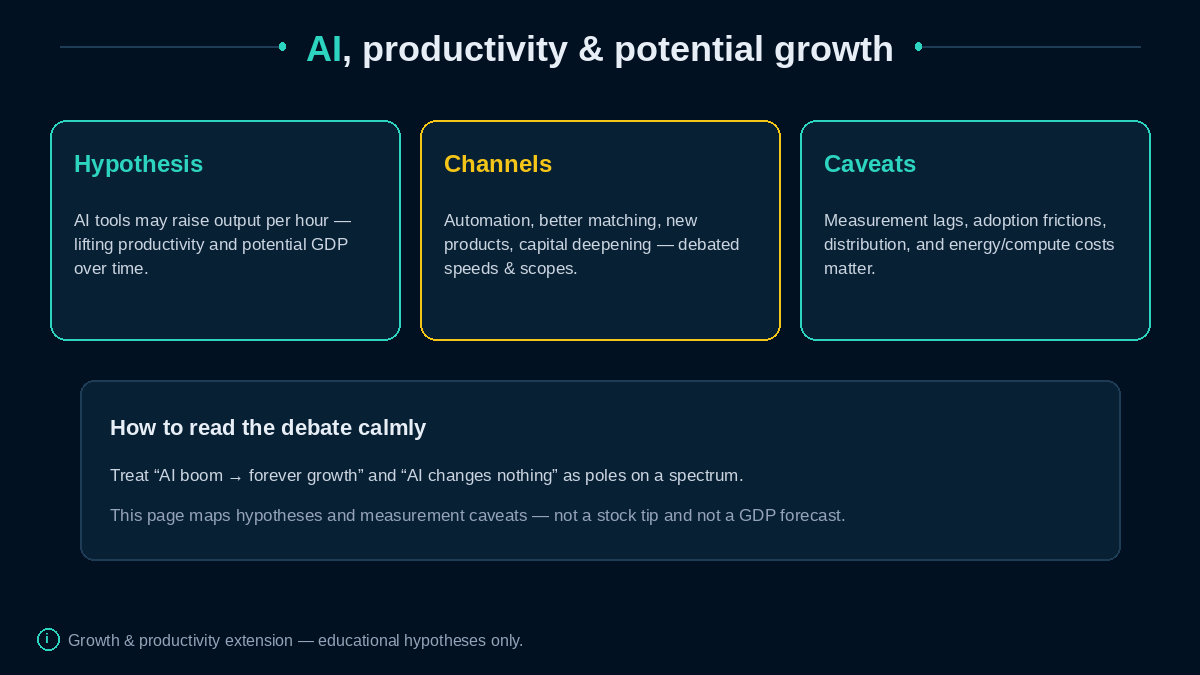
Diagram: Hypothesis → channels → caveats — educational spectrum, not a forecast.
What the optimistic hypothesis says
Productivity is output per unit of input—often summarized as output per hour. Rising productivity is how living standards grow without simply working more hours (Growth and productivity).
The AI-optimist sketch: better models and tools raise output per hour across writing, coding, customer support, design, research, and eventually more physical processes via robotics—lifting potential GDP over time as the technology diffuses.
That sketch is a hypothesis about capacity, not a promise about next quarter’s GDP print (GDP and measurement) and not a timed trade on any ticker.
Channels people debate
- Automation — same output with fewer hours in some tasks
- Augmentation — same hours, higher-quality or faster output
- New products and markets — demand-side growth, not only cost-cutting
- Capital deepening — complementary spending on compute, data centers, and software
- Reallocation — labor and capital shift across firms and sectors (messy, uneven)
Diffusion speed is the crux. Electricity and IT showed long lags between invention, adoption, and measured productivity in historical teaching cases. AI may be faster—or slowed by regulation, energy, skills, and organization. Nobody on this site knows the exact path.
Measurement caveats (why smart people disagree)
- Lags — Official productivity stats can miss intangible gains early.
- Concentration — Gains may show in a few firms before the aggregate budges.
- Quality vs quantity — Better services are hard to count.
- Costs — Energy, chips, and implementation spend can offset gross gains for a time.
- Distribution — Average productivity can rise while many workers feel disruption (Unemployment types for structural labels).
Treat “AI changes everything tomorrow” and “AI changes nothing” as poles on a spectrum. Most serious debate sits in between.
Macro links without hype
If potential growth truly rises, gap and inflation dynamics can shift over long horizons (Output gap and potential GDP, Phillips curve for beginners). Policy still faces the dual mandate with imperfect data. Equity narratives will race ahead of official stats—see Priced in / expectations and refuse signal-chasing (Risk assets 101).
Common confusions
- “Productivity hype = invest now.” This page has zero allocation advice.
- “If Nvidia rallies, potential GDP already jumped.” Market prices ≠ measured capacity.
- “Historical tech lags mean AI cannot matter.” Lags cut both ways—patience ≠ impossibility.
- “Only tech workers are affected.” Diffusion debates span many service sectors.
In practice — separating narrative from measurement
Equity narratives about AI can rerating long before BEA productivity releases show a durable upshift—and narratives can reverse without “disproving” long-run potential. Keep three trays on your desk: (1) firm-level anecdotes, (2) market prices, (3) official productivity and potential-growth estimates.
Move claims between trays carefully. That habit is the whole educational point of this page.
How this connects
- Growth and productivity · Output gap and potential GDP
- GDP and measurement · Jobs and growth
- Demand shocks vs supply shocks — technology as a supply-side story
- How to read macro
Related reads
Telegram
AI-and-productivity macro headlines: Join Macro Simplified.