
Common macro myths
Educational only. These myth/corrections pairs clear fog. They are not a debate-club dunk list, not market forecasts, and not buy/sell guidance.
Site vs Telegram
Myth busting stays evergreen here. Live prints still belong on Telegram: Macro Simplified on Telegram.
Macro Twitter runs on confident one-liners. Some are useful shortcuts. Many are half-true slogans that break the first time a print surprises. Here are common myths beginners bump into—and calmer corrections linked to primers on this site.
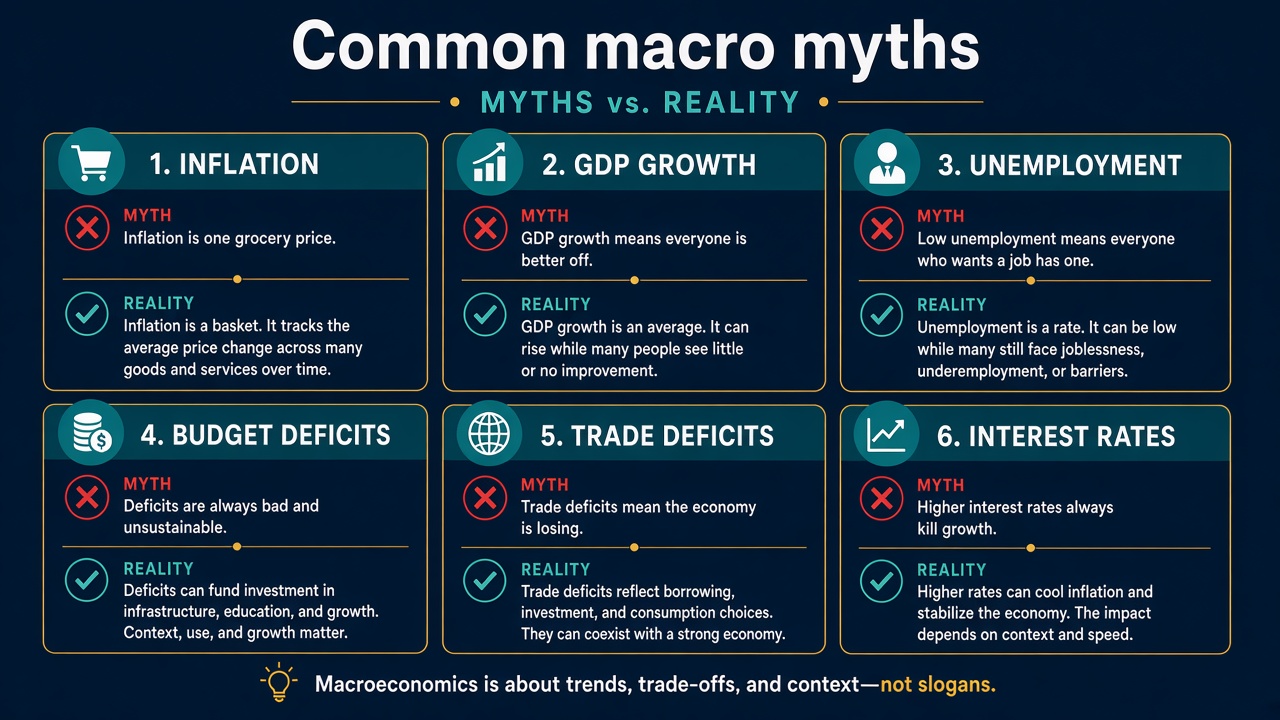
Diagram placeholder: myth vs correction cards — teaching aid only.
Myth 1: “The Fed sets all interest rates.”
Correction: The Fed sets a short-term policy rate target (and influences conditions via the balance sheet and guidance). Market yields on bonds—and the mortgage quotes that follow them—are set in trading and lending markets. They usually relate to the expected policy path, but they are not typed in by the FOMC each morning.
Read: The Fed toolkit · Interest rates and yields · Housing, mortgages, and rates
Myth 2: “Higher yields always mean sell stocks / crypto.”
Correction: Rising yields can weigh on risk mood—especially when they jump on sticky inflation and tighter financial conditions. They can also rise on stronger growth optimism, which sometimes accompanies risk-on stories. Context and priced-in expectations matter. There is no universal “yields up → sell risk” button on this site.
Read: Risk assets 101 · Priced in / expectations
Myth 3: “An inverted yield curve means recession starts next month.”
Correction: Curve shape is useful vocabulary for what markets are pricing across maturities. Inversions have historically appeared in recession conversations, but timing, depth, and false alarms vary. This site does not turn the curve into a dated recession call.
Read: Interest rates and yields · Recession vocabulary · Business cycle
Myth 4: “CPI is the only inflation number that matters.”
Correction: CPI is familiar and market-moving. The Fed has long emphasized PCE for its inflation goal. Headline vs core, and category details, change the story inside a single month. One print is a clue, not a personality transplant for the economy.
Read: Inflation 101 · Sources and habits
Myth 5: “Soft landing and hard landing are official forecasts you can bank on.”
Correction: Soft and hard landing are scenario labels people use while debating growth and inflation paths. They are not certificates issued by a bureau, and this site will not stamp either as “confirmed” with a date.
Read: Recession vocabulary · Jobs and growth · Business cycle
Myth 6: “QE always sends risk assets to the moon; QT always crushes them.”
Correction: Balance-sheet policy is part of the liquidity plumbing story and can influence conditions over time. It is not a joystick with a guaranteed asset-price outcome every week. Risk assets also respond to growth, inflation surprises, positioning, and mood.
Read: The Fed toolkit · Risk assets 101 · Financial conditions
Myth 7: “A strong dollar is always bad (or always good).”
Correction: Dollar strength and weakness create winners and losers—importers, exporters, commodity buyers priced in dollars, foreign borrowers with dollar debts. Headlines need a subject: bad for whom? Use dollar moves as context, not as a single moral score for “the market.”
Read: US dollar and FX · Commodities and the dollar
Myth 8: “If it’s priced in, nothing can happen.”
Correction: “Priced in” means a possibility is already reflected in prices and stories—largely, not perfectly. Surprises on timing, magnitude, or wording still move markets. Delivering a fully expected outcome can even produce odd short-term reactions. It is a teaching phrase, not a guarantee of calm.
Read: Priced in / expectations · Event playbook
Bonus myth: “Macro literacy means I should trade every print.”
Correction: Literacy means you can name the dial, find the primary source, and keep your cool. Many skilled learners watch FOMC/CPI/NFP days without placing a single order. This curriculum is built for understanding—not for maximizing trade frequency.
Read: How to read macro · First 30 days · About
How to use this page
Skim when a slogan shows up in your feed. Click through to the primer that holds the fuller map. If the slogan is attached to a live number, open the Event playbook and, if you want same-day language, Telegram—still with educational framing only.
Related reads
| If you want… | Read |
|---|---|
| Study order | First 30 days |
| Official sources | Sources and habits |
| Asset roles without recipes | Cash, stocks, and bonds |
| Definitions | Glossary |
Live decoding lives on Telegram
Site = durable primers. Telegram = live event decoding.