
The Fed toolkit
Educational only. This page is a primer for learning how the Federal Reserve’s tools work in everyday language. It is not financial advice, a forecast, or a recommendation to buy, sell, or hold any asset.
Site vs Telegram
This site holds durable primers you can re-read anytime. For live decoding of FOMC decisions, CPI, and NFP prints as they land, join the Telegram channel: Macro Simplified on Telegram.
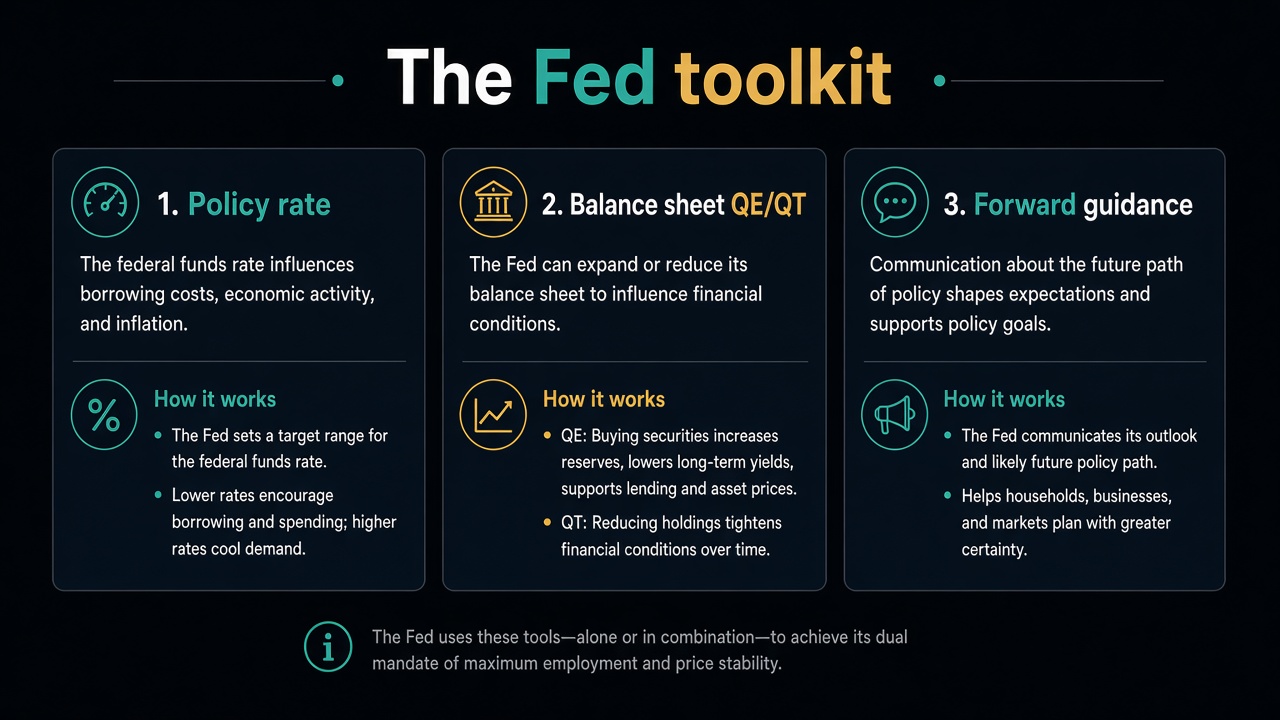
Diagram placeholder: Fed toolkit at a glance — rates, balance sheet, guidance.
Who the Fed is (and isn’t)
The Federal Reserve (often just “the Fed”) is the central bank of the United States. Its job is set by Congress. In simple terms, it has a dual mandate: keep prices reasonably stable, and support maximum sustainable employment. Those two goals sit behind almost every policy conversation you’ll hear about rates, inflation, and jobs.
The Fed is not a stock-market referee, a crypto regulator, or a government spending department. It does not set your tax rates or write the annual budget. When markets jump after a Fed speech, they are reacting to how investors interpret the path of policy—not to a guarantee about where prices “should” go next.
Think of the Fed as the institution that steers the short-term cost of money and the plumbing of bank reserves. Everyone else—households, businesses, traders—responds to that environment in their own way.
The policy rate
The Fed’s main day-to-day lever is the federal funds rate target range—often shortened to “the policy rate” or “interest rates.” Banks lend reserves to each other overnight near that range. When the Fed raises or lowers the target, it is changing the short-term price of money in the banking system.
In everyday terms:
- Higher rates make borrowing more expensive and saving a bit more rewarding. That can cool spending and investment over time.
- Lower rates make borrowing cheaper. That can support spending and investment when the economy needs a lift.
You do not need a trading model to understand the idea. Mortgage quotes, credit-card APRs, and business loan rates all tend to move with the broader interest-rate environment—sometimes quickly, sometimes with a lag. The Fed does not set your mortgage rate directly; it sets the short-term benchmark that influences the chain of rates above it.
This page will not call the next hike or cut. Rate decisions depend on incoming data, the Fed’s own forecasts, and judgment. Primers teach the toolkit; live prints belong on Telegram.
The balance sheet (QE/QT light)
Besides the policy rate, the Fed runs a large balance sheet—assets it holds (mostly Treasuries and mortgage-backed securities) and the liabilities that fund them (including bank reserves).
Two phrases show up constantly:
- Quantitative easing (QE) — When the Fed buys longer-term securities and pays for them by creating bank reserves. In plain language, it is adding reserves into the financial plumbing. The goal in past episodes was to ease financial conditions when the policy rate was already near zero, or to keep markets functioning in a stress period.
- Quantitative tightening (QT) — When the Fed lets securities mature without fully replacing them (or sells them), so the balance sheet shrinks and reserves leave the system gradually.
You do not need a PhD in money markets to remember the metaphor: rates are the steering wheel; the balance sheet is more like the fuel-and-plumbing system. QE/QT change how much liquidity sits in the banking system and can influence longer-term yields and risk appetite—but they are not a simple “print money → asset prices go up” switch.
Forward guidance
Forward guidance is the Fed’s way of talking about where policy might go, not only what it did today. Press conferences, FOMC statements, the Summary of Economic Projections (“dot plot”), and speeches by Fed officials all count.
Why do speeches move markets? Because investors constantly update their guess of the future path of rates and liquidity. A carefully worded phrase—“higher for longer,” “data dependent,” “risks are two-sided”—can shift those guesses in minutes. That is communication as a policy tool, not a crystal ball.
Reading guidance calmly means separating what was decided (the rate decision, balance-sheet plans) from how markets are spinning the words. The first is fact; the second is interpretation that can reverse by the next data print.
Myths to drop
A few ideas are sticky and wrong enough that they deserve a clean break:
- “The Fed controls the stock market.” The Fed influences financial conditions. Markets still price growth, profits, risk appetite, and surprises.
- “QE always equals free money for crypto / stocks.” Liquidity can support risk appetite in some environments; it is not a guaranteed one-way trade in any asset.
- “One speech locks in the next year of policy.” Guidance can change when the data change. That is a feature of a data-dependent central bank.
- “Inflation and jobs never conflict.” The dual mandate can pull in opposite directions. That tension is why Fed meetings feel consequential.
- “If you learn the toolkit, you can predict the next move.” Tools explain how policy works. They do not tell you what the committee will do next Tuesday.
How this connects
The Fed toolkit makes more sense when you wire it to the rest of the curriculum:
- Inflation is one half of the dual mandate — start with Inflation 101.
- Jobs and growth are the other half — see Jobs and growth.
- FOMC days are when the toolkit shows up live — keep the Event playbook open.
- New to reading macro at all? Begin with How to read macro.
- Definitions in one place: Glossary.
When a print or a meeting lands, revisit this page for the “what does this tool do?” layer, then use Telegram for the “what just happened in today’s language?” layer.
Related reads
Telegram
Live FOMC / CPI / NFP decoding lives on Telegram — not on this primer page: Join Macro Simplified.