
Automatic stabilizers
Educational only. How taxes and safety-net spending can cushion a downturn without a new bill every time. Not financial advice, not a forecast, and not a recommendation to buy, sell, or hold any asset.
Site vs Telegram
Durable primers live here. Live headline decoding belongs on Telegram: Macro Simplified on Telegram.
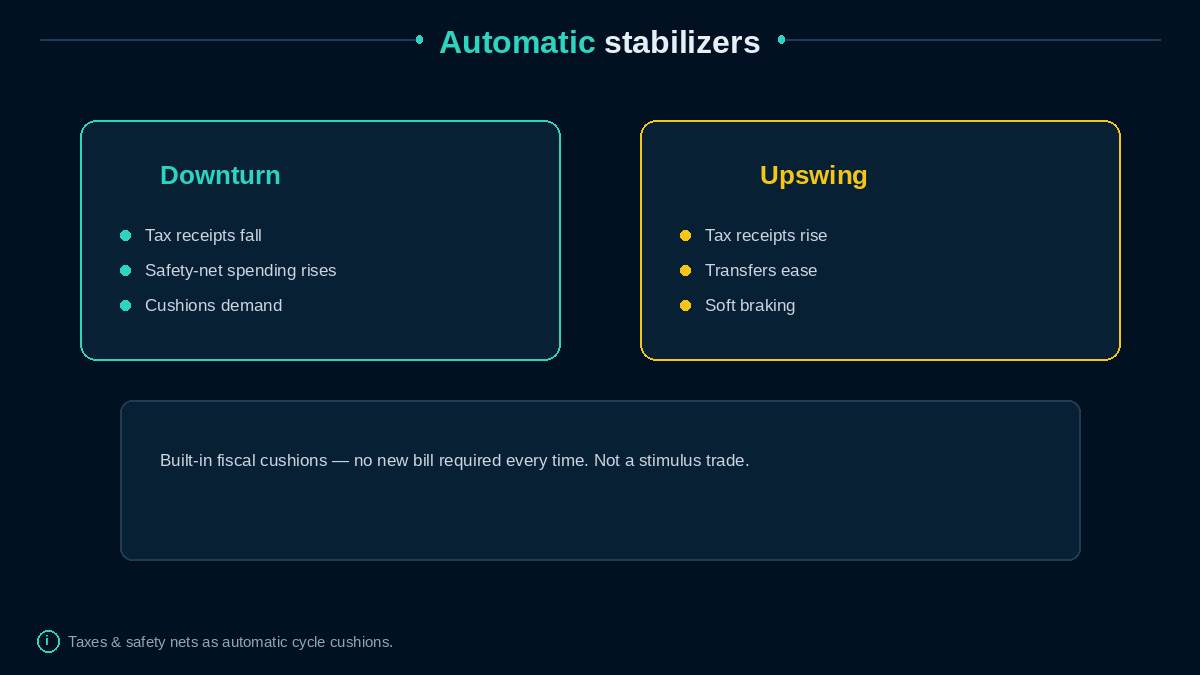
Diagram: Downturn cushions vs upswing soft brakes — taxes and transfers that move automatically.
Built-in cushions
Automatic stabilizers are fiscal features that support incomes in downturns and withdraw support in upswings without a fresh law each time. Classic examples: progressive income taxes (receipts fall when incomes fall) and unemployment insurance or other safety-net spending (outlays rise when need rises).
They differ from discretionary stimulus packages that require new legislation (Fiscal policy basics, The multiplier effect).
How they show up in the cycle
In a downturn, the budget deficit often widens partly because stabilizers activate—even before politicians pass a new bill. In an upswing, deficits can narrow as taxes recover and transfers ease. That is measurement and mechanism language beside Deficits, debt, and debt-to-GDP—not a campaign for any tax code.
Stabilizers cushion consumption and help limit feedback loops into unemployment (Business cycle, Unemployment types). They do not eliminate recessions.
Limits and design debates
Coverage gaps, delayed claims, and eligibility rules change how strong the cushion feels. Countries differ. Commentators argue about generosity versus work incentives; this site maps the automatic idea and leaves partisan design fights to politics—not to our primers.
Common confusions
- “Automatic stabilizers are the same as stimulus bills.” Stimulus is usually discretionary.
- “A wider deficit in recession always means reckless new spending.” Stabilizers alone can widen the gap.
- “Stabilizers time the stock market.” No.
- “This page endorses a party’s budget.” It does not.
In practice
When GDP contracts and the deficit widens, ask how much is automatic vs new discretionary measures. That split improves fiscal literacy before anyone shouts a slogan (Sources and habits).
Automatic stabilizers interact with the business cycle scoreboard: unemployment insurance outlays track joblessness; progressive taxes track taxable incomes (Jobs and growth, GDP and measurement). In deep downturns, discretionary packages may still be debated because automatic cushions alone may be judged too thin—or too slow for certain holes.
From a measurement angle, cyclically adjusted budget concepts try to separate the automatic piece from discretionary stance. You do not need the full econometrics; you need to know why raw deficit dollars are a muddy stance meter in recessions.
International comparisons differ with welfare-state design. Import that humility before declaring one country’s stabilizers “always stronger.”
Think of stabilizers as shock absorbers already bolted to the fiscal car; discretionary bills are optional body kits. Both can matter; confusing them muddies every deficit headline. In deep or unusual shocks, political systems still debate extra packages because absorbers have limits—timing, coverage, and replacement rates differ by design.
Watch for in headlines: deficits widening “automatically” in recessions, unemployment-insurance claims rising with layoffs, and debates that mix stabilizer math with new stimulus bills. Separating those threads is the whole skill.
How this connects
- Fiscal policy basics · Deficits, debt, and debt-to-GDP
- The multiplier effect · Business cycle
- Consumption and saving
Related reads
Telegram
Deficit-and-recession fiscal headlines: Join Macro Simplified.