
Data revisions and nowcasting
Educational only. This primer explains why macro data revise and what nowcasting means. It is not a system to beat the print, not a trading algorithm, and not advice to fade first releases.
Site vs Telegram
Data-literacy primers live here. When a revision rewrites last month’s story, Telegram carries the live gloss: Macro Simplified on Telegram.
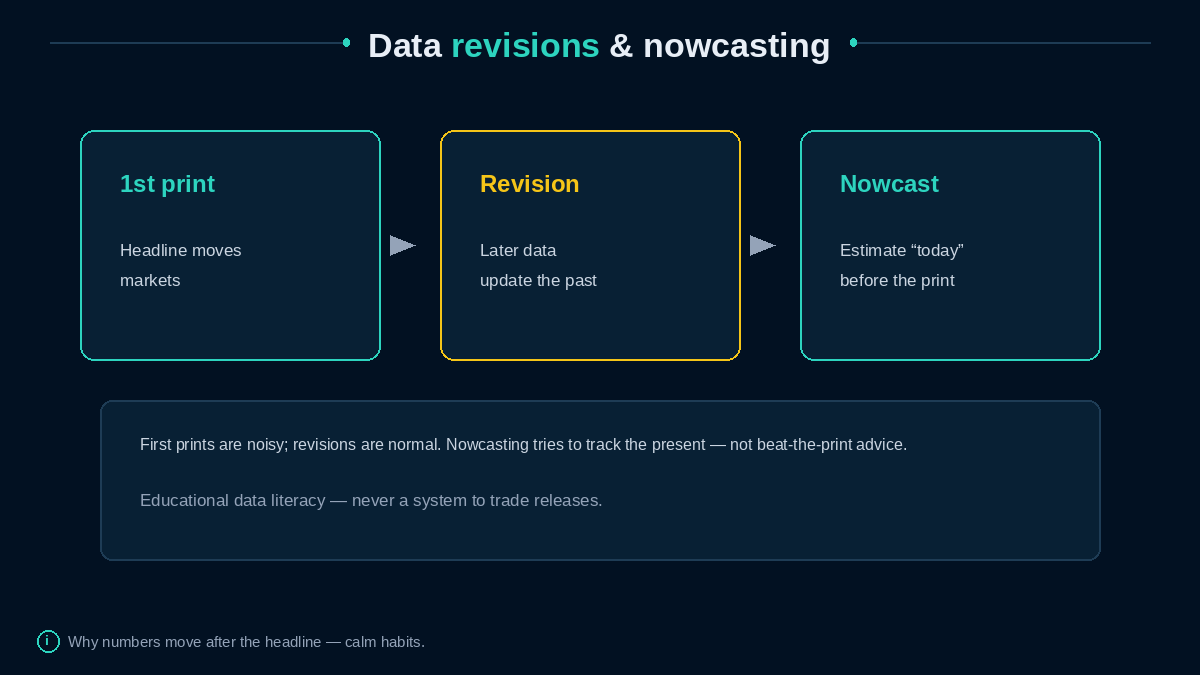
Diagram: First print → revision → nowcast — literacy, not a trading system.
First prints are drafts
Many flagship releases—GDP, jobs, some inflation details—arrive as initial estimates built from incomplete samples. Later, agencies incorporate more data and methodological updates. The past gets rewritten. That is not a conspiracy; it is statistical production (Sources and habits, BLS / BEA).
Markets often react to the first print because it is news relative to expectations (Priced in / expectations). Learners should remember the number may move.
Why revisions matter for stories
A “strong” month can be revised softer (or the reverse). Trend calls that leaned on one print can look silly after annual benchmarks. Payrolls revisions and GDP vintage changes are famous examples—use them as humility training beside Jobs and growth and GDP and measurement.
Seasonal adjustment quirks sometimes amplify early-year noise; they belong as a footnote here, not a whole primer.
What nowcasting tries to do
Nowcasting means estimating the current state of the economy (this quarter’s GDP, for example) using timely indicators before the official print arrives. It is a dashboard craft—PMIs, claims, card spending proxies, and more—related to Leading vs lagging indicators.
Nowcasts help description. They are not licensed on this site as “fade the consensus” machinery. Official prints still matter for policy and narrative even when nowcasts were close.
Common confusions
- “Revisions mean the agency is cooking books.” Incomplete data is the usual story; stay with primary sources.
- “If I nowcast well, I have a trade.” Measurement skill ≠ signal service.
- “Only GDP revises.” Many series revise; magnitudes differ.
- “First prints are useless.” They are noisy and still informative—handle with care.
In practice — a revision habit
When a revision drops, write two sentences: (1) what changed in the history, (2) whether the trend story changed or only one month’s drama. That habit pairs with the Event playbook better than screenshot outrage.
Vintage datasets (the sequence of published estimates for the same quarter) are how researchers study revision patterns. You do not need to build a vintage database to benefit: simply assume important macro claims should survive a later revision check. On Telegram-style live days, separate “surprise vs consensus on the first print” from “truth of the underlying trend.” Both matter; they are not the same sentence.
Flash estimates and advance releases exist precisely because users want speed; the cost is revision risk. Prefer process: note the vintage, note the surprise, update the trend gently (Business cycle).
Consensus forecasts often aim at the first print; knowing that keeps surprise math honest when revisions later rearrange the history.
Humility about first prints is a feature of calm macro reading—not a reason to ignore data.
How this connects
- Leading vs lagging indicators · Sources and habits
- GDP and measurement · Jobs and growth
- Event playbook · Priced in / expectations
Related reads
Telegram
Revision and print weeks: Join Macro Simplified.