
Monetary policy transmission
Educational only. This primer maps how policy-rate changes can transmit into the real economy and markets. It is not a forecast of the next hike or cut, and not advice to position around FOMC day.
Site vs Telegram
Transmission maps live here. When the Fed moves and markets debate “how tight is tight,” join Telegram: Macro Simplified on Telegram.
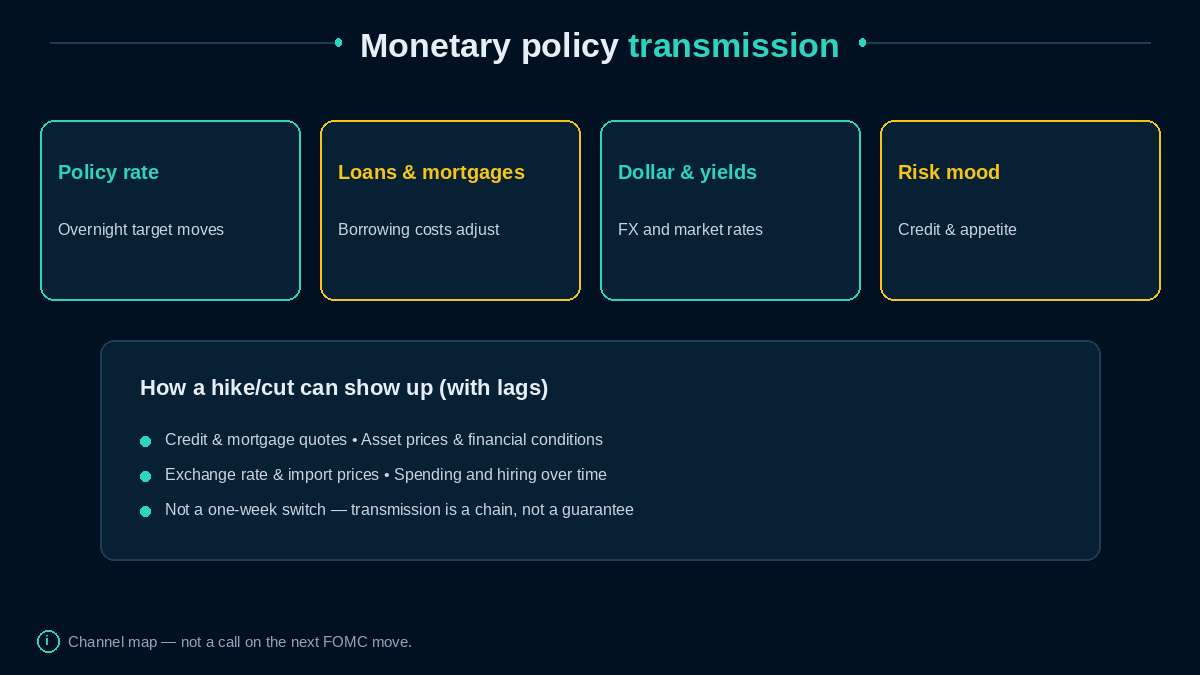
Diagram: Overnight policy → credit, yields/FX, risk mood — a chain with lags, not a switch.
From overnight rate to everyday costs
The Fed’s main lever is the federal funds target range (The Fed toolkit). Transmission is the story of how that lever can show up in:
- Loan and mortgage rates — borrowing costs for households and firms (Housing, mortgages, and rates)
- Market yields — bills, notes, and the curve (Interest rates and yields, Yield curve)
- The dollar — rate differentials and risk appetite (US dollar and FX)
- Credit spreads and risk mood — willingness to lend and take risk (Credit spreads, Financial conditions)
- Spending and hiring — with lags — capex and consumption respond over time (Consumption and saving, Investment and capital spending)
Balance-sheet tools (QE/QT) are a parallel plumbing channel (QE and QT explained). Forward guidance shapes expected paths (Reading the Fed).
Lags and leaky pipes
Transmission is not “hike Tuesday, recession Thursday.” Channels differ in speed. Some mortgages reprice slowly; markets can move in minutes; hiring decisions lag. Financial conditions can tighten more (or less) than the policy rate alone implies—credit standards and global spillovers matter (Credit cycles).
Think chain with friction, not light switch.
Common confusions
- “The Fed sets my mortgage rate equal to fed funds.” It influences the chain; lenders set quotes.
- “If stocks rally after a hike, transmission failed.” Risk assets price many things; one day is not the whole map.
- “Transmission is identical in every cycle.” Balance sheets, regulation, and global funding change the pipes.
- “This page predicts the next move.” It explains how, not what next.
In practice — a hike headline checklist
- What happened to the target range and guidance?
- Did market yields, the dollar, and credit spreads move in a “tighter” direction?
- Which real-economy channel is the commentary emphasizing (housing, capex, consumption)?
- Are we still inside the usual lag window?
Use the Event playbook for process discipline.
Global transmission matters for a reserve-currency economy: U.S. rate moves can spill into foreign funding costs and capital flows (Capital flows for beginners, US dollar and FX). Domestically, inequality of rate exposure—floating-rate borrowers vs locked-in mortgages—shapes how fast the chain bites. None of that yields a single “hours until impact” timer; it yields better questions when reading post-FOMC essays.
Equity and credit markets often reprice the path of policy, not only today’s setting—another reason guidance is part of transmission (Reading the Fed, Priced in / expectations). Treat violent one-day moves as pathway updates, not proof the real economy already shifted.
Bank lending standards surveys are a useful qualitative companion to the rate path—tight standards can reinforce transmission even when markets look calm.
How this connects
- The Fed toolkit · Financial conditions
- Dual mandate · Interest rates and yields
- Housing, mortgages, and rates · SOFR vs federal funds
Related reads
Telegram
FOMC transmission debates: Join Macro Simplified.