
Immigration and labor supply
Educational only. This primer maps immigration as a labor-supply channel in macro vocabulary. It is not a political campaign, not a border-policy endorsement or attack, not a wage forecast, and not advice about any person’s status or hiring decision.
Site vs Telegram
Neutral labor-supply explainers live here. When immigration appears in macro commentary, keep politics on the cable news—and use Telegram for calm data context: Macro Simplified on Telegram.
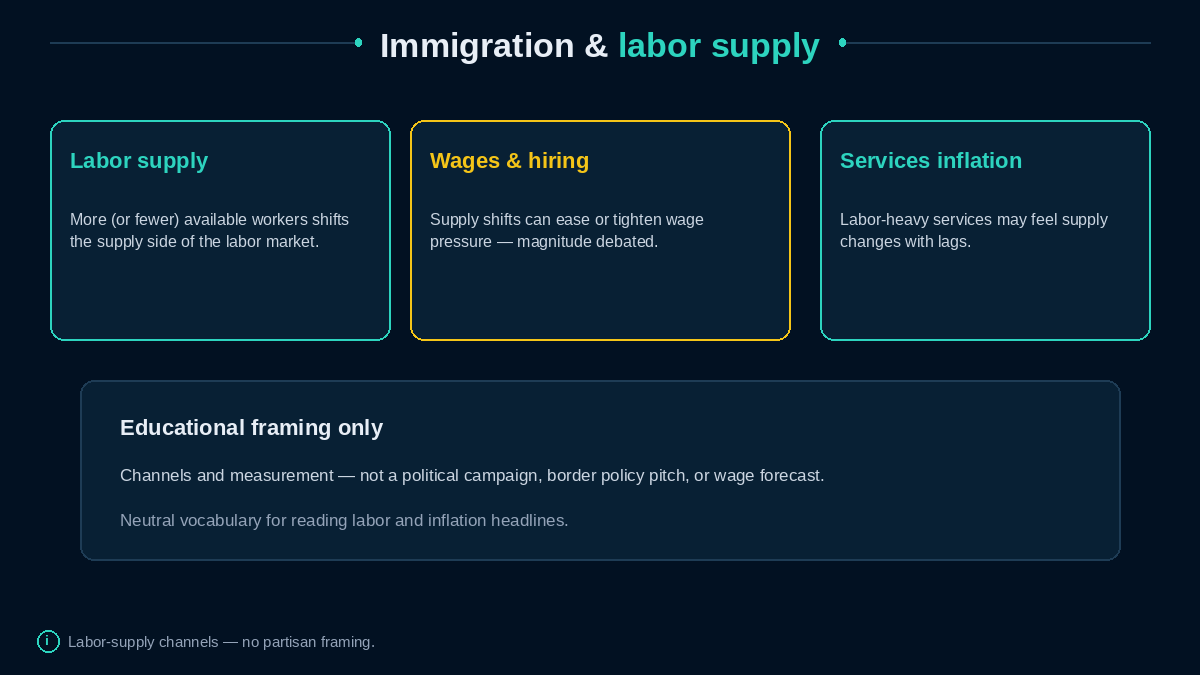
Diagram: Supply → hiring/wages → services inflation channels — educational, non-partisan.
Labor supply is a macro ingredient
Potential output depends on labor, capital, and technology (Output gap and potential GDP, Growth and productivity). Labor supply can change when participation shifts (Labor force participation) or when the working-age population changes—including through migration.
In teaching language, a larger available workforce can, other things equal, ease hiring bottlenecks and wage pressure in some sectors; a sudden shortfall can tighten them. Magnitudes, timing, and sector mix are empirical debates. This page teaches the channel, not a scored political conclusion.
Channels you will hear in headlines
- Hiring and vacancies — more (or fewer) candidates relative to openings
- Wage growth vocabulary — supply shifts enter debates about pay pressure
- Services inflation — labor-heavy services may reflect supply conditions with lags (Sticky services and shelter inflation)
- Measurement — population controls and survey methods affect how jobs and unemployment read (Jobs and growth, Data revisions and nowcasting)
Demand still matters. A supply increase into weak demand is a different story than a supply increase into a hot economy (Demand shocks vs supply shocks).
Hard neutrality rules for this primer
- No party scorekeeping
- No “immigration always lowers/raises wages” slogan presented as fact
- No moral judgment of migrants or natives
- No policy prescription disguised as macro
If a sentence cannot be framed as measurement or channel vocabulary, it does not belong here.
Common confusions
- “Labor supply is only immigration.” Participation, demographics, and health matter too.
- “One channel settles inflation forever.” Energy, shelter, expectations, and demand still matter.
- “Macro vocabulary equals political endorsement.” Not on this site.
- “This page tells firms whom to hire.” It does not.
In practice — translating a charged headline
Rewrite emotionally loaded headlines into: What happened to measured labor supply? Which sectors? What is claimed about wages or prices? What is still unknown? Then stop. That rewrite is the educational product.
Data quality deserves humility: population estimates, survey response rates, and administrative series can disagree in real time. That is another reason this page stays in channel language rather than crisp national scorekeeping. When a commentator asserts a precise wage effect to two decimal places, ask what identification assumptions they needed—and keep Data revisions and nowcasting nearby for measurement caution.
Sector mix matters: care, construction, agriculture, and hospitality often appear in labor-supply stories more than capital-intensive tech manufacturing. A national average can hide tight and slack markets side by side—another reason to avoid one-line slogans.
Keep the tone descriptive: channels and uncertainty first, slogans never.
How this connects
- Labor force participation · Unemployment types
- Jobs and growth · Sticky services and shelter inflation
- Output gap and potential GDP · Dual mandate
Related reads
Telegram
Labor-supply footnotes on jobs days: Join Macro Simplified.