
Investment and capital spending
Educational only. This primer explains investment (I) in the national-accounts sense. It is not a sector trade, not capex stock-picking, and not advice to buy machinery makers.
Site vs Telegram
Capex vocabulary lives here. When investment or durable-goods headlines move markets, use Telegram: Macro Simplified on Telegram.
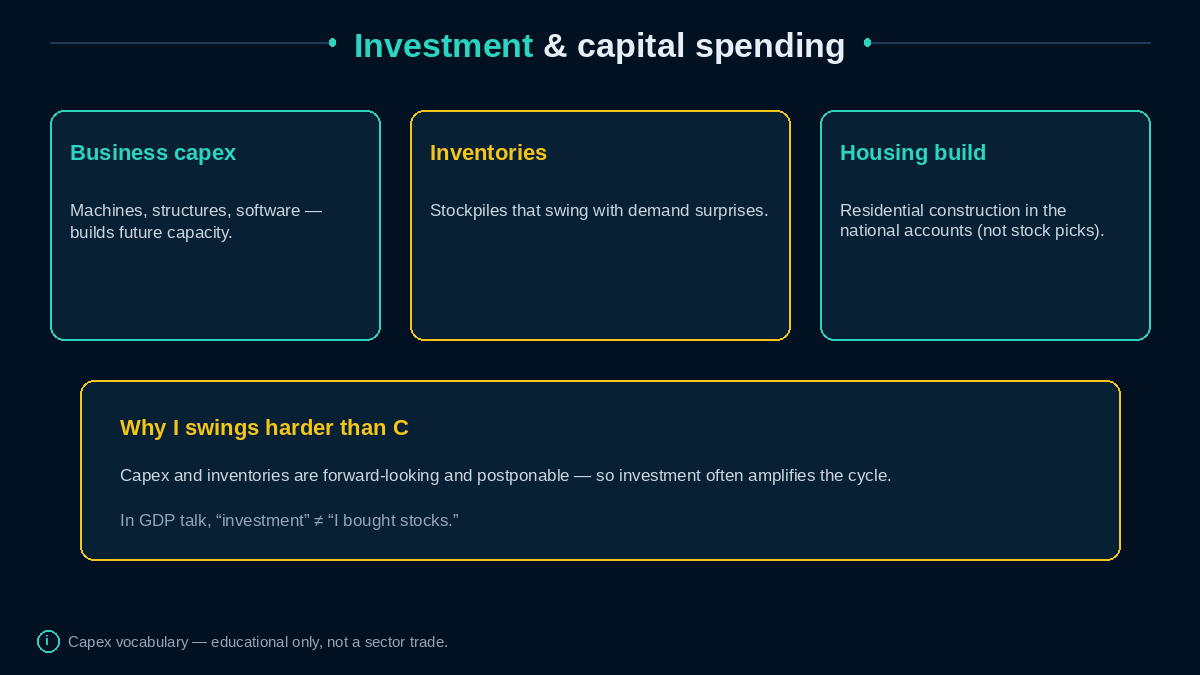
Diagram: Capex, inventories, housing construction — I swings harder than C.
What “investment” means in GDP
In everyday speech, “investment” often means buying stocks. In GDP teaching language, Investment (I) mainly means:
- Business capital spending (capex) — equipment, structures, intellectual-property products (software, R&D in modern accounts)
- Inventory changes — stockpiles rising or falling
- Residential construction — housing build, not the resale of existing homes as a GDP production concept
That is why a booming stock market is not the same sentence as “investment surged in GDP.” See GDP and measurement and contrast with household Consumption and saving.
Why I swings harder than C
Firms can postpone a factory or software project when uncertainty rises; households still buy groceries. Inventories swing when demand surprises. Housing starts respond to rates and credit (Housing, mortgages, and rates). So investment often amplifies the business cycle—up harder in expansions, down harder in contractions—without being a perfect leading indicator every time (Leading vs lagging indicators).
Policy rates and financial conditions matter because discount rates and loan standards shape whether projects clear the hurdle (Monetary policy transmission, Financial conditions).
Capex vs “I bought shares”
Keep the labels separate:
| Phrase | Teaching meaning |
|---|---|
| Capex / fixed investment | Building productive capacity |
| Portfolio investment | Buying financial claims |
| Inventory investment | Stock changes in the accounts |
All can appear in the same newspaper; only the first two rows of fixed + inventory (+ residential) are the GDP “I” story.
Common confusions
- “Investment always equals bullish stocks.” Different definitions.
- “Inventories are noise—ignore them.” Inventory swings can dominate a quarterly GDP print.
- “Soft capex means recession tomorrow.” Soft capex is a signal candidate, not a dating tool.
- “This primer picks industrial winners.” It does not.
In practice — reading an investment headline
Ask: is the story about equipment, structures, IP, housing build, or inventories? Then ask whether rates, demand, or supply chains are the constraint. Long-run capacity links to Growth and productivity and Output gap and potential GDP; near-term ripples link to The multiplier effect.
Public investment sometimes appears in broader “investment” chatter, but GDP’s G bucket already covers government purchases of goods and services (Fiscal policy basics). Keep private fixed investment, inventories, and housing build as the core of I, and treat infrastructure debates as neighboring fiscal stories—not a reason to blur the accounts. For productivity links when capex embeds new tech, see AI, productivity, and potential growth.
Inventory build can look like strength when it is really unsold goods stacking up; inventory drawdowns can subtract from GDP even when underlying sales are fine. Always ask whether the I impulse is intentional capex or accidental stock.
How this connects
- Consumption and saving · GDP and measurement
- Business cycle · Credit cycles
- AI, productivity, and potential growth
Related reads
- GDP and measurement
- Consumption and saving
- Monetary policy transmission
- Growth and productivity
- Glossary
Telegram
Capex and GDP-composition days: Join Macro Simplified.