
Tariffs as a macro shock
Educational only. This primer maps tariffs as a macro shock in plain English. It is not campaign coverage, not a scorecard for parties, and not a trade idea on importers or exporters.
Site vs Telegram
Evergreen shock vocabulary lives here. When tariff headlines move markets, plain-English context is on Telegram: Macro Simplified on Telegram.
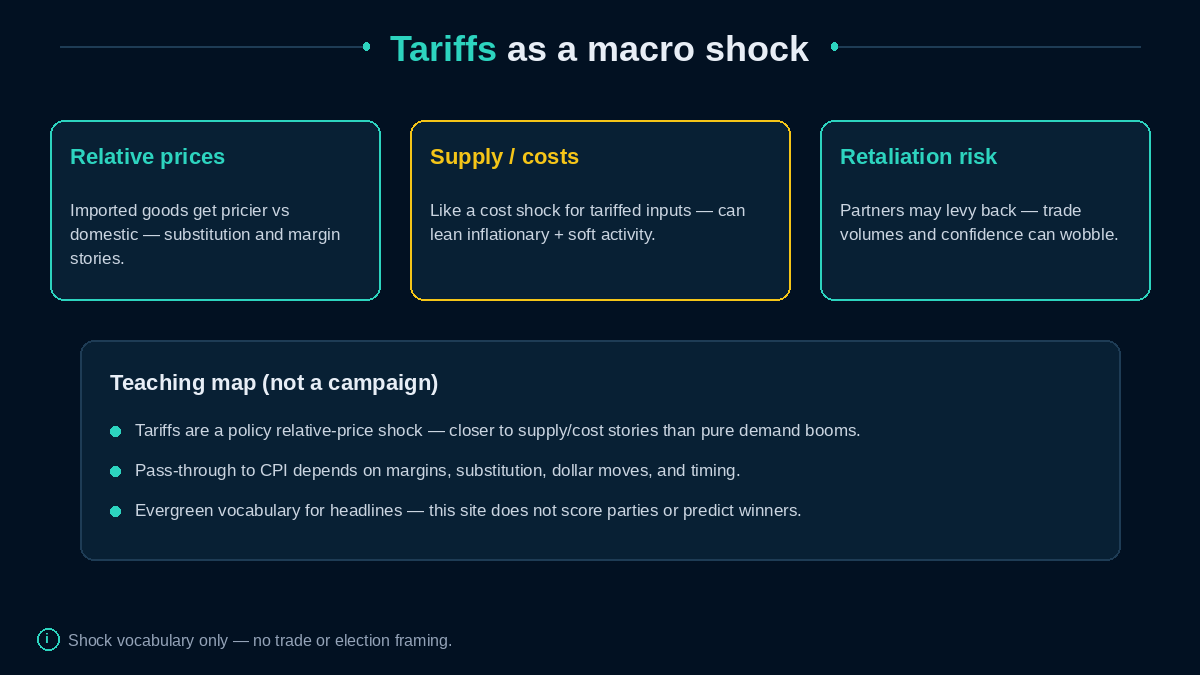
Diagram: Relative prices, supply/costs, and retaliation risk — teaching map, not a forecast.
What a tariff is doing in the story
A tariff is a tax on imports. In macro teaching language, it often behaves like a relative-price shock and a cost / supply-adjacent shock:
- Taxed imports become pricier relative to untaxed goods
- Firms may pass costs through, absorb margins, substitute suppliers, or redesign products
- Domestic producers of competing goods may see a temporary price umbrella—or new input-cost pain if they rely on taxed parts
That is closer to the supply-shock family in Demand shocks vs supply shocks than to a pure demand boom. Pass-through to CPI depends on margins, substitution, the dollar, timing, and which goods are covered—messy in practice, clear as vocabulary.
Channels beginners hear in headlines
- Inflation channel — higher prices for tariffed goods and related inputs (magnitude debated).
- Activity channel — weaker trade volumes, cautious capex, or sector reshuffling.
- Retaliation channel — partners levy counter-tariffs; exporters feel the mirror image.
- Uncertainty channel — firms delay plans when rules feel unstable (policy uncertainty as a demand/risk-premium drag in broader talk).
- FX / capital-flow footnotes — dollar and trade-balance stories can shift; see Trade and the balance of payments and US dollar and FX.
None of these channels is a timed “buy X / sell Y” recipe on this site.
How to stay evergreen (and non-partisan)
Tariffs appear under many administrations and in many countries. Learn the mechanics and channels, not a horse race. Historical case studies (trade wars, steel/aluminum episodes, large bilateral tariff rounds) are teaching tools—not predictions of the next election or the next print.
If a headline is mostly politics, translate it back: which relative prices changed, who faces higher costs, and is retaliation in play?
Common confusions
- “Tariffs are always paid only by foreigners.” Incidence is shared and empirical—consumers, importers, and foreign exporters can all share burden depending on elasticities.
- “Tariffs always raise GDP.” They reshuffle relative prices; growth effects are debated and often mixed with retaliation and uncertainty.
- “One tariff line explains the whole CPI.” Baskets are broad; energy, shelter, and services still matter (Sticky services and shelter inflation).
- “This primer picks a political side.” It does not.
In practice — translating a tariff headline
When a tariff announcement drops, run a five-second checklist:
- Which goods and partners are covered?
- Is this a new levy, an increase, or a pause/exemption story?
- Any retaliation mentioned?
- Is the market narrative mostly inflation, growth, or uncertainty?
Then park the politics. Return to relative prices and shock channels. That keeps you in learner mode even when cable news is not.
How this connects
- Shock spine: Demand shocks vs supply shocks · Inflation 101
- Open economy: Trade and the balance of payments · US dollar and FX
- Risk mood: Financial conditions · Risk assets 101
- Commodities footnote: Commodities and the dollar
Related reads
- Demand shocks vs supply shocks
- Trade and the balance of payments
- Inflation 101
- US dollar and FX
- Glossary
Telegram
Trade-policy shock headlines: Join Macro Simplified.