
Recession vocabulary
Educational only. This page teaches words people use when talking about slowdowns and recessions. It does not call a recession date, does not grade soft vs hard landing as a forecast, and does not tell you what to buy or sell.
Site vs Telegram
Cycle vocabulary stays here. Live data-day context: Macro Simplified on Telegram.
Few macro words travel farther on social media than “recession.” Used carefully, it is a label for a broad downturn in activity. Used carelessly, it becomes a scare word or a gotcha. Macro Simplified keeps it in the vocabulary drawer—next to expansion, contraction, soft landing, and hard landing—so you can decode headlines without treating every tweet as a dated call.
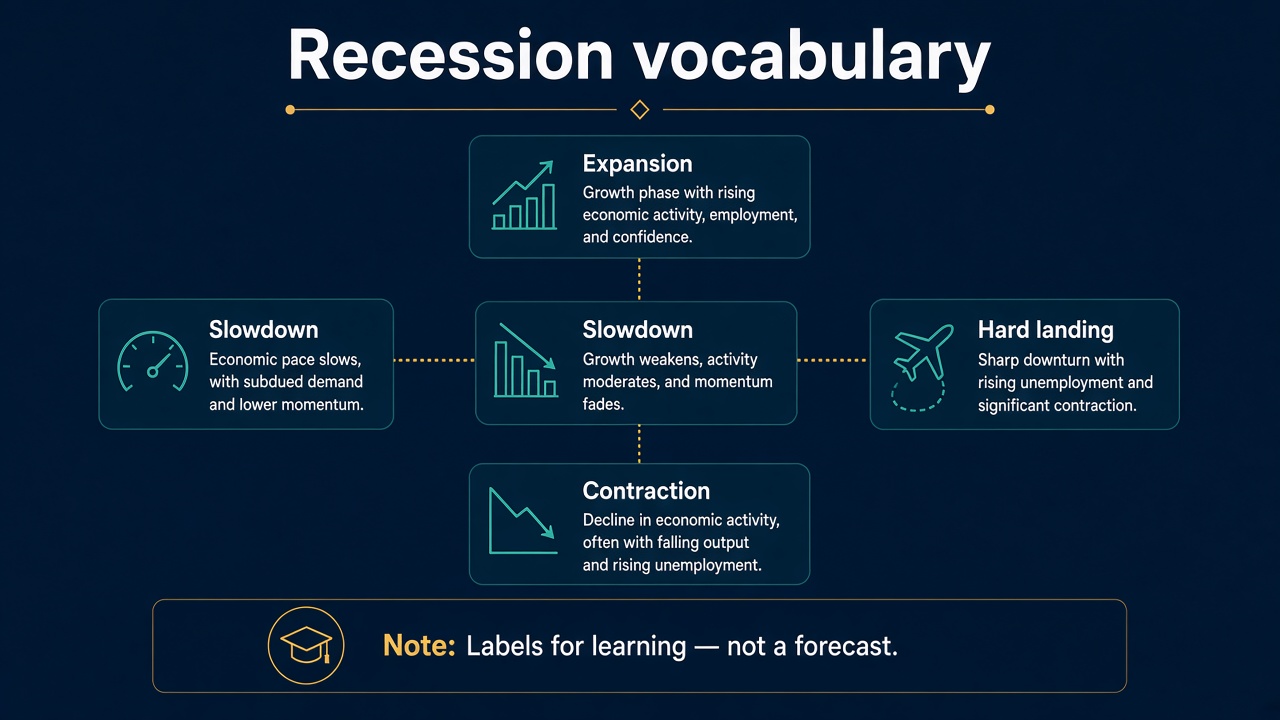
Diagram placeholder: recession vocabulary on the cycle map — labels only, not a dated forecast.
Expansion and contraction
Start with the business cycle map:
- Expansion — activity growing: more hiring, more spending, rising output in the broad story.
- Peak — the turn at the top of an expansion (easier to spot in hindsight than in real time).
- Contraction — activity shrinking: softer hiring, weaker spending, falling or stalled output.
- Trough — the bottom turn before expansion resumes (again, often clearest afterward).
Recession in everyday U.S. media talk usually means a significant, broad contraction—often later formalized by committees or rules of thumb. Different countries and analysts use different criteria. This site will not adjudicate whether “we are in one” on any given Tuesday. We teach how the word is used.
Two-quarter GDP declines show up in casual “technical recession” talk. Formal dating can look at depth, diffusion, and duration across many indicators. Beginners only need: contraction language describes direction; recession is a stronger, broader label—and both are retrospective more often than people admit on air.
Soft landing and hard landing (labels)
These are scenario labels, not weather reports:
- Soft landing — inflation cools toward the central bank’s comfort zone while growth slows only modestly and the labor market softens without a deep downturn. See also the glossary entry for soft landing.
- Hard landing — the cool-down is sharper: deeper contraction, larger job losses, or a more abrupt break in demand.
Useful teaching point: people argue about landings while the plane is still in the air. The same month of data can be read as soft by one desk and hard by another. Your job as a learner is to notice which label someone is using and which dials they cite—not to crown a winner from a primer.
This page will never say “soft landing confirmed” or “hard landing starts on [date].”
Related words you will hear
| Phrase | Plain meaning (teaching sense) |
|---|---|
| Slowdown | Growth cooling, not necessarily negative |
| Soft patch | Temporary weak stretch inside a broader expansion story |
| Downturn | Activity turning weaker—severity unspecified |
| Recession scare | Fear or narrative of recession without a settled call |
| Jobless recovery | Output improving while hiring stays weak (historical label) |
| Rolling recession | Sector-by-sector weakness without one clean economy-wide date |
None of these phrases is a trade signal. “Recession scare” days can coincide with sharp risk-off moves—or with relief rallies if the scare fades. Priced in / expectations explains why the surprise versus the story matters.
How this links to jobs, inflation, and the Fed
Recession talk is usually a mash-up of:
- Growth/jobs dial — payrolls, unemployment, claims (Jobs and growth).
- Inflation dial — whether price pressure is still forcing tight policy (Inflation 101).
- Policy dial — whether the Fed is still leaning against demand (The Fed toolkit).
- Conditions — whether markets are already tightening or easing the backdrop (Financial conditions).
A calm reader asks: “Which dial is this recession take really about?” That question beats doomscrolling.
What we refuse to do
- No recession start/end dates from this site.
- No probability percentages dressed up as certainty.
- No “position for recession” shopping lists.
- No mocking or cheerleading political actors—cycle language stays neutral.
Official dating bodies and research shops publish their own views on their own sites. We point you at habits and vocabulary; we do not compete with their calendars.
Related reads
| If you want… | Read |
|---|---|
| Full cycle map | Business cycle |
| Labor and GDP light | Jobs and growth |
| Tight vs easy backdrop | Financial conditions |
| Leading vs lagging habit | How to read macro |
| Calm print-day process | Event playbook |
Live decoding lives on Telegram
Site = durable primers. Telegram = live event decoding.