
Deficits, debt, and debt-to-GDP
Educational only. This primer teaches fiscal measurement vocabulary. It is not a budget endorsement, not a debt-crisis prophecy, and not advice to buy or sell bonds.
Site vs Telegram
Measurement explainers live here. When deficit or debt headlines spike, plain-English context is on Telegram: Macro Simplified on Telegram.
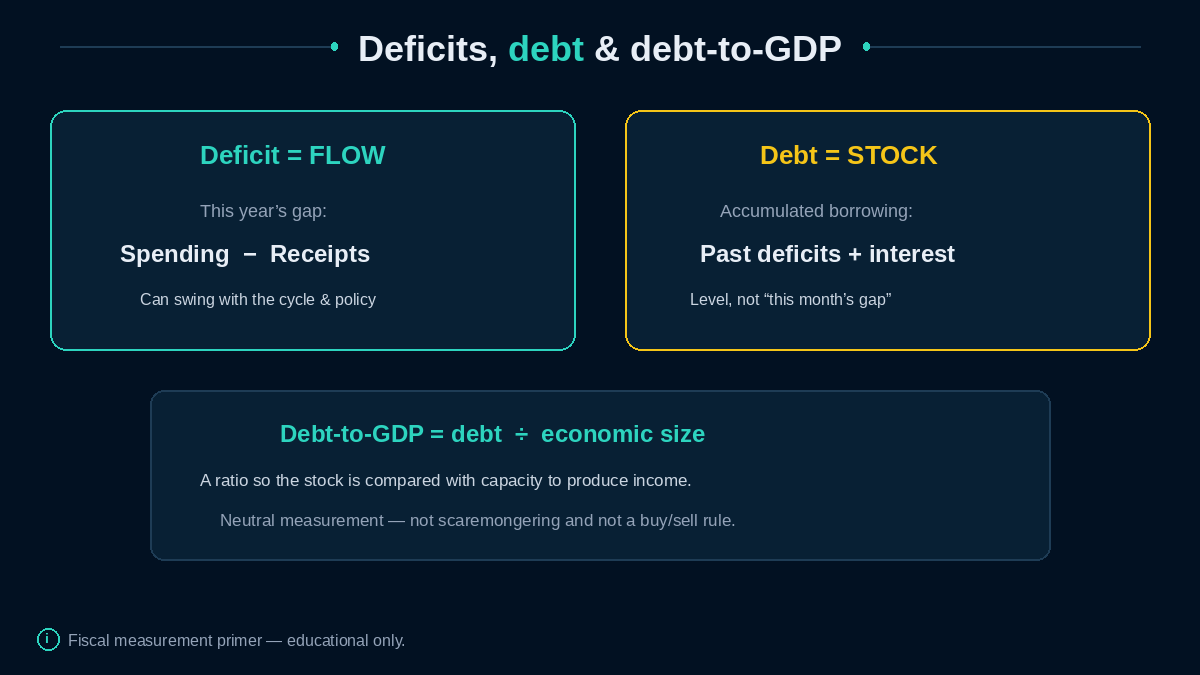
Diagram: Flow vs stock vs ratio — neutral fiscal measurement.
Deficit is a flow; debt is a stock
Keep the accounting picture straight:
- Fiscal deficit — when government spending exceeds receipts over a period (a year, a month). A flow: this period’s gap.
- Government debt — the stock of accumulated borrowing from past gaps (plus interest and other financing details).
A country can run a deficit this year while debating whether the stock of debt is high or low relative to history. Mixing flow and stock is the most common beginner confusion—and the easiest to fix.
Primary deficit language (excluding interest) shows up in advanced chatter; you only need the headline idea for now. Broader fiscal vs monetary contrast sits in Fiscal policy basics.
Why debt-to-GDP?
People divide debt by GDP so the stock is compared with the economy’s size—the capacity to produce income. A larger economy can typically support a larger debt stock the way a higher income can support a larger mortgage in a loose analogy (governments are not households; the analogy teaches scale, not identical constraints).
Debt-to-GDP can fall if debt grows slower than GDP, or if GDP rebounds after a shock. It can rise if deficits are large or growth is weak. Treat the ratio as a measurement dashboard, not a moral score and not an automatic default clock.
What this measurement does not settle
Heated debates—about sustainability, inflation, crowding-out, or modern monetary ideas—use the same vocabulary with different frameworks. This site’s job is to teach deficit / debt / ratio cleanly so you can follow those debates without drowning.
We do not campaign for a party’s budget, publish “doom” dates, or tell you to short or buy government bonds because of a ratio level. For how debt interacts with private leverage cycles, see Debt and leverage. For yield-supply footnotes, see Term premium.
Common confusions
- “The deficit is the same as the national debt.” Flow vs stock.
- “Debt-to-GDP is only for emerging markets.” Advanced economies watch it too—as a scale metric.
- “Any deficit is always inflationary.” Context matters: slack vs overheating (Output gap and potential GDP), monetary offset, and supply conditions.
- “Household budget rules map one-for-one onto sovereigns.” Useful intuition for scale; dangerous if treated as identical constraints.
In practice — reading a fiscal headline
If a headline cites a “record deficit,” check whether it means dollars this year (flow), a stock of debt, or a ratio to GDP. If it cites “debt hits a new high,” ask: dollars, or percent of GDP? Dollar stocks often rise even when ratios stabilize in a growing economy.
Interest costs as a share of spending show up in advanced chatter; beginners can treat them as a reminder that debt stocks carry servicing flows—without leaping to crisis theater.
How this connects
- Fiscal policy basics · GDP and measurement
- Debt and leverage · Interest rates and yields
- Term premium · Financial conditions
Related reads
Telegram
Fiscal and Treasury-supply headlines: Join Macro Simplified.