
Stablecoins and dollar liquidity
Educational only. This primer explains how dollar stablecoins show up in liquidity talk. It is not a recommendation to buy, sell, hold, or use any token; not yield-farming advice; not a pitch for any issuer.
Site vs Telegram
Plumbing-style explainers live here. When stablecoin and crypto-liquidity headlines spike, Telegram carries the live gloss: Macro Simplified on Telegram.
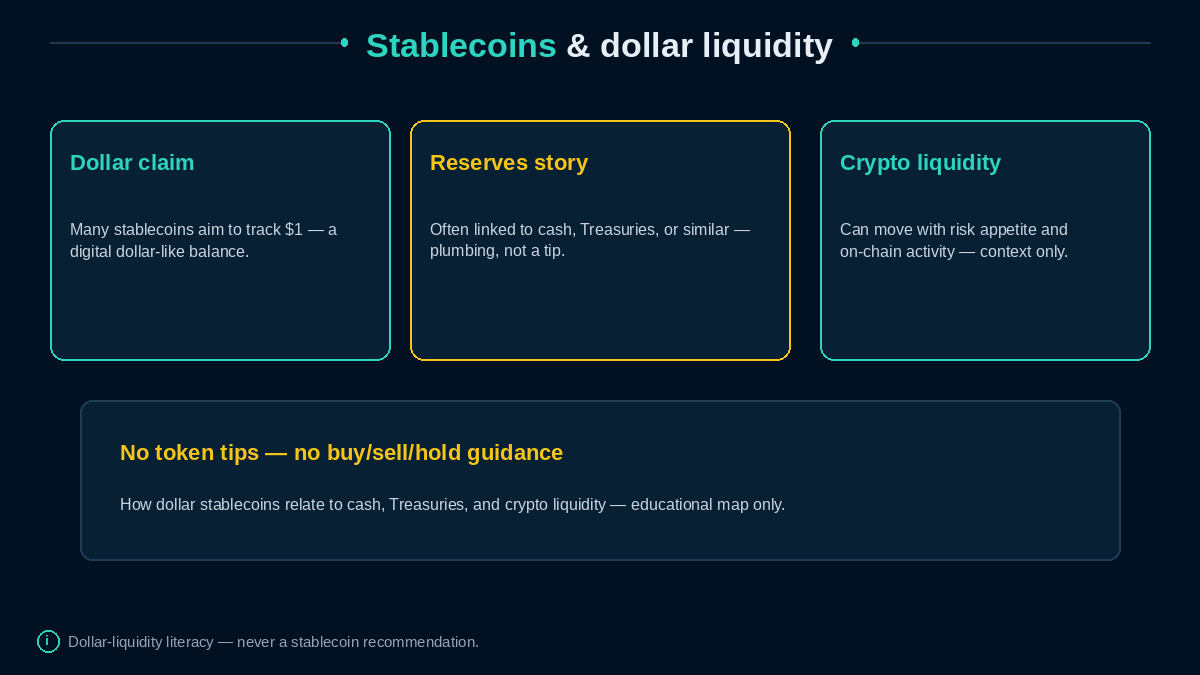
Diagram: Dollar claim ↔ reserves story ↔ crypto liquidity — map only, no token tips.
What a dollar stablecoin is trying to be
Many stablecoins aim to track one U.S. dollar per token—a digital balance people use inside crypto markets for trading, payments experiments, and liquidity parking. Design details differ by issuer; this page stays at the macro-liquidity idea, not a product review.
Neighboring primers: Crypto and macro liquidity, Money and banking, US dollar and FX.
The reserves / cash story (vocabulary)
Commentary often asks what backs a dollar stablecoin: cash, bank deposits, short-term Treasuries, or other assets. That question is a plumbing and credit-risk question—sibling to money-market literacy (Treasury issuance basics, SOFR vs federal funds)—not a coupon to chase on this site.
Large shifts between stablecoins and traditional money-market instruments can show up in discussions of short-term dollar funding—again as channels, not trade setups (Overnight RRP plumbing for traditional nonbank cash parking).
Crypto liquidity link
Stablecoin supply and on-exchange balances sometimes correlate with crypto risk appetite in research chatter—when people want dry powder inside crypto venues. Risk-on/off still dominates broader stories (Risk assets 101, Financial conditions). Treat correlations as fragile.
Hard “no tip” rules
- No named token recommendations
- No “this one is safe” rankings
- No leverage or farming tutorials
- No price targets
If you want macro literacy about crypto as a high-beta risk asset, use Crypto and macro liquidity. If you want dollar plumbing, stay with reserves and Treasuries language above.
Common confusions
- “Stablecoin equals Fed liability.” Usually private issuer claims—read the design; do not assume central-bank money.
- “Peg means zero risk.” Peg aims are not guarantees; operational and asset risks exist in teaching cases.
- “Learning this means buy the token.” Opposite of this page’s purpose.
- “Stablecoins replace M2 overnight.” Measurement and regulation debates continue; avoid slogans.
In practice — reading a stablecoin headline
Ask: Is the story about peg stress, reserve composition, regulatory news, or crypto volume? Translate to dollar-liquidity language—then refuse the buy/sell leap. Pair with Liquidity vs solvency if redemption-run language appears.
Regulation and disclosure debates—what must be published about reserves, where assets are held, how redemptions work—belong in the same literacy bucket as money-market fund rules: they shape run risk and confidence. This site still will not rank issuers. If a headline is mostly price speculation on a token, step back to Crypto and macro liquidity and the anti-signal rules there.
Bank deposits, money-fund shares, Treasury bills, and stablecoins can be competing parking spots for dollar liquidity in different ecosystems. Shifts among them are interesting plumbing—never a ranked product list on Macro Simplified.
How this connects
- Crypto and macro liquidity · Money and banking
- Treasury issuance basics · Fed balance sheet and reserves
- US dollar and FX · Risk assets 101
Related reads
Telegram
Crypto-liquidity and dollar-plumbing headlines: Join Macro Simplified.